
- 89% of IT leaders anticipate organizational restructuring due to AI integration.
- 76% of IT managers report moderate or increasing stress.
- 95% of IT professionals acknowledge major skill changes will be required by 2030.
Experts agree that soft skills like critical thinking and emotional intelligence are becoming indispensable in an AI-driven workforce, requiring organizations to prioritize continuous learning and adaptive cultures to remain competitive.
The Human Edge: Why Your Soft Skills Are Now Your Biggest Tech Asset
LAS VEGAS, NV – June 09, 2026
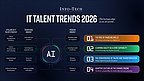
A new report from Info-Tech Research Group, launched amidst the glitz of Las Vegas, suggests the most significant bet in technology is no longer on faster chips or smarter algorithms, but on people. The firm's "IT Talent Trends 2026" report argues that in a world increasingly run by artificial intelligence, technical prowess alone is a depreciating asset. The new coin of the realm? "Uniquely human abilities" like critical thinking, business acumen, and emotional intelligence. This isn't just a recommendation; it's a strategic imperative for CIOs navigating a landscape of constant disruption.
The New Consensus: Human Insight as the Core Commodity
The central thesis of Info-Tech's report, subtitled "The Human Edge in an AI World," is that as AI automates routine execution, the value of IT talent shifts from technical delivery to strategic advisory. "These kinds of soft skills...enable IT experts to grasp business requirements, foster innovation, and manage complex transformations in ways that technical knowledge alone can't achieve," explains Heather Leier-Murray, a research director at the firm. This declaration, made at the Info-Tech LIVE 2026 conference, isn't a lone voice in the wilderness. It reflects a powerful, industry-wide consensus.
Research from major analyst firms like Gartner and IDC reinforces this view. Gartner predicts that by 2030, all IT work will involve AI, but it warns of "skills atrophy" if organizations fail to cultivate human judgment. They see critical thinking becoming an increasingly rare and valuable commodity. Similarly, IDC asserts that technical skills will be insufficient, highlighting the need for human abilities like "problem framing, assumption spotting, and hallucination detection" to effectively partner with AI systems. The message is clear: the future isn't human vs. machine, but human-plus-machine, and the human's role is to provide the irreplaceable context, judgment, and strategic oversight that AI lacks.
The CIO's Mandate: Architecting an Adaptive Organization
For C-suite executives, this shift is less a philosophical debate and more an urgent operational challenge. The Info-Tech report paints a picture of a workforce in flux, with a staggering 89% of IT leaders anticipating organizational restructuring. The era of predictable, episodic change is over. "The steady state is gone, and it's not coming back," states Leier-Murray. "CIOs can no longer treat talent strategy as a periodic adjustment."
This new reality demands a fundamental rewiring of corporate culture. The report emphasizes "Adaptive Culture as the Change Engine," urging leaders to invest in psychological safety and decentralized decision-making so teams can adapt without being overwhelmed. It's a move from rigid hierarchies to resilient networks. This aligns with findings from Deloitte, which notes that leading organizations are already designing "hybrid human-digital workforces," a process that requires massive investment in culture and learning. The challenge is immense, as 65% of organizations anticipate structural changes specifically due to generative AI, forcing CIOs to redesign teams around how work itself is changing, not just bolting new tools onto old models. It is a call to treat AI agents as part of the talent model, forcing a complete rethink of roles, responsibilities, and workflows.
A Workforce Under Pressure: The Human Cost of Transformation
Beneath the surface of this strategic realignment lies a more complex human story. The same report that champions human abilities also quantifies the strain on the current workforce. With 76% of IT managers reporting moderate or increasing stress and 42% of all IT professionals actively or passively job-seeking, the data suggests a workforce teetering on the edge of burnout. The relentless pace of change, coupled with the pressure to adapt, is taking a toll.
While executives are overwhelmingly optimistic about AI—with 94% of Info-Tech's respondents expecting a positive impact—the view from the trenches is more complicated. A recent Upwork study revealed a startling disconnect: while executives believe AI boosts productivity, a majority of workers reported feeling their workload had actually increased. Research from Harvard Business Review supports this, finding that AI can intensify work, leading to longer hours and cognitive strain as employees are pushed to take on more tasks. Add to this the pervasive fear of job displacement—a sentiment captured in Forrester research showing 43% of employees worry about job loss to automation—and the picture becomes one of a workforce caught between the promise of an AI-augmented future and the anxiety of the present transition.
Redefining Readiness: From Training Events to Continuous Learning
The only viable path through this disruption, according to Info-Tech and its peers, is a radical commitment to continuous learning. With 95% of IT professionals acknowledging that major skill changes will be required by 2030, the old model of ad hoc training is obsolete. The report champions "Learning Agility as a Core Capability," advocating for embedding learning directly into the flow of work. This means development is no longer a separate event but an ongoing process of acquiring and applying new skills in real-time.
This requires a dual commitment. For individuals, it means embracing a mindset of perpetual evolution, focusing on building those "enabling skills"—adaptability, communication, business acumen—that provide a durable advantage. For organizations, it demands a significant investment in creating a learning ecosystem. Forrester data indicates a troubling gap, with only half of organizations currently offering AI training to non-technical staff. Closing this gap is critical. CIOs must not only provide the tools but also foster a culture where curiosity is rewarded and experimentation is safe. By redefining entry-level roles away from tasks easily automated by AI and toward those that cultivate strategic thinking and problem-solving, leaders can begin to build a talent pipeline that is resilient, adaptive, and ready for a future where the most powerful processor is still the one between our ears.