
- 75% of C-Suite executives and 78% of HR professionals prioritize candidates with life skills over AI expertise.
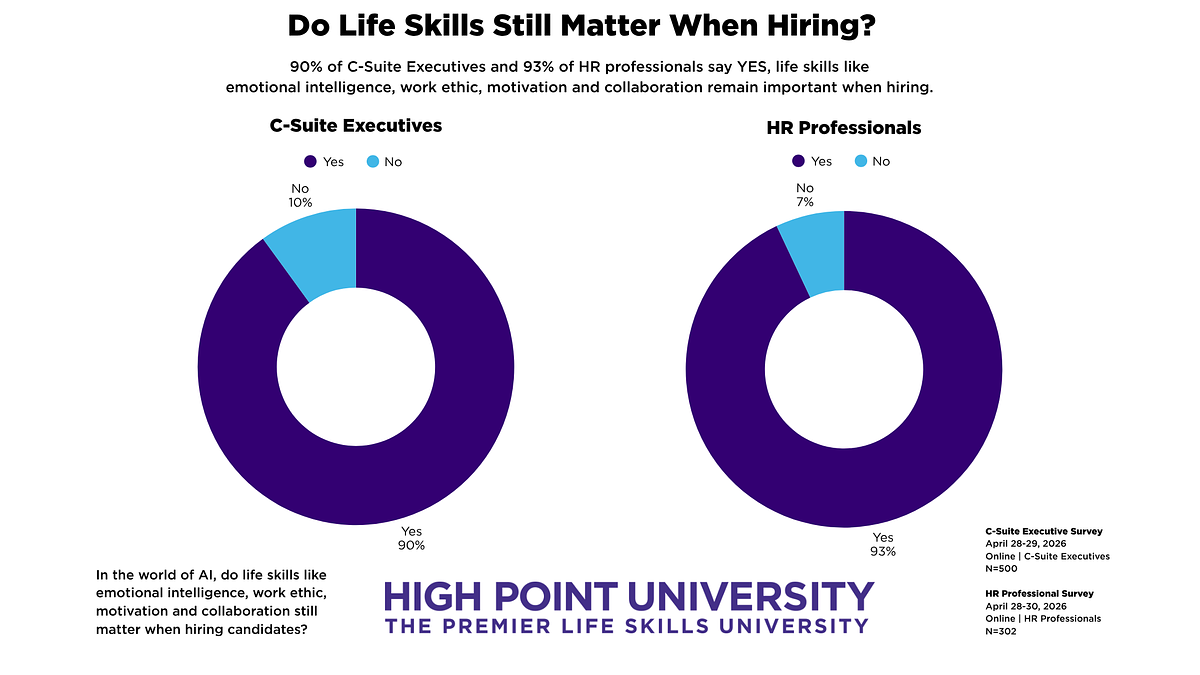
- 90% of executives and 93% of HR professionals agree life skills still matter in hiring.
- 81% of executives say leadership is harder to train than AI skills.
Experts conclude that while AI skills are valuable, human-centric life skills like emotional intelligence, motivation, and adaptability are the decisive factors in hiring and career advancement in the 2026 workforce.
The Human Premium: Why Life Skills Outvalue AI in the 2026 Workforce
HIGH POINT, N.C. – June 17, 2026 – In a landscape increasingly defined by algorithms and automation, a landmark new study reveals a powerful counter-narrative shaping the future of work: human-centric life skills are not just relevant, they are the decisive factor in hiring and career advancement. A national study from High Point University (HPU) shows a striking consensus between C-Suite executives and HR professionals who, despite their deep immersion in AI, overwhelmingly prioritize candidates with emotional intelligence, motivation, and coachability over those with purely technical AI expertise.
The findings challenge the prevailing notion that technical proficiency is the singular key to the kingdom in the AI era. While both groups of leaders acknowledge the value of AI skills—with a majority using the technology daily—they are making a clear distinction between a tool and the person who wields it. When forced to choose between a candidate with only AI capabilities and one with only life skills, the preference was unambiguous: 75% of C-Suite executives and 78% of HR professionals chose the life skills candidate.
The Enduring Value of the Human Element
The data, gathered in late April 2026 from two separate surveys, paints a detailed picture of what leaders truly value. An overwhelming 90% of executives and 93% of HR professionals agree that life skills still matter when hiring. This preference holds firm even in direct comparisons. For instance, 70% of executives and 72% of HR pros would hire a candidate with emotional intelligence over one with just AI skills. Similarly, motivation was preferred by 75% of executives and 79% of HR pros.
This sentiment is not an anomaly but reflects a broader trend recognized across industries. The World Economic Forum has noted that seven of the top eight most desired skills for workers are human-centric, including resilience, agility, leadership, and empathy. A recent LinkedIn Learning report echoed this, finding that 91% of learning and development professionals believe soft skills are gaining importance precisely because AI is automating routine tasks, freeing up humans to focus on what they do best: building relationships, strategic thinking, and complex collaboration. As one Harvard Business School researcher recently put it, mastering skills like communication and critical thinking may be even more crucial than technical know-how as AI reshapes the workforce.
“Employers want graduates who can use AI, but they hire for life skills,” said Johnny Taylor, President and CEO of SHRM and HPU’s Human Capital Expert in Residence, commenting on the findings. “The employee who possesses life skills holds a currency that grows in value.” This combination of technical awareness and human capability is what 87% of executives and 92% of HR leaders describe as the ideal balance for a leader in their organization.
A Strategic Imperative: The Trainability Deficit
Perhaps the most strategically significant finding from the HPU study is the consensus on which skills are hardest to develop. Both C-suite and HR leaders overwhelmingly agree that life skills are substantially more difficult to train than AI skills. A staggering 81% of executives said leadership is harder to train than AI, followed closely by emotional intelligence (80%) and problem-solving (79%). From the other side of the hiring desk, HR professionals concurred, with 77% stating that AI skills are easier to train than motivation.
This "trainability deficit" creates a clear strategic imperative for businesses. If foundational human attributes are difficult and costly to instill, but technical skills are relatively easy to teach, the logical conclusion is to hire for character and train for competence. This shifts the focus of talent acquisition from screening for specific software knowledge to identifying candidates with innate adaptability, a strong work ethic, and the capacity for critical thought. As one president and CEO of a workforce development non-profit noted, "the skills that are most resistant to displacement by AI are the ones that are the most distinctly human," such as relationship building, conflict resolution, and ethical judgment.
This reality is forcing organizations to rethink their entire talent pipeline, from recruitment to internal development. The study found that only 17% of executives and 14% of HR professionals have ever hired someone based solely on their AI experience. Instead, they are looking for resilient, adaptable teams that can leverage AI effectively precisely because they possess strong foundational human capabilities.
Mind the Gap: Education's New Mandate
While business leaders are clear on their preferences, the study uncovers a concerning disconnect with the talent pipeline. Nearly half of all executives (44%) and HR leaders (46%) believe recent college graduates are more prepared with AI and technical skills than with life skills. By contrast, only about 17% of leaders feel graduates are well-prepared with the life skills and professionalism they so clearly desire. This skills gap highlights a potential crisis in higher education, where a focus on technical proficiency may be coming at the expense of holistic human development.
In response, some institutions are pioneering a new model. High Point University, which commissioned the study, brands itself as "The Premier Life Skills University," integrating these competencies directly into its curriculum. All first-year students are required to take a seminar taught by HPU President Nido Qubein on topics like relational capital, communication, and resilience. "These results reaffirm our mission," Qubein stated. "Even in the midst of artificial intelligence changing the workplace, employers continue to tell us they need graduates equipped with life skills that outlast inevitable technological disruption."
The challenge for the broader educational system is to move beyond a curriculum that, as one study found, often fails to teach students how to frame their own questions—a critical skill for lifelong learning. With employers looking for "uniquely human" skills, the mandate for universities is to produce graduates who are not just technically competent but also adaptable, collaborative, and ethically grounded.
Ultimately, the conversation is not about AI versus humans, but about how humans can best leverage AI. The C-Suite executives in the HPU study confirmed this by identifying the very life skills they prioritize as the essential foundation for implementing AI successfully. The top skills cited as crucial for learning and deploying AI were not technical, but human: problem-solving (68%) and adaptability (63%). These ranked higher than "high-level math, analytical or computer skills" (41%), proving that in the world of 2026, our most advanced technology still relies on our most fundamental human strengths.