
- 34TB capacity: Toshiba's new M12 Series HDDs offer a massive 34 terabytes of storage, a significant leap in density.
- 18% power efficiency improvement: The drives provide an 18% boost in power efficiency per terabyte compared to previous generations.
- 282 MiB/s transfer rate: The data transfer rate is 282 megabytes per second, an 8% increase over prior models.
Experts agree that Toshiba's 34TB HDDs are a critical advancement for hyperscale data centers, addressing the urgent need for cost-effective, high-density storage solutions in an AI-driven digital economy.
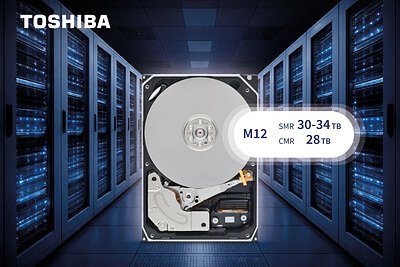
Toshiba Unveils 34TB HDDs to Feed a Data-Hungry AI World
TAIPEI, Taiwan – March 31, 2026 – In a move to address the voracious data storage needs of the modern internet, Toshiba has begun sampling its next generation of nearline hard disk drives (HDDs), pushing capacities to a colossal 34 terabytes. The announcement of the M12 Series, made fittingly on World Backup Day, underscores the immense pressure on data centers to keep pace with a digital world increasingly dominated by AI, streaming video, and massive cloud services.
The new 3.5-inch drives are aimed squarely at the heart of the digital economy: hyperscale and cloud service providers. These are the companies that operate the vast, server-filled warehouses that power our online lives. With the M12 Series, Toshiba is providing a critical tool to manage the unprecedented scale of data generation, offering a significant leap in storage density and efficiency.
Taming the Data Deluge
The demand for such high-capacity storage is no longer a distant forecast; it is a present-day reality. Industry analysts project that the global datasphere—the total sum of all data created, captured, and replicated—is on track to exceed 290 zettabytes by 2027. This explosion is fueled by the rapid adoption of data-hungry AI and machine learning models, the constant stream of high-definition video content, and the fundamental shift of enterprise and consumer life onto the cloud.
For the hyperscale data centers that serve as the world's digital repositories, managing this growth is a battle fought on two fronts: space and power. While Solid State Drives (SSDs) offer superior speed for active workloads, nearline HDDs remain the undisputed champion of cost-effective mass storage. The primary metric for these environments is cost-per-terabyte, and every increase in a single drive's capacity represents a significant reduction in physical footprint, power consumption, and overall operational expense for the data center.
Toshiba's M12 Series is engineered to meet this challenge head-on. By packing up to 34 TB into a single drive, data center operators can increase their total system storage capacity without adding more server racks, helping them scale more efficiently and sustainably.
The Technology Behind the Terabytes
Achieving this new capacity milestone required a multi-faceted engineering approach. The M12 Series drives are a showcase of Toshiba's latest innovations, surpassing previous generations by stacking an unprecedented 11 magnetic disks inside a standard helium-filled enclosure. This was made possible by replacing the traditional aluminum platters with a thinner, more durable glass substrate, a technology cultivated through the company's long history in compact product design.
The core of the capacity gain comes from combining two advanced recording technologies: Flux Control Microwave-Assisted Magnetic Recording (FC-MAMR™) and Shingled Magnetic Recording (SMR). FC-MAMR is Toshiba's proprietary technology that uses a microwave field to enable more precise and dense data writing. This is then layered with SMR, which increases density by overlapping data tracks like shingles on a roof.
While SMR has historically faced performance concerns in enterprise environments due to slower random write speeds, Toshiba is targeting the M12 Series at sophisticated hyperscale clients by using a host-managed SMR architecture. This approach gives the data center's own software control over data placement, allowing them to optimize write operations for their specific workloads, such as archival and sequential data streaming. This effectively mitigates the performance drawbacks for a user base that has the engineering capability to leverage the technology's full potential. The result is a drive that offers a roughly 18% improvement in power efficiency per terabyte and a data transfer rate of 282 MiB/s, an 8% boost over the prior generation.
The High-Stakes Battle for the Cloud
Toshiba's announcement does not happen in a vacuum. The high-capacity nearline HDD market is a fiercely competitive battleground dominated by three major players, all racing to provide the foundational storage for the cloud. The M12 Series positions Toshiba directly against its rivals, Seagate and Western Digital, each pursuing its own path to higher densities.
Seagate has been aggressively pushing its Heat-Assisted Magnetic Recording (HAMR) technology, already shipping drives in the 30TB+ range to select customers. Meanwhile, Western Digital has been leveraging its own energy-assisted recording (ePMR) and advanced SMR technologies to offer drives up to 28TB. Toshiba's strategy with the FC-MAMR and SMR combination allows it to compete at the 30-34TB capacity point, demonstrating a viable, alternative pathway to higher areal density.
Recognizing that not all customers are ready or willing to adopt SMR, Toshiba also announced plans to ship a 28TB version of the M12 Series using Conventional Magnetic Recording (CMR) in the third quarter of 2026. This dual-pronged strategy allows the company to serve both the hyperscale market hungry for maximum capacity and the broader enterprise market that prioritizes the drop-in compatibility of CMR drives.
Looking ahead, the entire industry is focused on the next set of technological leaps. Toshiba has indicated that its future roadmap includes adopting next-generation technologies like HAMR and developing drives with even more platters, having already verified a 12-disk configuration. This continuous cycle of innovation is essential, as the race to increase HDD capacity is a direct reflection of the relentless growth of the digital universe.