
- Launch Date: Late 2026
- Payloads: 4 distinct NASA instruments
- Rover Capacity: FLEX rover can transport over 1,500 kg of cargo
Experts view this mission as a critical step in advancing lunar exploration through public-private partnerships, demonstrating both scientific and technological progress essential for sustainable Moon missions.
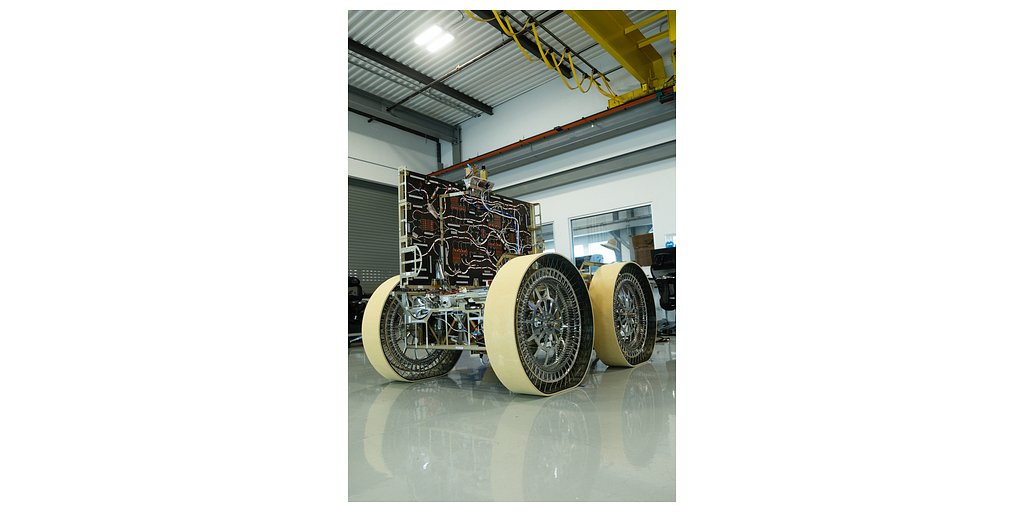
Astrolab Rover to Deploy NASA Science at the Moon's South Pole
HAWTHORNE, CA – May 18, 2026 – Aerospace firm Astrolab has announced that its first lunar rover will carry a suite of critical NASA science instruments to the Moon’s south pole in late 2026. The mission marks a significant step in the partnership between private industry and the U.S. space agency to accelerate the scientific and exploratory goals of the Artemis program.
The company’s FLIP (FLEX Lunar Innovation Platform) rover is slated to launch aboard Astrobotic’s Griffin-1 lander, a mission procured under NASA's Commercial Lunar Payload Services (CLPS) initiative. This flight will deliver the compact, nimble rover to one of the most strategic and challenging locations on the lunar surface, a region believed to hold vast resources critical for a sustained human presence on the Moon.
The Commercial Vanguard for Artemis
This mission is a prime example of NASA’s evolving strategy for lunar exploration. The CLPS program offloads the cost and complexity of building and flying landers to commercial partners, allowing the agency to act as a customer, purchasing rides for its scientific payloads. This model aims to foster a competitive commercial marketplace for lunar services, reduce costs, and increase the frequency of missions to the Moon.
The approach is not without its risks, as the harsh realities of spaceflight have shown. Astrobotic, whose Griffin lander will carry FLIP, saw its earlier Peregrine mission fail to reach the lunar surface in January 2024 due to a propulsion anomaly. However, the CLPS program is designed to embrace this higher-risk, higher-reward environment, with successes like Intuitive Machines' Odysseus landing in February 2024 demonstrating the viability of the commercial model. For NASA, the data gathered even from failed missions is valuable, and the overall strategy allows for more frequent, targeted scientific endeavors than would be possible with traditional, large-scale government programs.
“We’re honored to deliver NASA’s instruments to the lunar surface,” said Jaret Matthews, founder and CEO of Astrolab, in the company's announcement. “With FLIP, we can provide a nimble, mobile platform that enables multiple NASA investigations in one mission. Together, these efforts will help pave the way for Artemis astronauts to explore more of the Moon.”
A Rover's Toolkit for a New World
The FLIP rover will not be traveling light. It serves as a mobile laboratory, carrying four distinct payloads from different NASA centers, each designed to answer key questions and test technologies essential for future long-duration stays on the Moon.
Searching for Future Fuel: The Moon Exploration for Titanium with Active Lighting (METAL) instrument from NASA’s Ames Research Center will seek to estimate the concentration of helium-3 in the lunar soil, or regolith. This rare isotope, abundant on the Moon due to solar wind, is a potential fuel for future clean fusion reactors on Earth. Understanding its distribution is a first step toward assessing the feasibility of lunar resource mining.
Tackling the Dust Problem: Lunar dust, a fine, abrasive, and electrostatically charged powder, poses a significant threat to equipment and human health. The Lunar Dust level sensor and Effects on Surfaces (LDES) payload from NASA’s Johnson Space Center will directly measure how this dust accumulates on critical surfaces like radiators and solar panels, quantifying its degrading effects. This data is vital for designing durable habitats, rovers, and spacesuits for the Artemis generation.
Mapping the Way Forward: From NASA’s Marshall Space Flight Center, the Lunar LiDAR Demonstration will use a hardened laser-based system to create high-resolution 3D maps of the surrounding terrain. This technology is crucial for enabling rovers to navigate autonomously, identify hazards like rocks and small craters, and chart safe and efficient paths for exploration.
A Permanent Lunar Landmark: The Goddard Space Flight Center’s Laser Retroreflector Array (LRA) is a simple but powerful passive device. This dome of precision mirrors will be the first of its kind mounted on a rover. It will reflect laser beams from orbiting spacecraft, allowing for incredibly precise tracking of the rover's position. Long after FLIP’s mission ends, the LRA will remain as a permanent geodetic marker, contributing to a lunar positioning system that will guide future missions with pinpoint accuracy.
Innovative Engineering for Lunar Mobility
Beyond the science it carries, the FLIP rover is itself a technology demonstration. Astrolab, founded by a team of NASA, SpaceX, and JPL veterans, has focused on creating adaptive and robust mobility solutions. A key innovation in the FLIP design is its ability to perform a “ramp-less egress.” Unlike traditional rovers that require a heavy and complex ramp to descend from a lander, FLIP is designed to drive directly off the lander’s deck onto the lunar surface. This seemingly simple change reduces mission mass, complexity, and a potential point of failure.
This mission is also a crucial stepping stone for Astrolab’s larger ambitions. The operational data and experience gained from FLIP will directly inform the development of the company’s full-scale Flexible Logistics and Exploration (FLEX) rover. The FLEX is a much larger, modular vehicle designed to be a true lunar workhorse, capable of transporting over 1,500 kg of cargo, deploying infrastructure, and even carrying two suited astronauts on exploratory traverses. The 2026 mission will prove out the core mobility and operational concepts on the real lunar surface, de-risking the technology for these future, more demanding applications.
By combining scientific investigation with engineering validation, the FLIP mission embodies the multifaceted nature of this new lunar era. Each kilometer it drives and every data point it collects will not only expand our understanding of the Moon but also build the foundation of technologies and operational knowledge needed to establish a permanent human foothold beyond Earth.