
- 42% of organizations are actively adopting or implementing AI within their contracting processes, yet 71% still use shared drives as primary storage outside a central repository.
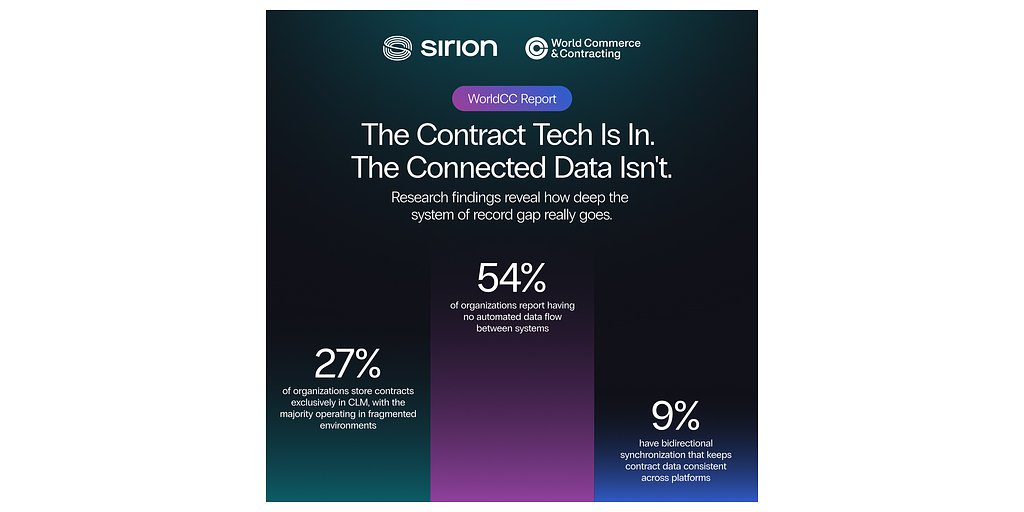
- Only 27% of organizations store all contracts in a dedicated CLM platform, with just 9% achieving bidirectional synchronization.
- Poor contract management can erode profitability by nearly 9% annually through value leakage.
Experts agree that the success of enterprise AI hinges on having a trusted, structured data foundation, particularly for contract management, and warn that fragmented data systems undermine AI reliability and business efficiency.
The AI Illusion: Why Enterprise AI Stalls at the Contract Stage
LEHI, Utah – May 18, 2026 – As enterprises across the globe race to embed artificial intelligence into their operations, a critical and costly bottleneck is emerging from an unlikely source: the humble contract. A new report from AI-native contract lifecycle management (CLM) leader Sirion and the global association World Commerce & Contracting (WorldCC) reveals that most organizations lack the foundational data infrastructure needed to make their AI ambitions a reality.
The report, titled “Trusted Contract Data: From Repository to System of Record,” suggests a growing chasm between companies that simply store contracts and those that can harness them as a source of structured, actionable intelligence. For many, the dream of AI-driven efficiency is crashing against the hard reality of fragmented, untrusted, and inaccessible contract data.
The AI Paradox: Ambition Outpaces Reality
The study, which surveyed over 170 global enterprise leaders, found that while ambition is high, data readiness is alarmingly low. A significant 42% of organizations are actively adopting or implementing AI within their contracting processes. Yet, the very data meant to fuel these advanced systems is often locked away in disconnected documents, spread across shared drives, and siloed in disparate repositories.
“GenAI is exposing a hard truth across enterprises: AI is only as reliable as the underlying data foundation,” said Ajay Agrawal, Co-Founder and CEO of Sirion, in the report. “Most organizations still manage contracts as disconnected documents spread across repositories, shared drives, and siloed systems. That model breaks down in an AI-driven enterprise.”
This isn't merely an IT issue; it's a fundamental business problem. When AI models are fed a diet of inconsistent and unstructured legal language, the outputs are unreliable at best and dangerously misleading at worst. The barrier to successful AI adoption is no longer the capability of the algorithms but the quality of the data they consume. Without a trusted foundation, Agrawal noted, “AI cannot reliably drive decisions, automation, or enterprise-scale execution.”
Beyond the Digital Filing Cabinet
The core of the problem, according to the report, is a widespread misunderstanding of what it means to manage contracts in the digital age. While most companies have moved away from physical filing cabinets, many have simply replaced them with digital ones—shared drives and basic repositories that do little to unlock the value within the documents.
The survey data paints a vivid picture of this fragmentation. In North America, 71% of respondents still use shared drives as a primary storage location outside of a central repository. Globally, only 27% of organizations store all their executed contracts exclusively within a dedicated CLM platform. This digital disarray is compounded by a severe lack of integration, with 54% of organizations reporting no automated data flow between their systems. A mere 9% have achieved bidirectional synchronization, the gold standard for keeping contract data consistent across the enterprise.
“This report is a warning against mistaking storage for control,” stated Sally Guyer, CEO of WorldCC. “Organizations may have digitized their contract archives, but that does not mean they have trusted contract data.”
The operational consequences are severe. Industry analysis suggests that poor contract management can erode a company's profitability by nearly 9% annually through value leakage—missed deadlines, unclaimed entitlements, and unwanted auto-renewals. The lack of a central, trusted “System of Record” (SOR) for contracts forces employees to rely on manual interpretation and institutional knowledge, leading to slower decision-making, weaker compliance, and increased risk.
An Industrial Divide in Data Mastery
The report also highlights a significant disparity in contract management maturity across industries. The Banking and Financial Services sector leads the pack, with 50% of organizations centralizing contracts in a CLM system. This is largely driven by intense regulatory pressure and the critical need for airtight risk management. The IT/Technology Services (33%) and Energy/Oil & Gas (25%) sectors also show higher-than-average maturity, reflecting the complexity and high stakes of their contractual agreements.
These leading industries provide a blueprint for others. Their progress is not just about technology adoption but about a strategic shift in viewing contracts as active, data-rich assets rather than static legal documents. They recognize that a trusted SOR is essential for navigating complex regulations, managing third-party risk, and maintaining a competitive edge.
For industries lagging, the report serves as a crucial wake-up call. Continuing to operate with a fragmented data landscape not only creates operational drag but also closes the door on the transformative potential of AI and advanced analytics.
Charting a Course from Repository to Record
Transitioning from a fragmented repository to a trusted System of Record is a significant undertaking that extends beyond the legal or procurement departments. It requires a concerted, enterprise-wide effort focused on technology, process, and people.
Experts emphasize the need for robust data governance to standardize how contract information is captured and maintained. This must be paired with the implementation of integrated CLM platforms that can connect with other core business systems like CRM and ERP, creating a seamless flow of information. The goal is to create a single source of truth that the entire organization can rely on for confident, data-driven decision-making.
However, technology alone is not a panacea. “Change management remains the most under-considered element in contracting transformation, yet it is often the determining factor between success and failure,” noted Leandro Doca, VP at Capgemini, in the survey.
The organizations that succeed will be those that clean up their data, connect their systems, and define clear ownership. As Guyer of WorldCC concluded, “They will not rely on AI to fix weak foundations. They will use AI to amplify strong ones.” The potential return on this investment is substantial, with some companies reporting ROI in the thousands of percent from CLM implementations, driven by massive efficiency gains and recovered value. For the modern enterprise, building this strong data foundation is no longer optional; it is the essential first step to truly competing in an AI-driven world.