
- Profit Margins on New Car Sales: As low as 0.4% - F&I Department Profit Retention: 70-80 cents of every dollar generated - E-Contracting Adoption Increase: Over 70% since late 2021
Experts agree that transforming the F&I department from a transactional endpoint to a hub for long-term customer relationships is critical for dealership survival in the current market.
F&I as a Lifeline: Driving Dealership Survival in a Shifting Market
NAPLES, FL – May 18, 2026 – As the automotive industry grapples with tightening profit margins, evolving customer expectations, and a volatile sales landscape, dealership leaders are looking beyond the sales floor for stability. The once-ancillary Finance and Insurance (F&I) department is now being thrust into the spotlight as a critical engine for profitability and, more importantly, long-term customer loyalty.
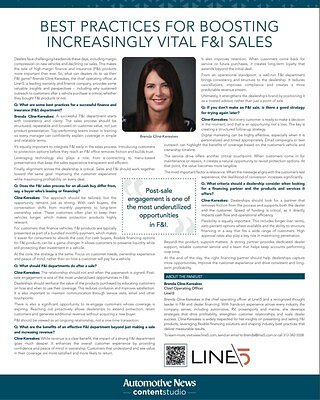
This strategic shift was recently highlighted by Line\5 Chief Operating Officer Brenda Cline-Kereakes in an executive Q&A with Automotive News. She argued that for dealerships to navigate current headwinds like margin compression and changing buyer behavior, they must fundamentally rethink the role of F&I. The key, she suggests, is transforming it from a transactional endpoint into the beginning of a lasting customer relationship.
The New Reality of Dealership Profitability
The challenges facing dealerships are not theoretical. Industry data reveals a stark reality: profit margins on new car sales have dwindled to as low as 0.4%, leaving little room for error. In contrast, a well-run F&I department can retain 70 to 80 cents of every dollar generated, making it the undeniable profit anchor for modern dealerships. However, capitalizing on this opportunity is more complex than ever.
Today's consumers, armed with information and facing an affordability crunch from high vehicle prices and rising interest rates, are more discerning. They demand transparency, efficiency, and value. According to market studies, two-thirds of car shoppers are more likely to buy from a dealership that offers their preferred, streamlined experience. This puts traditional, high-pressure F&I tactics on a path to extinction.
Cline-Kereakes' insights address this new paradigm directly, emphasizing that success lies in aligning F&I practices with customer needs. This includes introducing protection products earlier in the sales journey not as upsells, but as solutions to legitimate concerns about future repair costs and vehicle ownership expenses. A transparent, consistent process builds trust and confidence, leading to higher attachment rates for products that genuinely benefit the customer.
From Transaction to Enduring Relationship
The most profound shift advocated by industry leaders is the move away from a transactional mindset. "F&I should be viewed as an ongoing relationship, not a one-time transaction," Cline-Kereakes stated in her feature. This philosophy recasts the F&I office as a hub for building long-term value for both the customer and the dealership.
Implementing this vision involves a multi-pronged strategy focused on post-sale engagement. Dealerships that succeed in this area are the ones that continue the conversation long after the customer drives off the lot. This includes leveraging service visits as opportunities to re-engage, offering targeted follow-ups, and using F&I products like vehicle service contracts (VSCs) as a tool to ensure customers return to the dealership for maintenance and repairs. This strategy is vital, as industry analysis confirms retaining an existing customer is significantly more cost-effective than acquiring a new one.
Experts note that when the F&I office is positioned as a source of protection and peace of mind, it fundamentally changes the customer's perception. This builds the kind of brand loyalty that drives repeat business and positive word-of-mouth, creating a sustainable model for growth that isn't solely dependent on the next new-car sale.
The Tech-Powered F&I Transformation
Underpinning this strategic evolution is a wave of technological innovation designed to eliminate friction and enhance the customer journey. The days of endless paperwork and hours spent in the F&I office are numbered. Forward-thinking dealerships are aggressively adopting digital tools to meet consumer demands for a faster, more convenient process.
E-contracting has emerged as a cornerstone of this transformation. Adoption has surged by over 70% since late 2021, and the benefits are clear: funding from lenders is up to 83% faster than with paper contracts, and built-in validation rules drastically reduce costly errors. This speed and accuracy translate directly to a better experience for the customer.
Similarly, digital menu presentations on tablets and screens are replacing paper brochures, allowing for a more interactive and less intimidating F&I process. Dealerships using these tools have reported significant gains, including an average profit lift of $150 per vehicle and VSC penetration rates climbing as high as 75-80%. Technology empowers F&I managers to become consultants, guiding customers to the right products rather than simply selling to them.
The Crucial Role of Strategic Partnerships
As dealerships navigate this complex environment, they are not expected to go it alone. The final piece of the puzzle, as outlined by Cline-Kereakes, is the selection of strategic partners who can facilitate this new F&I model. This is especially true when it comes to financing for F&I products.
Offering flexible payment options for service contracts and other protection products makes them accessible to a wider range of customers, directly addressing the affordability concerns that can be a major barrier to purchase. The right financing partner can make this process seamless.
"Today's dealerships need partners that remove friction from the process and support both the dealer and the customer," Cline-Kereakes added. She stressed that dealers should evaluate potential partners based on their speed, flexibility, quality of dealer support, and commitment to customer service. A strong partner doesn't just provide capital; they provide a solution that helps the dealership capture more opportunities, improve efficiency, and strengthen the very customer relationships they are working so hard to build. By integrating the right technology and partners, the F&I department is being successfully reimagined as a dealership's most resilient and strategic asset for long-term success.