
- 5-minute average order fulfillment time, keeping it competitive with fast-food chains.
- Up to 50 orders per hour in storefronts, with Blendmobiles serving 100 orders per hour.
- Prices starting under $10, designed for high-volume, efficient service.
Experts would likely conclude that Better Blend’s success hinges on its ability to deliver highly customized, nutrition-focused meals at fast-food speeds, creating a defensible advantage in the competitive wellness market.
The Smoothie as Strategy: How Better Blend Deploys Speed and Data
TAMPA, FL – June 04, 2026 – This Saturday, a new storefront will open in a Brandon shopping plaza, serving smoothies and açaí bowls. On the surface, the arrival of Better Blend Nutrition is another addition to Tampa Bay's growing wellness scene. But to view it as merely another health food option is to miss the larger strategic play. The company’s expansion into Florida is a meticulously engineered case study in the new mechanics of fast-casual dining, where the product isn't just the food, but the seamless integration of speed, customization, and community access.
Better Blend’s model is a direct response to a fundamental shift in the market, one identified in recent National Restaurant Association reports: the consumer demand for meals that are not only convenient but also actively contribute to health and wellness goals. The friction between a busy schedule and a healthy lifestyle is the gap where profit and market share are now being won. The company's strategy is built on the premise that it can close that gap more efficiently than its competitors, turning a simple smoothie into a high-throughput, data-driven nutritional tool.
Deconstructing the 'Health & Speed' Value Proposition
The fast-casual sector was built on the promise of higher quality than fast food, served with comparable speed. For years, the focus was on fresh ingredients and elevated recipes. Today, the definition of “quality” has evolved to include functional and nutritional value. Better Blend’s approach treats this not as a menu feature, but as the central pillar of its operational design.
Its core value proposition rests on two metrics: time and macros. Most orders are fulfilled in about five minutes, a critical benchmark that keeps it competitive with legacy fast-food chains. With storefronts capable of producing up to 50 orders per hour and prices starting under $10, the model is engineered for volume. This operational tempo is crucial, particularly during the lunch rush, which the company has identified as its busiest period. It demonstrates a clear understanding that for the modern consumer—from office workers to busy parents—time is a non-negotiable currency.
Parallel to this efficiency is a sophisticated menu strategy. The offerings are explicitly “macro-balanced,” focusing on high-protein, low-sugar formulas designed to taste indulgent while delivering specific nutritional outcomes. This isn't just about offering a “healthy option”; it's about providing a tool for managing personal wellness. The ability for customers to add functional ingredients like creatine for muscle recovery, collagen for joint health, or probiotics for gut function transforms a standardized product into a personalized prescription. This layer of customization is a powerful driver of customer loyalty and higher margins, moving the transaction beyond a simple food purchase into a collaborative wellness partnership.
The 'Blendmobile' as a Market Entry Beachhead
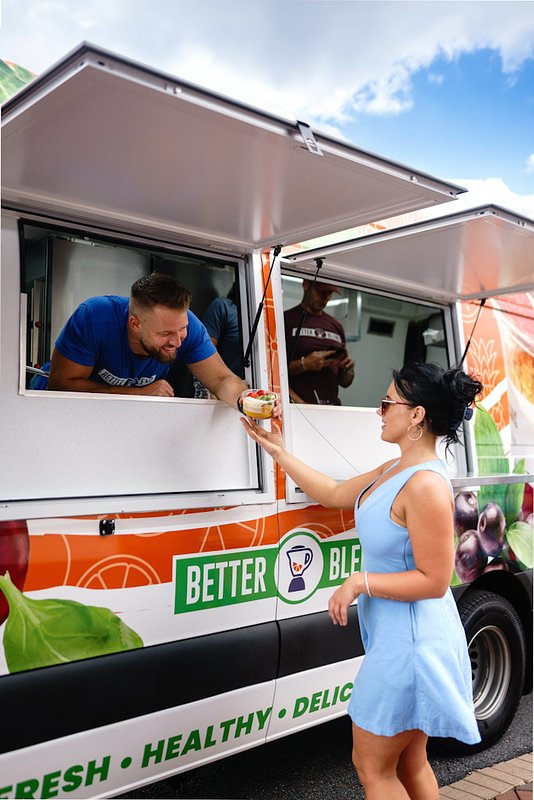
Perhaps the most telling component of Better Blend’s strategy is its dual-channel distribution model. Before committing the capital for its first brick-and-mortar location in Brandon, the company deployed two “Blendmobile” food trucks across the Tampa Bay area. This is far more than a marketing gimmick; it is a textbook execution of agile market entry.
These mobile units are strategic assets that serve multiple functions. First, they are high-efficiency production hubs, capable of serving up to 100 orders per hour—double the rate of a physical store. This allows the company to service high-density locations like corporate campuses, gyms, and community festivals with remarkable efficiency. Second, they act as mobile market research labs. By operating in various neighborhoods and contexts, the Blendmobiles gather real-world data on customer preferences, peak demand times, and pricing sensitivity, effectively de-risking the subsequent investment in a permanent location. The “positive feedback” gathered by franchisee Mike Faustini was not just encouraging; it was actionable intelligence.
This approach allows the brand to meet customers where they are, embedding itself in their routines before a storefront even opens. As CEO Isaac Hamlin stated, “People want food that keeps up with both their lifestyle and their goals.” The Blendmobile is the literal vehicle for that mission, delivering on the promise of accessibility and convenience in a way a fixed location cannot. It builds brand awareness and a loyal customer base, ensuring that when the doors to the physical store finally open, it is launching into a warm, pre-validated market.
The Tampa Test: Navigating a Competitive Wellness Market
Better Blend is not entering a vacuum. The Tampa Bay region has witnessed a “steady influx of bowl and açaí concepts,” creating a competitive and crowded landscape. The company’s decision to enter this market is a calculated test of its model’s superiority. Its success will hinge on whether its operational efficiency and deep customization can create a defensible moat against incumbent players.
The choice of Brandon for the first location, coupled with the franchisee's local roots in nearby Riverview, points to a strategy of community integration rather than corporate conquest. The plan to open three locations in the coming years signals a long-term commitment, suggesting the company views Tampa as a key regional hub, not a speculative venture. By leading with the Blendmobiles, the company has already begun weaving itself into the local fabric, making appearances at events and building a groundswell of support.
This methodical, multi-stage entry mitigates the risks associated with new market expansion. While competitors may have established brand recognition, Better Blend is betting that its hyper-efficient, highly personalized model offers a distinct and more compelling value proposition. It is a direct challenge to the existing market, predicated on the idea that convenience and deep customization, delivered simultaneously, will win.
The Economics of Customization at Scale
The ultimate sophistication of the Better Blend model lies in its ability to deliver mass customization at fast-food speeds. In a traditional high-volume environment, customization is the enemy of efficiency. It introduces complexity, slows down the production line, and increases the margin of error. Better Blend appears to have engineered its workflow and supply chain to accommodate this complexity without sacrificing its five-minute order promise.
This capability is a significant competitive advantage. It allows the company to cater to the increasingly fragmented and specific demands of the health-conscious consumer. One customer may want a post-workout recovery shake with creatine, while another seeks a low-sugar vegan meal replacement. By serving both from the same line with equal speed, the company captures a wider swath of the market than a one-size-fits-all competitor. This is the new frontier of consumer service: delivering a personalized experience at scale.
“Our mission is to make healthy eating easy, accessible, and something customers can actually look forward to,” Hamlin remarked. The key to that mission is not just the quality of the ingredients, but the power of a system that puts complex nutritional choices into the hands of the consumer without adding friction to their day. As Better Blend marks its Florida debut, it offers a clear glimpse into the future of an industry where the most successful players will be those who master the logistics of personalization.