
- 28% of CMOs report 'very high' influence within their organizations.
- 84% of CMOs struggle to align leadership around a unified marketing vision.
- Only 12% of marketing leaders rate their organization's AI technology enablement as 'excellent'.
Experts would likely conclude that CMOs are caught in a paradox where short-term performance demands undermine long-term brand health, requiring a strategic shift to balance immediate results with sustainable growth.
The CMO's Paradox: Trading Brand Futures for C-Suite Credibility
NEW YORK, NY – June 17, 2026 – The modern Chief Marketing Officer stands at a precarious crossroads. Tasked with navigating the seismic shifts of artificial intelligence and driving enterprise growth, they are simultaneously caught in an organizational vise. A new global study reveals a startling disconnect: while expectations for marketing leaders have soared, their influence and autonomy have not kept pace, forcing them into a high-stakes gamble with their company's future.
The findings, detailed in the 'CMO Outlook 2026' report by global consultancy Lippincott, paint a picture of a leadership role under immense pressure. The study, conducted in partnership with Bloomberg Media and fielded by NewtonX, surveyed over 500 marketing leaders and identified what it calls the "CMO Trust Trade-Off"—a dynamic where marketers prioritize short-term performance demands to earn credibility with the C-suite, often at the direct expense of long-term brand building and sustainable growth.
The Influence Paradox: A Crisis of Confidence
At the heart of the issue is a profound crisis of influence. The study's data is stark: a mere 28% of CMOs describe their influence within their organizations as 'very high.' This struggle for a seat at the table is compounded by structural challenges. A significant 15% of marketing heads report they are not even the most senior marketing decision-maker in their company. Furthermore, in a telling sign of marketing's diluted identity, more than 20% of these senior-most marketing leaders don't have 'marketing' in their title, instead holding roles like Chief Growth or Chief Revenue Officer.
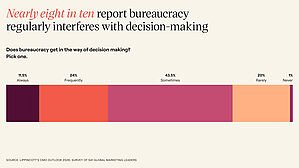
These titles, while signaling a welcome focus on analytical rigor, can also foster a "brute-force approach" geared toward immediate conversions over foundational brand strategy. This environment is choked by organizational friction. An overwhelming 84% of CMOs report difficulty aligning leadership around a unified marketing vision, and nearly eight in ten say bureaucracy regularly interferes with decision-making. With fewer than half (44%) of marketing departments operating with a high degree of autonomy, the mandate to drive growth is often undermined by the very structure in which it exists.
"The conventional wisdom of focusing entirely on what the CEO and CFO demand has ushered in this current era of marketing, in which the focus on quantifiable, immediate performance comes at the expense of brand health," said Michael D'Esopo, CEO of Lippincott. "But in this new world order, CMOs and businesses both lose. Our research suggests the next era of marketing requires a different mindset."
The Long-Term Cost of Short-Term Wins
The trade-off for C-suite trust is paid for with the currency of brand equity. While respondents identified long-term growth and customer perception as top priorities, the reality of their daily operations tells a different story. Teams are consumed with proving marketing's immediate impact and hitting short-term business targets. This short-termism, fueled by macroeconomic uncertainty and intense budget scrutiny, forces a tactical retreat from strategic investments.
Foundational brand elements—the very bedrock of customer relationships and market differentiation—are being deprioritized. Investments in website development, user experience (UX), thought leadership content, and customer loyalty programs are often the first to be sidelined in favor of campaigns that deliver quick, measurable results. "We all know we need to build the brand for the next five years," one CMO noted anonymously, reflecting a common sentiment, "but my performance is judged on the results of the next five weeks."
This relentless focus on the next click or conversion erodes the underlying consumer demand that fuels sustainable growth. Chasing immediate revenue can create a vicious cycle, where a weakened brand requires ever-more aggressive performance marketing to maintain sales, further starving the brand of the investment it needs to recover. It's a strategic debt that accumulates quietly until it triggers a market-share crisis.
AI's Promise Clouded by Organizational Drag
Nowhere is this conflict more perilous than in the adoption of artificial intelligence. AI ranks as a top leadership priority for CMOs, yet the chasm between ambition and reality is vast. According to the Lippincott study, only 12% of marketing leaders rate their organization's technology enablement for AI as excellent, and a paltry 11% believe their companies excel at adopting and innovating with new marketing technologies.
The irony is profound. The very brand-building activities being sacrificed for short-term metrics—high-quality content, seamless user experiences, and a distinct brand voice—are the essential inputs that AI systems rely on to discover, understand, and recommend brands. By neglecting these fundamentals, companies are inadvertently sabotaging their long-term viability in an AI-driven world. An algorithm cannot recommend a brand it cannot find or does not understand.
While the proliferation of AI-powered analytics dashboards makes short-term performance more visible than ever—a useful tool for demonstrating impact to finance leaders—it also risks reinforcing the myopic focus on immediate results. Without a strategic counterweight, the tools meant to empower marketers could instead trap them more deeply in the cycle of the 'Trust Trade-Off,' optimizing for the next quarter at the cost of the next decade.
Forging a New Mandate for Marketing
Escaping this paradox requires more than just a shift in marketing tactics; it demands a recalibration of marketing's role within the organization. Lippincott's analysis suggests that the path forward lies in tackling the organizational conditions that foster short-termism. The report frames stakeholder alignment as an "undervalued lever" and the "hidden driver of marketing effectiveness."
This calls for a 'both/and' approach, where CMOs champion a balanced scorecard that integrates immediate performance metrics with long-term measures of brand health. This involves reframing marketing's mandate with fellow executives, positioning the function as a growth engine accountable for both immediate revenue and the appreciation of the brand as a core business asset. By linking brand strength to tangible outcomes like pricing power, lower customer acquisition costs, and higher conversion rates, CMOs can make a compelling case for sustained investment.
One practical strategy is to codify budget allocations—for instance, a 60/40 or 50/50 split between brand-building and performance-oriented activities—and to make any deviation from this an explicit, strategic decision rather than a reactive concession to quarterly pressure. The most effective marketing leaders of the coming era will be those who master the art of organizational influence, building the internal alignment necessary to protect long-term value creation from the relentless pull of the present.