
- 25% productivity boost for top 100 'Market-Shaping Enterprises' since 2019
- 28% productivity surge for elite 'Productivity Pathfinders™' (30 companies)
- 30-35% higher operating margins for Pathfinders vs. industry baseline
Experts would likely conclude that the manufacturing sector is experiencing a structural bifurcation, where a small group of high-performing companies is pulling away from the rest due to self-reinforcing productivity cycles, requiring fundamental operational transformations for laggards to compete.
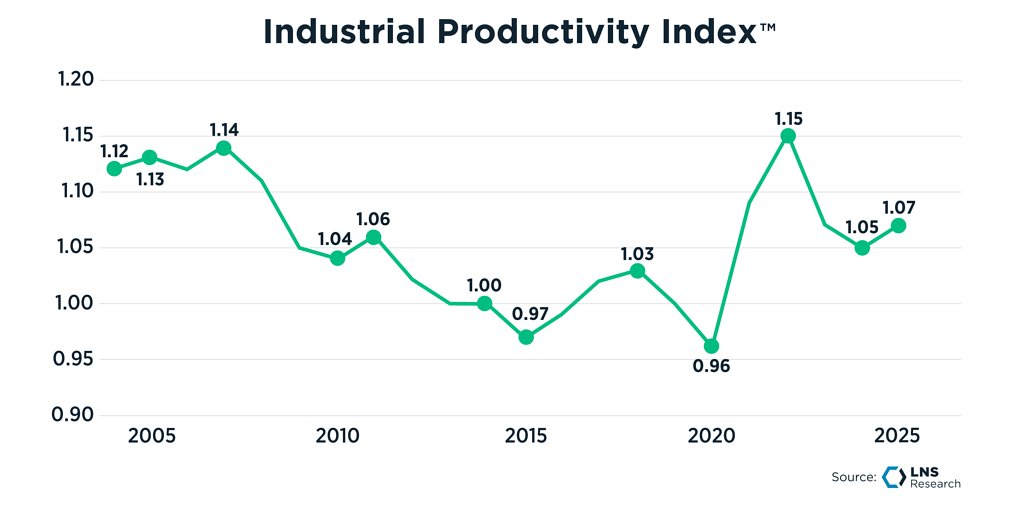
Manufacturing's Great Divide: Productivity Boom Creates a Two-Tiered Industry
CAMBRIDGE, Mass. – June 17, 2026 – After years of volatility marked by supply chain shocks and workforce instability, the global manufacturing sector is showing signs of life. Aggregate industrial productivity has officially returned to growth. But beneath this encouraging headline lies a more complex and cautionary tale: a stark and rapidly widening chasm is splitting the industry into two distinct tiers.
New findings from the LNS Research 2026 Industrial Productivity Index™ reveal a dramatic divergence between a handful of elite performers and the vast majority of their peers. The annual index, a rigorous quantitative analysis of over 600 publicly traded industrial companies, shows that the gap between the strongest and the rest has grown every year since 2019, creating a separation that is becoming dangerously self-reinforcing.
"Last year was a historic inflection point for global manufacturing," said Matthew Littlefield, Co-founder and President of LNS Research, in a statement accompanying the release. "Our data tells two stories simultaneously. The aggregate picture improved, but beneath the surface, two dynamics are running in opposite directions.”
This bifurcation presents a critical challenge for investors and executives. While one group of companies is building a seemingly insurmountable lead, the other risks being trapped in a cycle of decline, raising fundamental questions about long-term competitiveness and the very structure of the modern industrial economy.
The Widening Chasm
The numbers paint a stark picture of this growing divide. LNS Research has designated the top 100 performers as “Market-Shaping Enterprises.” On a revenue-weighted basis, this group has boosted its productivity by an astonishing 25 percent since 2019. In stark contrast, the remaining 512 companies analyzed in the index saw a meager 3 percent improvement over the same period. This disparity is not just a line on a chart; it translates directly into commercial viability, with the leaders showing superior operating margins, net income ratios, and free cash flow.
According to Littlefield, companies that fall behind are confronting “a negative feedback loop, with weaker productivity compressing margins and cash, leaving less to reinvest in the capability that would restore it.” This vicious cycle makes it increasingly difficult for laggards to fund the very innovation and operational overhauls needed to catch up.
Conversely, the top performers are experiencing what LNS Research calls an “accumulated advantage.” Their productivity gains generate superior financial returns, which are then reinvested into technologies, processes, and talent that further accelerate their performance. This virtuous cycle is creating a formidable barrier to entry for competitors, making the leaders’ advantage increasingly self-funding and sustainable.
Decoding the 'Productivity Pathfinders'
Within the top 100, an even more elite cohort of 30 organizations, dubbed “Productivity Pathfinders™,” represents the absolute pinnacle of industrial performance. Making up less than 5 percent of the total companies analyzed, this group has achieved a productivity surge of over 28 percent since 2019. Their operating margins are running 30 to 35 percent above the broad industrial baseline, a clear testament to their operational excellence.
So, what sets these Pathfinders apart? The research suggests it’s not a single silver bullet but a holistic approach that integrates strategy, technology, and culture. These companies—a group that includes discussions with major players like Ford, PepsiCo, ExxonMobil, and GE Healthcare—are not merely optimizing existing processes. They are fundamentally rethinking how their businesses operate.
"Productivity Pathfinders are not simply running the same race a few steps ahead," Littlefield added. "They are reinvesting their advantage faster than the field can close it, and that is what makes the separation sustainable."
Key characteristics of these leaders include a disciplined, enterprise-wide operating model, simplified technology architectures that allow innovation to scale beyond pilot projects, and a commitment to sharing information across the entire value chain to reduce variance and increase speed. Critically, they invest as deliberately in their people and decision intelligence as they do in capital and automation, empowering their workforce to turn insights into action.
Beyond Benchmarking: How AI is Redefining the 'Why'
Perhaps the most significant aspect of the 2026 index is not just the identification of who is winning, but the deeper understanding of why. For this year's analysis, LNS Research deployed new causal modeling techniques, including Bayesian networks and machine learning, to map the internal conditions that drive productivity.
This advanced analytical approach moves beyond simple correlation to identify the root causes of both success and failure. The result, as the firm states, is “a more exacting picture of not just who the leaders are, but why separation persists and what other companies can do about it.” This aligns with a broader industry trend toward leveraging Industrial DataOps and AI to close the “insight-to-action gap”—the critical delay between generating a data-driven insight and executing a decision on the factory floor or in the supply chain.
By pinpointing the specific governance controls and operational models that prevent decline, the research provides a strategic blueprint for the rest of the industry. It suggests that sustained productivity is not a matter of chance but the result of a deliberate, data-informed strategy that aligns leadership, technology, and execution across the entire organization.
For the hundreds of companies on the wrong side of the productivity chasm, the message is clear: incremental improvements are no longer sufficient. The path to commercial viability now requires a fundamental transformation in how they operate, invest, and compete. The strategies of the Pathfinders, now illuminated by advanced data science, offer a potential roadmap. For those willing to embrace it, the opportunity to bridge the gap remains, while those who hesitate risk being left permanently behind in a new, unforgiving industrial landscape. LNS Research will recognize this year’s winning companies at its annual The Transformation Event in Boston this October, where leaders will convene to discuss these very challenges.