
- 55 TOPS: The VTA-439's NPU delivers 55 trillion operations per second, surpassing Microsoft's 40 TOPS benchmark for AI-capable PCs.
- 150 million units: AI-capable PCs may constitute a majority of all PC shipments by 2027, with annual sales exceeding 150 million units.
- $1,049: The VTA-439's starting price aims to undercut long-term cloud AI subscription costs.
Experts agree that the rise of local AI through devices like the VTA-439 represents a significant shift toward privacy, accessibility, and economic independence in AI computing, though challenges in user-friendliness remain.
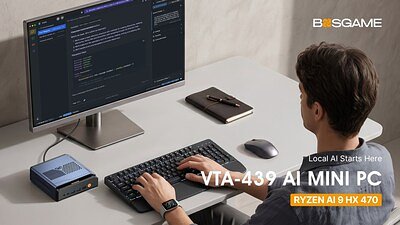
The AI on Your Desk: How Mini PCs Are Democratizing Local AI
SHENZHEN, China – June 04, 2026 – For the better part of a decade, artificial intelligence has felt like a distant, powerful entity residing in the cloud—something we access through a browser, governed by subscriptions and opaque data policies. A fundamental shift is underway, however, moving AI from remote data centers to the physical confines of our own desks. This transition towards local, on-device AI is not just a niche trend; it’s a burgeoning revolution driven by rising cloud costs, growing data privacy concerns, and a desire for digital independence.
Market analysts are forecasting an explosion in this new category of hardware. Firms like Gartner and IDC project that AI-capable PCs, which represented a fraction of the market just a year ago, will constitute a majority of all PC shipments by 2027, with sales potentially exceeding 150 million units annually. Against this backdrop, technology firm BOSGAME has introduced its VTA-439, a mini PC that encapsulates this movement by promising to put high-performance, private AI into the hands of everyday users, creators, and small businesses.
Unpacking the Power: What 55 TOPS Really Means
At the heart of the VTA-439 is AMD’s new Ryzen™ AI 9 HX 470 processor, a chip built specifically for the new era of AI-infused computing. Its most significant feature is a Neural Processing Unit (NPU) based on the advanced AMD XDNA™ 2 architecture, capable of 55 TOPS, or 55 trillion operations per second.
To put that number in context, Microsoft recently set a new industry benchmark with its “Copilot+ PC” designation, requiring a minimum of 40 TOPS from a device's NPU to natively run its next-generation AI features. The VTA-439’s 55 TOPS capability not only clears this bar but significantly surpasses it, signaling a machine engineered for demanding local AI workloads. This NPU is designed to handle the parallel processing required by AI models far more efficiently than a traditional CPU, enabling real-time performance without consuming excessive power or generating significant heat—a crucial factor in its compact, mini PC form factor.
“The raw numbers are impressive, but what they represent is a paradigm shift in accessibility,” noted one industry analyst. “We’re moving from a world where meaningful AI work required either a powerful, power-hungry desktop GPU or expensive cloud credits, to one where a quiet, small-footprint device can become a personal AI powerhouse.” This level of on-device performance is what makes the promise of local AI tangible.
From the Cloud to the Desktop: The Practicality of Local AI
Powerful hardware is only half the story; its true impact lies in the applications it enables. The VTA-439 is positioned to run a suite of popular open-source AI tools that were once the exclusive domain of developers with high-end setups. Users can run large language models like Meta’s Llama 3 8B via the user-friendly Ollama platform, effectively creating a private, offline chatbot or writing assistant that learns from and operates on data that never leaves the machine.
For visual creators, the device can run ComfyUI, a sophisticated interface for AI image generation, allowing for rapid iteration and experimentation without uploading prompts or content to a third-party service. Similarly, its ability to perform offline voice transcription using OpenAI’s Whisper model offers journalists, researchers, and students a secure and fast way to convert audio to text. While platforms like Ollama have simplified the process, the journey to making these tools truly “plug-and-play” for non-technical users is ongoing. The initial setup may still present a learning curve, placing a responsibility on manufacturers like BOSGAME to provide robust tutorials and software support to fully realize their vision of accessibility.
The Economics of AI Independence
The move to local AI is also an economic one. The subscription-based model of cloud AI can create significant and often unpredictable costs for individuals and small teams. By contrast, the VTA-439 represents a one-time hardware investment. With a starting price of $1,049, BOSGAME is making an aggressive play to undercut the long-term cost of cloud dependency.
This competitive pricing is made possible by the company’s vertically integrated structure. Leveraging a factory-direct sales model, a large proprietary manufacturing facility in Shenzhen, and a substantial R&D team of over 300 engineers, the firm streamlines its production pipeline to reduce overhead. This strategy is not just about selling a product; it’s about offering a different economic proposition for AI access—one based on ownership rather than rental.
Redefining Privacy and Ownership in the AI Age
Perhaps the most compelling driver behind the local AI movement is the quest for digital sovereignty. In an era where personal and corporate data is routinely harvested and processed by large tech companies, the ability to run AI workloads in a completely private environment is a powerful proposition. The VTA-439 ensures that all processing happens on-device, meaning sensitive documents, personal conversations, and proprietary creative work remain under the user's exclusive control.
This principle of user-centric control is at the core of the company's message. "We are seeing a fundamental shift in how people think about AI, from something you access through a browser to something that runs on your desk, on your terms," said James Cao, General Manager of BOSGAME. "The VTA-439 was designed for exactly this moment: powerful enough to run meaningful AI workloads locally, compact enough to fit any workspace, and priced so that this capability is not limited to enterprises or researchers. Local AI should be for everyone."
By intersecting powerful hardware with a commitment to privacy and accessibility, this new generation of AI PCs is doing more than just accelerating tasks. It is fundamentally reshaping our relationship with artificial intelligence, transforming it from a centralized, corporate-controlled service into a personal, customizable, and trustworthy tool for innovation.