
- 59% of organizations in the US and UK made a 'bad AI hire' in the past year
- 53% of hiring managers prioritize AI fluency over deep domain expertise
- The cost of a bad hire can reach over 240,000 USD for senior IT roles
Experts agree that traditional hiring methods are failing to accurately assess AI fluency, leading to costly mismatches between candidate confidence and actual competence.
The AI Hiring Paradox: Why Companies Are Failing to Find Real Talent
LONDON – May 06, 2026 – A staggering 59% of organizations in the US and UK have made a "bad AI hire" in the past year, according to a new report that exposes a critical disconnect between the urgent demand for artificial intelligence skills and the outdated methods used to find them. The research from skills-based hiring platform TestGorilla, titled The State of Hiring for AI Fluency, reveals a workforce in transition, where 53% of hiring managers now prioritize AI fluency over deep domain expertise, yet struggle profoundly to identify genuine competence.
The findings paint a picture of ambition outpacing reality. While nearly all organizations surveyed list AI fluency as a hiring requirement—with over 70% in both the US and UK having formally defined the term—they are consistently hiring candidates who can talk the talk but cannot deliver on the job. This expensive misstep highlights a growing crisis in talent acquisition, where the ability to speak convincingly about AI in an interview has become a poor and costly proxy for actual skill.
The 'Infrastructure Paradox'
The report identifies this dilemma as the "Infrastructure Paradox": companies are layering AI requirements onto hiring frameworks built on the same broken proxies that have failed recruiters for decades. This paradox manifests in three distinct traps that ensnare hiring managers and lead to poor outcomes.
First is the Awareness Trap, where the bar for AI fluency is set perilously low. The research found that 37% of organizations define the minimum standard as simple tool awareness—merely knowing that a tool like ChatGPT or an AI workflow exists. This superficial benchmark rewards candidates who have read about AI, not those who can apply it.
Second, the Subjectivity Trap plagues 19% of companies, which leave AI assessment entirely to individual hiring manager discretion. Without a shared, objective rubric, "AI fluency" becomes a vibe-check. This rewards the best storyteller—the candidate who can weave the most compelling narrative about their supposed AI prowess—rather than the most competent applicant.
"Organizations are no longer just looking for subject matter experts; they are looking for AI-augmented performers who can use emerging technology to 10x their output," says Wouter Durville, CEO of TestGorilla, in the report's release. "But a candidate can learn the vocabulary, 'agentic workflows,' 'RAG,' 'prompt chaining' in a single weekend. They can describe a workflow convincingly without ever having built one."
This leads directly to the third and most critical issue: Confidence vs. Competence. Traditional interviews are designed to observe communication and confidence, not hands-on execution. A candidate can speak eloquently about auditing an AI's output or redesigning a prompt chain without ever having successfully performed the task, leaving their actual ability untested until they are already on the payroll.
The Staggering Cost of a Bad Hire
The consequences of these hiring failures extend far beyond a single poor performance review. A bad AI hire can be more financially damaging to fix than leaving a position vacant, creating a ripple effect of lost productivity, wasted resources, and demoralized teams.
According to the U.S. Department of Labor, the cost of a bad hire can be at least 30% of the employee's first-year earnings. However, for specialized technical roles, that figure is a conservative floor. Research from the Society for Human Resource Management (SHRM) suggests the true cost of replacing an employee can be anywhere from 50% to 200% of their annual salary. For senior IT roles, some estimates place the total financial impact—factoring in recruitment, compensation, lost productivity, and project delays—at over $240,000.
These indirect costs are often the most corrosive. A struggling new hire can consume an inordinate amount of a manager's time and divert senior engineers from their own high-impact work. One industry analysis found that a single underperforming developer can occupy 25% to 50% of a senior colleague's time in coaching and rework, creating technical debt and slowing down the entire team. This drain on morale and productivity was confirmed by an HR survey where 85% of professionals reported that a single bad hire negatively impacts the entire team's output and spirit.
A Transatlantic Divide in AI Strategy
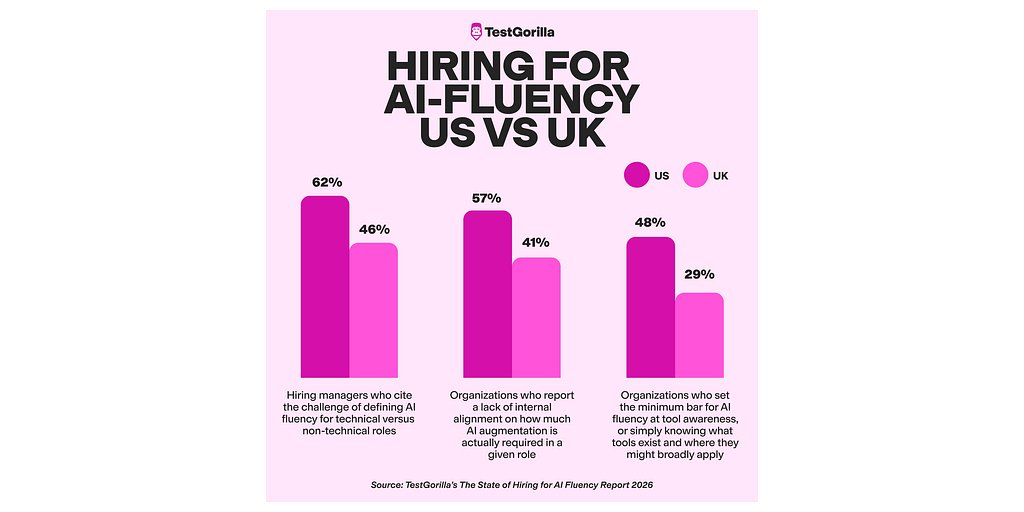
TestGorilla's report also uncovers a sharp transatlantic divide in how organizations are navigating the AI talent landscape. The data reveals that US companies are struggling significantly more with the consequences of poor AI hiring. A full 33% of US organizations report frequent AI-driven errors in the workplace, compared to just 13% in the UK.
This disparity appears linked to a difference in strategic rigor. US employers are far more likely to fall into the "Awareness Trap," with 45% setting the bar at mere tool awareness, compared to a more discerning 29% in the UK. This suggests that UK firms have developed a stronger internal consensus on what AI fluency truly requires, moving beyond superficial knowledge toward verifiable application.
While the report does not pinpoint the exact cause of this divergence, it suggests that UK organizations may be adopting more structured and objective evaluation methods. This smarter approach appears to be yielding better results, offering a potential learning opportunity for US and other global companies grappling with a higher frequency of costly AI-related mistakes.
Beyond the Buzzwords: A New Era of Assessment
The consensus emerging from this and other industry analyses is that subjective evaluation is no longer fit for purpose in the AI era. To bridge the gap between a candidate's stated confidence and their actual competence, leading organizations are moving toward objective, skills-based assessment. This paradigm shift involves verifying ability through practical application rather than relying on credentials or interview charisma.
The market is responding with a new generation of assessment tools designed to test, not just talk about, AI skills. Instead of asking a candidate if they can use an AI tool, these platforms create real-world scenarios. Some, like Canditech, use job simulations with embedded AI tools to see how candidates perform tasks. Others, such as HackerEarth and Codility, offer sophisticated coding environments to evaluate not only a developer's code but also their ability to collaborate with AI copilots to solve complex problems. This approach directly measures critical skills like prompt engineering and the ability to critically evaluate AI-generated outputs.
This evolution is echoed by reports from major analysts. Gartner predicts that by 2027, 75% of hiring processes will include tests for workplace AI proficiency, noting that the rise of generative AI makes it "harder for employers to evaluate candidates' true abilities" through traditional means. The solution is not to abandon AI, but to use better, more objective methods to verify the human skills required to wield it effectively. As businesses continue their rapid integration of artificial intelligence, the ability to accurately identify and hire truly fluent talent will be the defining factor between leading the pack and falling behind.