
- Grand Prize: RMB 300,000 (approx. $42,000 USD) for the winner
- Submission Deadline: May 15, 2026
- Shortlisted Authors: 4, each receiving RMB 20,000 (approx. $2,800 USD)
Experts view the Blancpain-Imaginist Literary Prize as a pivotal challenge to redefine human creativity in the age of AI, emphasizing the irreplaceable value of originality and emotional depth in literature.
Literature's Decisive Moment: A Prize Challenges AI's Rise
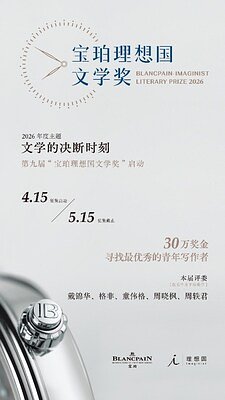
BEIJING, CN – April 24, 2026 – The Blancpain-Imaginist Literary Prize, a major force in contemporary Chinese letters, has officially launched its ninth edition, calling on young authors to confront one of the most urgent questions of our time. With a theme titled "The Decisive Moment of Literature," the prestigious award directly challenges writers to define the value of human creativity in a world increasingly shaped by artificial intelligence.
The prize, co-founded by Swiss luxury watchmaker Blancpain and influential Chinese publisher Imaginist, continues its mission to discover and nurture outstanding Chinese-language writers under the age of 45. Submissions are open until May 15, with a grand prize of RMB 300,000 awaiting the winner, who will be unveiled in late October. Four other shortlisted authors will each receive RMB 20,000, providing crucial support in a field often defined by solitary dedication.
A Challenge in a Technological Jungle
This year's theme is not a gentle suggestion but a direct confrontation with the "creative fog of perpetual uncertainty" that has descended upon the literary world. The prize's manifesto acknowledges a landscape fraught with "controversies, the perplexity of originality, crises of trust, and disenchantment with values," with the rise of AI compelling a fundamental re-evaluation of writing itself. "Can what writing has lost be balanced by what it has gained?" the organizers ask. "What is the meaning of literature today?"
This question resonates deeply within China's vibrant but anxious literary scene. While some authors and online publishing platforms are embracing AI as a tool for translation, brainstorming, and efficiency, a significant undercurrent of concern persists. The discourse is rife with debates over whether AI can replicate the "soul" of human experience, with many fearing that an over-reliance on algorithms could erode the very originality and emotional depth that defines great literature.
The prize's call to action is a powerful response to this anxiety. It urges writers to "step away from inertia and old orders" and use their craft to "record, in the face of all dissolution, inertia, and shortcuts, the hidden traces of our time." It is a plea for authors to cast their hearts with the pen, preserving the complexities of the human heart and rebuilding spiritual coordinates in a world where the singularity of individual expression feels threatened.
Luxury, Letters, and a Lasting Legacy
The unique partnership between a nearly 300-year-old watch manufacture and a leading publishing house provides the foundation for this ambitious cultural project. For Blancpain, founded in 1735, the prize is a natural extension of a brand philosophy steeped in craftsmanship, tradition, and the intrinsic value of time. Known for its steadfast commitment to producing only mechanical watches, the company views the meticulous work of a writer as analogous to that of a master watchmaker—both are "true artisans, [who] refine every word — stroke by painstaking stroke."
This ethos is encapsulated in the prize's enduring motto: "Reading makes time more valuable." Blancpain's involvement is not a fleeting marketing campaign but part of a long-standing pattern of cultural and environmental patronage, which includes its celebrated "Ocean Commitment" to marine conservation. By investing in literature, the brand aligns its identity with the timeless pursuit of humanistic expression.
Equally crucial is the role of Imaginist, widely regarded as China's most influential publishing brand. Known for its high-quality editorial standards and its commitment to "thoughtful writing," Imaginist lends the prize immense credibility and authority. The publisher has a storied history of championing both established literary icons and today's most vibrant young voices, making its involvement a guarantee of literary seriousness. This partnership ensures the prize's principles of "Fairness, Authority, and Professionalism" are more than just words, creating a trusted platform for discovering tomorrow's literary talents.
Forging the Next Generation of Literary Stars
Since its inception, the Blancpain-Imaginist Literary Prize has proven to be a formidable catalyst for the careers of young Chinese authors. Its impact is often compared to that of career-making awards like the Booker Prize or Japan's Akutagawa Prize, which famously recognized future Nobel laureates early in their journeys.
The prize’s inaugural winner in 2018, Wang Zhanhei, captured the literary world's attention with her debut collection Air Cannon, and has since published another acclaimed collection and seen her work translated for international audiences. The prize has consistently identified writers who go on to build sustained and significant careers. Past winners like Chen Chuncheng (The Submarine at Night, 2021) and Liao Jing (Spring Will Never Fall, 2025) were celebrated for their innovative narratives and profound emotional depth.
The prize's shortlist is also a testament to its influence, having featured authors like Zhang Yueran and Shuang Xuetao, who have since achieved significant international recognition with multiple works translated into English. By providing a combination of financial support, critical validation, and a powerful public platform, the award has repeatedly succeeded in elevating emerging writers from relative obscurity to national and even global prominence.
A Jury of Stature and Strict Standards
The task of navigating this "decisive moment" falls to a jury of five distinguished figures from Chinese literature and culture. The 2026 panel includes DAI Jinhua, a renowned Peking University professor and cultural critic known for her sharp analyses of technology and capitalism; GE Fei, a celebrated avant-garde writer and Tsinghua University professor; writer TONG Weige; writer ZHOU Xiaofeng; and documentary director and journalist ZHOU Yijun. Their collective expertise, spanning critical theory, avant-garde fiction, and journalism, ensures a rigorous and intellectually diverse evaluation process.
The prize maintains strict eligibility criteria, accepting only physical, single-volume novels or short story collections published in mainland China within the past year by authors under 45. The rules explicitly exclude electronic publications and require that debut short story collections consist of at least two-thirds new material, underscoring a commitment to fresh and original work.
As submissions open, the Chinese literary world watches with anticipation. The longlist will be announced on August 1st, followed by the five-author shortlist on September 15th. The final winner, to be chosen in late October, will not only receive a substantial award but will also be seen as offering an answer, however personal, to the urgent challenge posed by the prize: to define what literature can and must be in an age of profound and perilous enchantment.