
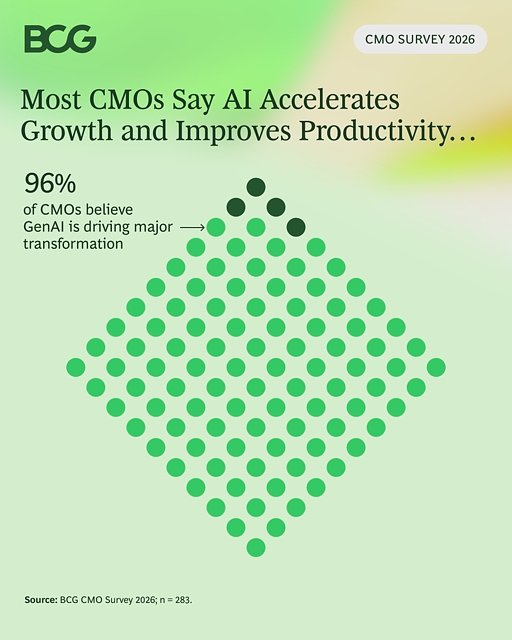
- 96% of CMOs believe AI is driving end-to-end transformation, but only 8% run autonomous AI campaigns.
- 43% of companies report AI marketing investments exceeding $15 million in 2026.
- 31% of B2C CMOs and 20% of B2B CMOs report measurable revenue impact from AI transformations.
Experts agree that while AI adoption in marketing is widely recognized as transformative, most CMOs are still in early stages of implementation, risking competitive disadvantage if they fail to accelerate systemic change.
Marketing’s AI Mirage: Belief Is High, But True Transformation Is Lagging
BOSTON, MA – June 14, 2026 – In the boardrooms and marketing departments of 2026, AI is the word on everyone’s lips. It is hailed as the engine of a new industrial revolution, the key to unlocking unprecedented growth and efficiency. And nowhere is this belief more fervent than in the office of the Chief Marketing Officer. Yet, a stark new report from Boston Consulting Group (BCG) suggests that for most, this belief is more of a mirage than a reality.
The report, titled “How CMOs are Moving Agentic Marketing from Illusion to Reality,” paints a picture of a profound disconnect. It finds that while a staggering 96% of CMOs believe AI is driving an end-to-end transformation of their function, their actions tell a different story. The vast majority are still dipping their toes in the water, leaving them vulnerable in a landscape that is changing faster than they are.
Acknowledgment Without Action
The data reveals a chasm between acknowledgment and adoption. While nearly every marketing leader sees the tidal wave of AI coming, only a tiny fraction are building an ark. According to BCG’s global survey of 300 CMOs, a mere 8% are running campaigns where multiple AI agents operate autonomously—planning, executing, and learning with minimal human oversight. A more significant portion, 42%, are using Generative AI in the most basic way possible: as a digital assistant for individual tasks, a glorified intern for a handful of workflows.
This isn't transformation; it's task augmentation. It’s the equivalent of swapping a typewriter for a word processor and calling it a digital revolution. The true revolution lies in agentic systems—interconnected AI agents that can orchestrate entire campaigns, from strategic planning and content creation to media buying and performance analysis.
“Ninety percent of the CMOs in our survey agreed that GenAI is already reshaping how consumers discover and evaluate brands. But most marketing organizations are not yet built to compete in that environment,” warns Mark Abraham, a BCG managing director and senior partner who coauthored the report. The pressure to adapt is immense, with 94% of CMOs feeling that CEO expectations of marketing have soared over the past two years. This pressure is matched by soaring budgets; 43% of companies now report AI investments in marketing exceeding $15 million this year, up from 28% in 2025. The money is flowing, but is it building a bridge to the future or just paving a road to nowhere?
The CMO in the Driver's Seat
Interestingly, the report uncovers a crucial power shift that puts the onus squarely on marketing leaders to close this gap. While enterprise-wide AI strategy is often a CEO-led initiative, roughly half of all CMOs now say their marketing organization leads AI investment decisions for their own function. This newfound autonomy is a double-edged sword: it provides the authority to act decisively but removes any excuse for inaction.
Those who are moving decisively are seeing tangible results. The report notes that early adopters are already reaping rewards, with close to a third of B2C CMOs (31%) and a fifth of B2B CMOs (20%) reporting significant, measurable revenue impact from their agentic marketing transformations. These leaders are not just buying tools; they are re-architecting their entire operating model. Their top investment area, rising sharply since last year, is in the foundational layers of martech and data orchestration.
“The introduction of end-to-end agentic workflows is forcing a fundamental reset of the marketing operating model,” says Lauren Wiener, a BCG managing director and senior partner. She notes that CMOs have a “rare opportunity to drive enterprise value by moving early.” The message is clear: the ROI is real for those willing to move beyond experimentation and commit to a full system redesign.
The Human Element in an Agentic World
The biggest barrier to this redesign isn't technology or budget—it's talent. Several CMOs interviewed for the report described the need for a workforce with skills they “cannot recruit but must create themselves.” This highlights the critical, and perhaps most difficult, piece of the puzzle: upskilling.
An overwhelming 80% of CMOs report making significant investments in AI-specific upskilling programs, a figure that includes a growing emphasis on responsible AI and ethics training. The role of the marketer is fundamentally shifting. The siloed channel specialist is becoming obsolete, replaced by the “orchestrator-in-chief”—a strategist who understands how to design, deploy, and manage a symphony of intelligent agents.
This new role requires a blend of technical fluency, strategic acumen, and creative judgment. Marketers must learn to write effective prompts, interpret AI-driven analytics, and, most importantly, know when to let the machine run and when a human needs to take the controls. This is less about becoming a data scientist and more about becoming an architect of intelligent systems.
The Rise of the Agentic-Native
The strategic imperative to close the transformation gap is made urgent by a new and gathering threat. As Mark Abraham cautions, “If established brands don't build this first, new agentic-native attacker brands will do so.”
These are not legacy companies trying to bolt AI onto old systems. They are startups being born today, built from the ground up on an agentic operating model. Their marketing function will not be a department of people assisted by AI, but a system of AI agents orchestrated by a handful of people. They will be able to discover market niches, target consumers with hyper-personalized messaging, and adapt to market changes at a speed and scale that traditional organizations simply cannot match.
With 90% of CMOs already agreeing that AI is changing how consumers discover brands, the battlefield is shifting. Soon, consumers won't just be searching on Google; they will be dispatching their personal AI agents to find the best product, negotiate the best price, and make the purchase. Brands that have not built the infrastructure to be discovered and evaluated by these agents will become invisible. The choice for today's marketing leaders is becoming increasingly stark: embrace the difficult work of true transformation or risk being rendered obsolete by those who will.