
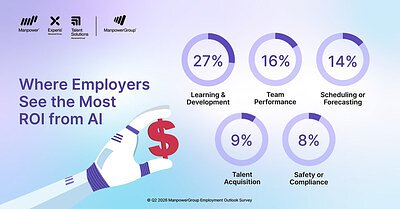
- Global Net Employment Outlook (NEO): 31%, a six-point jump from the previous quarter and a seven-point rise year-over-year. - Employers Planning to Hire: 45% of organizations. - AI Adoption in Workplace: 67% of organizations using AI in hiring, onboarding, or training, with 27% reporting the highest ROI in Learning and Development (L&D).
Experts conclude that while global hiring confidence has reached a two-year high, the outlook is tempered by geopolitical uncertainties and uneven AI integration, requiring cautious optimism and strategic workforce planning.
Global Hiring Hits 2-Year High, But AI and Geopolitics Loom Large
MILWAUKEE, WI – March 10, 2026 – Global employer confidence has surged to its highest point in nearly four years, with hiring intentions for the second quarter of 2026 rebounding to levels not seen since a more optimistic Q3 2022. The latest ManpowerGroup Employment Outlook Survey, a comprehensive poll of over 41,700 employers across 42 countries, reveals a global Net Employment Outlook (NEO) of 31%.
This figure, a key indicator derived by subtracting employers expecting to reduce staff from those planning to hire, marks a significant six-point jump from the previous quarter and a seven-point rise year-over-year. The data suggests a widespread easing of economic uncertainty, with 45% of organizations planning to increase their headcount. However, the optimism is tempered by the survey's timing—conducted before new geopolitical tensions emerged in the Middle East—and a complex picture of AI's true impact on the workforce.
A Nuanced Recovery
The headline number points to a robust recovery, but the details paint a more complex picture of the global labor market. While nearly half of employers are ready to hire, a substantial 40% are choosing to hold their ground, maintaining current staffing levels. Meanwhile, the portion of companies planning layoffs has shrunk to 13%, a three-point improvement from the last quarter. The number of undecided employers has also halved to just 2%, signaling greater clarity, if not universal bullishness.
"The data tells a nuanced story, with more employers hiring for expansion and to backfill roles, and fewer reducing headcount than we've seen in recent quarters," said Jonas Prising, ManpowerGroup Chair & CEO, in the official release. "Yet the second-largest group remains those holding steady, watching the environment before they commit."
This cautious optimism is a return to form. The survey, now in its 64th year and widely regarded as a bellwether for labor trends due to its consistent methodology, shows the current 31% NEO is just shy of the +30% outlook recorded in Q3 2022. It suggests that after navigating several quarters of uncertainty, businesses are once again viewing human talent as a primary engine for growth.
The Geopolitical Shadow and AI's Mixed Returns
A significant caveat hangs over the optimistic forecast. The survey data was collected between January 1 and February 3, 2026, a period that concluded before what the report describes as "geopolitical developments that began across the Middle East in late February." This timing means the reported confidence does not account for any potential shockwaves from new conflicts, which could disrupt supply chains, spike energy prices, and cause businesses to pause ambitious hiring plans.
Prising acknowledged this, stating, "Though current geopolitical uncertainty may contribute to more hesitancy, the direction is encouraging, and businesses have become used to navigating complex environments." This resilience is being tested not only by global events but also by the rapid integration of technology.
Parallel to the hiring outlook, the survey provides a critical look at Artificial Intelligence's role in the workplace. Two-thirds (67%) of organizations are now using AI in hiring, onboarding, or training, with adoption soaring to 80% in the Asia Pacific region. Yet, the returns are uneven. The biggest success story for AI appears to be in employee development, with 27% of employers reporting the highest return on investment from AI applications in Learning and Development (L&D)—more than double the ROI seen in Talent Acquisition (9%).
Despite this, the technology is far from a silver bullet. A mere 8% of employers feel AI is fully meeting their expectations in hiring and training, and 16% report seeing no positive ROI at all. The primary roadblocks are not just technical, but organizational and ethical. Privacy and regulatory concerns (13%) top the list of barriers, followed closely by a lack of sufficient company training (10%) and a workforce that lacks the necessary skills to leverage the new tools (10%). This points to an "AI upskilling imperative," where the technology's potential is capped by the human capacity to manage and utilize it effectively.
A World of Difference: Regional and Sector Divides
The global average of 31% masks dramatic variations between regions and industries. The most optimistic hiring plans are concentrated in the Asia Pacific region, which leads the world with a 39% NEO. India is the global frontrunner with a staggering 68% outlook, followed by newcomer Vietnam at 47%. In contrast, Hong Kong reports the region's most cautious outlook at a modest 11%.
The Americas are also posting strong numbers with a regional outlook of 37%. Confidence is particularly high in Latin America, led by Brazil (55%), while the United States shows resilient labor demand with a robust 38% outlook. Colombia (18%) is the most hesitant market in the Americas.
Europe and the Middle East lag significantly, with the lowest regional outlook of 23%. This region is a study in contrasts, hosting both the second-most optimistic country globally, the United Arab Emirates (60%), and the weakest, Romania, which posted a negative outlook of -5%.
Sector-wise, the digital and financial economies continue to drive job growth. The Information sector reports the strongest hiring intentions (41%), followed by Finance & Insurance (35%), as industries continue to invest heavily in digital transformation, fintech, and data analytics. On the other end of the spectrum, the Hospitality sector is the most cautious, with a 22% NEO. While recovering from past disruptions, the sector remains sensitive to economic fluctuations and potential shifts in consumer spending, leading to more reserved hiring plans for the quarter ahead.
Topics & Related
Fintech
AI & Machine Learning
Cloud & Infrastructure
Consumer & Retail
Artificial Intelligence
Generative AI
Machine Learning
Digital Transformation
Corporate Finance
Revenue
EBITDA
Net Income
Related Company Pulse