
- 72% of communications professionals expect their function to wield greater influence by 2030.
- Only 29% feel fully ready for future demands.
- 44% of professionals could imagine leaving the field by 2030.
Experts agree that while the communications industry's influence is growing, a critical skills gap and readiness deficit threaten its future effectiveness, requiring urgent adaptation to AI and evolving strategic demands.
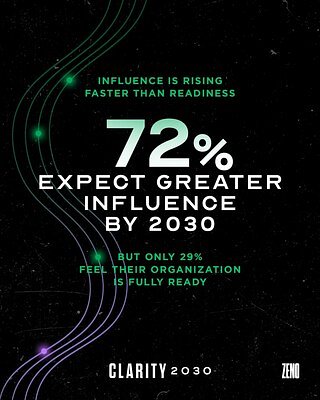
Comms at a Crossroads: Influence Soars as Readiness Falters
NEW YORK, NY – March 10, 2026 – The communications industry is facing a critical paradox: its strategic influence within global organizations is skyrocketing, yet the professionals steering the function feel overwhelmingly unprepared for the future, according to a major new study.
The "Clarity 2030" report, released today by global communications agency Zeno Group, surveyed over 1,400 communicators worldwide and found a widening chasm between rising importance and practical readiness. As CEOs increasingly lean on their communications chiefs for counsel on everything from business strategy to AI governance, the report suggests the industry is at an inflection point that could either solidify its role as a growth driver or expose a critical skills and talent deficit.
The Readiness Paradox
According to the research, nearly three-quarters (72%) of communications professionals expect their function to wield even greater influence over business strategy, growth, and risk by 2030. This sentiment aligns with broader industry trends, as other recent analyses, such as Edelman's "Future of Corporate Communications" studies, have confirmed the Chief Communications Officer's (CCO) ascent as a key strategic partner in the C-suite.
"Communications is no longer adjacent to the business. It is the business," said Barby K. Siegel, Global CEO of Zeno Group, in the press release. "We are moving from being managers of the message to drivers of strategic growth and that is an important and exciting shift."
However, this newfound power is tempered by a stark lack of confidence. The study reveals that a mere 29% of communicators feel fully ready—at an individual, team, or organizational level—for the demands that lie just four years ahead. Compounding this anxiety, 77% believe their roles will require entirely new skill sets by 2030, a clear signal that the competencies that brought success in the past may not be sufficient for the future.
AI's Double-Edged Sword
At the heart of this transformation is artificial intelligence. The technology is simultaneously empowering communicators and creating significant new pressures. A majority of professionals (65%) report that they are more influential than their IT counterparts in shaping their company's AI adoption and change management.
Despite this influence, a critical disconnect exists in tooling and governance. Fewer than half of respondents said their teams have access to company-approved AI tools. This has led to a burgeoning "shadow IT" problem, with nearly one in five admitting to the use of unsanctioned tools, introducing potential security, privacy, and ethical risks. While companies like Cision and Meltwater are rapidly integrating AI into their platforms for everything from media monitoring to pitch writing, the formal adoption and policy creation within organizations lags behind.
The rise of AI is also fundamentally changing how information is consumed and trusted. As Large Language Models (LLMs) begin to replace traditional search for many users, 79% of communicators believe earned media is more important than ever in shaping reputation. Furthermore, a majority (58%) predict that by 2030, AI engines themselves will have the greatest impact on public perception—outpacing journalists, leaders, and even social media algorithms. This positions communications as the last line of defense for accuracy and truth, a role of immense responsibility.
A Looming Talent Crisis?
The profound disruption caused by AI, coupled with other industry pressures, is fueling a significant retention risk. The Zeno study uncovers what it calls a "quiet exit risk," with a startling 44% of communications professionals admitting they could imagine leaving the field entirely by 2030.
The primary drivers behind this potential exodus are a mix of technological anxiety, leadership misalignment, job security fears, and limited opportunities for advancement. External research supports these concerns, with recent SHRM data indicating that a significant percentage of U.S. workers, particularly younger generations, are worried about AI displacing their jobs.
However, the picture is not entirely bleak. The report also identifies the key factors that motivate communicators to stay: creative fulfillment, variety of work, flexibility, and the opportunity to influence leadership. This suggests that organizations that can successfully integrate AI as a tool for augmentation—freeing up professionals for more strategic and creative work—may be better positioned to retain top talent.
Redefining Skills for a New Era
To close the readiness gap and navigate the challenges ahead, a fundamental skills evolution is required. The study found that creative experimentation now ranks as the single most important human capability for future communications leaders. This is not about simply adopting new technology, but about fostering a mindset of curiosity and innovation.
Just as critical are skills rooted in emotional intelligence. The ability to make tough calls under pressure, demonstrate empathy, and adapt to rapidly changing circumstances will become key differentiators. As one industry analyst noted, the focus must shift from what PR professionals do—the tactical execution of tasks that AI can increasingly handle—to why they do it, which is to achieve strategic business outcomes through human connection and ethical judgment.
The findings present a clear mandate for the industry. As Thomas Bunn, Zeno's Chief Client Impact Officer, stated, "This is not a warning about what communications might lose. It is an opportunity to firmly position communications as a strategic growth engine at a time when the stakes have never been higher and the role of communicators has never been more integral to business success." The challenge now is for organizations to provide the structure, training, and tools necessary to turn that opportunity into a reality.