
- 138 million viewers: Super Bowl LX shattered viewership records.
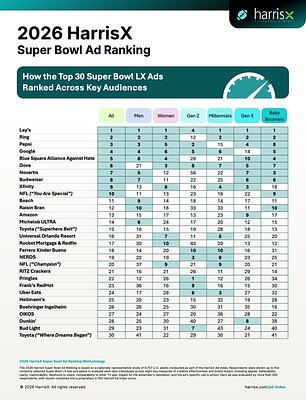
- 93.2/100: Lay's 'Last Harvest' was the top-ranked ad, with 92% viewer approval.
- 94.8/100 (Gen Z): Pringles' 'Pringleleo' was Gen Z's favorite, but only ranked 22nd overall (78.5).
Experts agree that emotional storytelling, purpose-driven messaging, and human-centric AI applications were the most effective strategies in Super Bowl LX ads, though generational preferences highlight the need for tailored creative approaches.
Super Bowl Ads 2026: Heartfelt Stories Win, But Gen Z Has a New Favorite
By Michael Bennett
WASHINGTON – February 12, 2026 – In a year that saw Super Bowl LX shatter viewership records with nearly 138 million Americans tuning in, the advertising battle was won not with spectacle and shock, but with sincerity and story. Lay's potato chips captured the nation's heart with "Last Harvest," an emotional tale of a family farm, making it the top-ranked commercial of the night, according to the newly released 2026 HarrisX Super Bowl Ad Ranking.
The comprehensive study, which evaluated all 70 national ads, found a clear trend: commercials that aimed for emotional connection, purpose, and clarity consistently outperformed those that relied on complexity or novelty alone. Lay's' winning spot, a multigenerational story about a farm's legacy passing from father to daughter, scored an impressive 93.2 out of 100, with 92% of viewers liking the ad.
"The strongest Super Bowl ads this year weren't trying to do the most — they were trying to connect," said HarrisX CEO Dritan Nesho in the company's press release. "Whether through family storytelling, social impact, or disciplined humor, the top-ranked ads showed that clarity and emotional relevance still win on the biggest advertising stage."
The Triumph of Modern Americana and Purpose
This year’s top-performing ads painted a portrait of modern Americana, favoring warmth and human-centric narratives over celebrity-packed extravaganzas. Following Lay's at the top of the charts was Ring’s "Be a Hero in Your Neighborhood" (91.8), which showcased an AI feature that helps reunite lost pets, striking a chord with its community-focused message.
Google's "New Home" (86.8) also landed in the top five by centering on the emotional journey of moving, subtly weaving its AI technology into a narrative of life transitions. Budweiser's "American Icons" (83.6) leaned into its heritage, pairing its iconic Clydesdales with a bald eagle to evoke a sense of national pride and brand legacy. These ads succeeded by grounding their message in relatable themes of family, community, and home.
Alongside these heartfelt stories, purpose-driven messaging proved to be a powerful force. Half of the top ten ads carried a social impact or public health theme. The Blue Square Alliance Against Hate earned the fifth spot with its minimalist yet powerful "Sticky Note" ad confronting antisemitism. Dove’s "The Game Is Ours" (85.0) championed inclusion for girls in sports, while Novartis’s humor-led spot "Relax Your Tight End" (83.8) successfully promoted prostate cancer screening. The continued success of these mission-led campaigns, mirroring a similar trend from last year, confirms that audiences are receptive to brands that take a clear and authentic stand on important issues.
The AI Ad Paradox: Human-Centered Tech Wins
Artificial intelligence was a dominant theme in this year's Super Bowl ad lineup, but the results revealed a stark divide between success and failure. The HarrisX ranking shows that how AI was presented mattered far more than its mere presence. The two most successful AI-themed ads, Ring's pet-finding spot and Google's moving-day assistant, won by framing the technology as a practical tool for human good.
These campaigns positioned AI not as a futuristic abstraction, but as a helpful partner in meaningful life moments. They focused on clear, tangible benefits that strengthen communities and support individuals. This human-centric approach stood in sharp contrast to a slew of other AI ads that faltered.
Five of the seven lowest-performing ads of Super Bowl LX came from AI-focused companies, including OpenAI, Anthropic, and Salesforce. These spots were criticized by viewers for being confusing or overly technical, focusing on the technology itself rather than what it can do for people. For example, Anthropic's ad, "Can I Get a Six Pack Quickly?," was found to be confusing by 42% of respondents. The lesson for the tech industry is clear: to win over a mass audience, AI must be shown to serve humanity, not the other way around.
A Generational Divide: Gen Z Crowns Its Own Winner
While Lay's was the undisputed champion among Millennials, Gen X, and Boomers, a look at younger viewers reveals a completely different story. Gen Z, a demographic with its own distinct cultural currency, rejected the overall consensus and crowned a different ad its favorite: Pringles' "Pringleleo," starring pop superstar Sabrina Carpenter.
The playful, surreal ad, which featured Carpenter building her perfect man out of Pringles chips, earned a massive 94.8 score among Gen Z viewers. However, it ranked just 22nd overall with a score of 78.5, highlighting a significant gap in taste between generations. Lay's top-ranked ad only placed fourth among this younger cohort.
The divergence didn't stop there. Five other ads that made Gen Z's top list—from brands like NERDS, Uber Eats, and Bud Light—failed to crack the overall Top 15. This pattern reinforces what marketers are increasingly learning: Gen Z operates on a "distinct creative playbook," as HarrisX notes, one that prioritizes cultural relevance, specific humor, and a tone of authenticity that often differs sharply from what appeals to older audiences. The success of "Pringleleo" suggests that for brands targeting this demographic, leveraging the right celebrity and a dose of quirky, internet-savvy humor is a more effective strategy than pulling on heartstrings.
Measuring the Moment in a Fractured Landscape
The HarrisX ranking provides a robust, data-driven look at ad effectiveness, but it's one of several lenses through which the Super Bowl's advertising spectacle is judged. The firm's methodology is extensive, surveying over 9,700 adults on eight specific metrics, including appeal, memorability, and purchase intent, to create a composite index score.
This survey-based approach, which measures audience sentiment and perception, differs from other prominent trackers. The long-running USA Today Ad Meter, for instance, relies on a pre-selected panel of consumers to rate ads based on pure likeability in real-time. Another key player, Entertainment Data Oracle (EDO), measures success through behavioral outcomes, tracking how many viewers conduct online searches for a brand immediately after its ad airs.
These different methodologies can and often do produce different winners, reflecting the complexity of measuring success in a fragmented media environment. An ad might win on sentiment but fail to drive immediate action, or be popular with a panel but not resonate broadly. The 2026 results from these varied rankings underscore a critical takeaway for the hundreds of brands that invest millions in a 30-second spot: defining victory in the Super Bowl ad war depends entirely on what you choose to measure.