
- AI-Generated Games in Minutes: SoonLab's platform creates playable soccer games from natural language prompts in under 10 minutes.
- World Cup Engagement: The launch is timed with the 2026 FIFA World Cup, leveraging global fan interest.
- Freemium Model: Paid tiers range from $19.99 to $49.99, offering advanced features like source code access.
Experts would likely conclude that SoonLab's AI-native platform represents a significant step toward democratizing game development, though its long-term success will depend on refining AI creativity and addressing current limitations in artistic output.
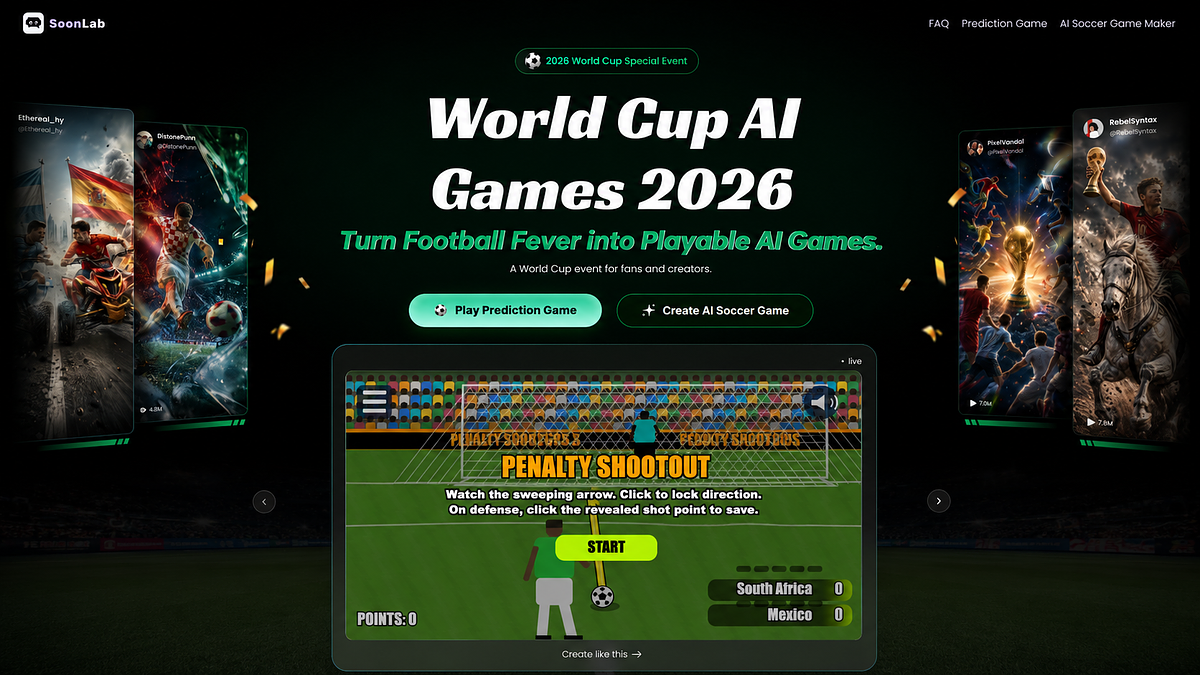
From Sidelines to Studios: AI Turns World Cup Fans Into Game Creators
NEW YORK, NY – June 16, 2026 – While millions of eyes are glued to the FIFA World Cup, a significant disruption is quietly unfolding off the pitch. A new Hong Kong-based startup, SoonLab, has launched an AI-native platform that promises to turn any fan with an idea into a game developer. By simply describing a concept in natural language, users can now generate their own playable soccer games, moving from the spectator stands to the creator's studio.
This public debut is timed to harness the global passion of the tournament, offering a new way to engage with the beautiful game. The company's mission, as it enters a burgeoning market for generative AI tools, is to dismantle the technical barriers that have long made game development an exclusive domain.
"The World Cup inspires creativity far beyond the matches themselves," said Jack, the SoonLab’s PM, in a statement accompanying the launch. "Fans imagine alternative outcomes, dream up new challenges, and create their own football experiences every day. We believe those ideas should be playable."
The Democratization of Development
For decades, the path from a game concept to a playable product was a gauntlet of coding, complex software, and specialized expertise. SoonLab aims to pave over that path with artificial intelligence. The platform’s workflow is designed for radical simplicity: a user types a prompt—anything from a penalty shootout challenge to a team management simulator—and the AI takes over.
Behind the scenes, the process is more sophisticated than a simple prompt-to-game conversion. Conversational AI agents first engage the user, helping to refine the concept and automatically generating a Game Design Document (GDD). This crucial step, which mimics the initial phase of professional development, allows the user to confirm and modify the game's logic, rules, and objectives before a single line of code is generated. The platform then utilizes advanced models like GPT 5.5 and Claude Opus 4.7 to build the game, which is typically delivered as a browser-based experience in under ten minutes.
Early adopters have lauded the platform’s accessibility. One reviewer called it "the best AI game creating platform as of now," praising its ability to rapidly produce functional prototypes. However, the technology is still in its infancy. Others note that it "still needs quite a bit of refinement," expressing a desire for "more control, better clarity in execution and tighter results." While the AI excels at generating game logic and even interesting power-ups, some find its artistic output can be inconsistent without highly specific instructions. For those who wish to dig deeper, the platform offers a 'Game Config' button for modifying assets and variables, and paid tiers provide the ability to download the full HTML code for local development.
Riding the World Cup Wave
The decision to anchor its launch to the World Cup is a savvy strategic play. SoonLab is not merely releasing a tool; it is curating an event. The World Cup community campaign cleverly transforms passive viewership into active participation. By predicting match outcomes, fans can earn free platform credits, which they can then spend to generate their own soccer-themed games.
This model creates a powerful flywheel of engagement. To earn more prediction chances, users are incentivized to share their creations on social media, turning them into brand evangelists and driving organic growth. The most compelling user-generated games are featured within the SoonLab community, fostering a sense of discovery and shared creation. It’s a strategy that taps directly into a broader shift in media consumption, particularly in sports, where audiences increasingly seek interactive and participatory experiences.
By positioning itself at the intersection of AI, gaming, and global sports culture, SoonLab is doing more than just acquiring users. It is testing a powerful thesis: that the future of fan engagement lies in empowering audiences to co-create the culture they are passionate about. The campaign serves as a large-scale, real-world experiment on how generative AI can transform a global cultural moment into a creative playground.
A New Contender in a Crowded Field
SoonLab enters a market that is both promising and fiercely competitive. The appetite for tools that simplify creation is immense, with industry reports indicating that over half of all game studios already use AI to improve efficiency. The AI game development sector is projected for exponential growth, attracting a host of competitors.
The landscape includes other direct AI game generators like Rosebud AI, as well as established game engines such as Unity and Unreal Engine, which are steadily integrating their own AI-powered features like Unity Muse. Platforms like Roblox have long offered simplified development tools, but their new AI assistants primarily focus on helping users write code within the existing ecosystem.
SoonLab's differentiation lies in its ambitious goal of generating a complete "first playable version" directly from a prompt. Where other tools might generate code snippets or art assets, this platform aims to deliver a cohesive, interactive experience from the outset. It follows a "Human-in-the-Loop" design philosophy, positioning the AI not as an autonomous creator, but as an incredibly fast and capable assistant with the user acting as the director. This collaborative approach may be the key to navigating the creative limitations of current AI, keeping human ingenuity at the center of the process.
The Business of Imagination
Ultimately, SoonLab is betting on a future where the value is in the accessibility of the tools, not the gatekeeping of the skills. The company's business model reflects this, operating on a freemium, points-based system. A free plan allows anyone to experiment, while paid subscription tiers—ranging from a $19.99 basic plan to a $49.99 pro bundle—offer more "creator points," access to more powerful AI models, and the ability to download source code.
This model effectively monetizes the act of creation itself, with the cost of generating a game tied to its complexity. It's a direct appeal to the growing population of hobbyists, educators, marketers, and aspiring developers who have ideas but lack the means to realize them. The promise is not just to create games, but to do so at the speed of thought, enabling rapid prototyping and experimentation that was previously unimaginable.
The company’s vision is to make "Game Developer" a title accessible to everyone, fundamentally shifting the industry from one of "gatekept development" to one of "universal expression." While the technology is still evolving, the launch of platforms like SoonLab suggests that the tools to build new worlds may soon be in the hands of anyone with a story to tell.