
- 2 million visitors across Europe before London debut
- 16 immersive installations including a pink ball pit and upside-down apartment
- AI-powered DreamBand for personalized visitor experiences
Experts would likely conclude that 'House of Dreamers' represents a significant evolution in experiential marketing, blending art, technology, and motivational psychology to create a uniquely personalized attraction that stands out in London's competitive immersive entertainment landscape.
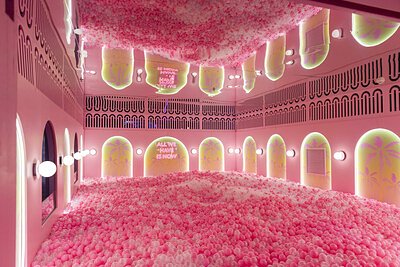
Dreamscapes by Design: AI and Ambition Fuel London's Newest Spectacle
LONDON, UK – June 04, 2026 – The modern experience economy, a landscape I've tracked from luxury travel to high-end real estate, has a new heavyweight contender. A meticulously designed phenomenon that has captivated millions across Europe is setting its sights on London, and it arrives not just as entertainment, but as a statement on aspiration itself. 'House of Dreamers,' an immersive exhibition by Italian design duo Elena and Giulia Sella, is preparing to open at Immerse LDN on June 26th, and its model reveals much about the shifting desires of the modern consumer.
At first glance, the concept is a vibrant, photogenic playground. Sixteen experiential installations, including an iconic pink ball pit and a fully upside-down apartment, promise a visual feast. But to dismiss this as merely another 'Instagram museum' would be to miss the sophisticated engine running beneath the surface. This is a calculated fusion of art, technology, and motivational psychology, engineered for an era that demands more than passive consumption.
A Proven European Blueprint
Before landing at the Excel Waterfront, House of Dreamers became a cultural touchstone in Milan, Madrid, Rome, and Paris. The press release cites an impressive two million visitors, a figure that gains credibility when viewed through the lens of the Sella sisters' broader success. Through their agency Postology, the Politecnico di Milano graduates have launched a series of hit concepts like 'Museum of Dreamers' and 'Space Dreamers,' collectively drawing crowds well into the seven figures. They have perfected a formula that blends whimsical aesthetics with an undercurrent of empowerment.
Each installation is explicitly tied to a motivational message. 'CHANGE PERSPECTIVE' invites visitors into an inverted apartment, a literal prompt to see the world differently. 'NEVER GIVE UP' provides a space to physically punch through obstacles, gamifying resilience. 'DO WHAT YOU LOVE' is a spectacular heart-shaped tunnel reinforcing the virtue of passion. This is not subtle subtext; it is the core product. The exhibition's stated ambition is to "re-educate people to the culture of dreams," a mission that feels perfectly timed for a post-pandemic world grappling with burnout and a collective reassessment of life's priorities.
The Technology of Dreams: AI-Powered Personalization
What truly sets the London debut apart, and what places it firmly on my beat, is the integration of new technology. For its UK run, the experience will be augmented by the 'DreamBand,' a wearable AI device designed to personalize each visit. This moves the needle from a static, one-size-fits-all attraction to a dynamic, responsive environment.
While specifics on the technology are forthcoming, its application aligns with the most transformative trends in experiential marketing. We are moving beyond simple interactivity into an era of hyper-personalization. This wearable likely tracks a visitor's journey, dwell times, and interactions, using that data to subtly alter the experience in real-time. Imagine lighting shifting to match a crowd's energy, soundscapes adapting to a visitor's path, or personalized digital souvenirs being generated based on which installations resonated most. No two experiences will be alike because no two visitors are alike.
This is the next frontier of exclusivity. It's not about barring entry, but about creating an experience so unique to the individual that it feels like a private commission. For the Sella sisters, it's a powerful tool to deepen their message, ensuring the 'dream' each visitor engages with is fundamentally their own. For the industry, it's a case study in how AI is no longer just an analytical tool but a creative partner in architecting human experience.
Navigating London's Crowded Immersive Landscape
The challenge, of course, is the sheer density of London's cultural scene. The city is a global hub for immersive entertainment, with world-class offerings from the high-art digital tapestries of Frameless to the revolutionary tech-nostalgia of ABBA Voyage and the free-to-access spectacle of Outernet London. To succeed here requires more than just a novel concept; it requires a distinct and compelling value proposition.
House of Dreamers arrives with a three-pronged advantage. First, its proven European success de-risks the venture and provides a ready-made marketing narrative. Second, the AI-powered DreamBand offers a technological edge and a hook for a tech-savvy audience. But most importantly, its unique positioning as a temple to self-actualization carves out a powerful niche. It sits at the intersection of entertainment, wellness, and personal development—a potent combination for consumers who increasingly seek purpose in their leisure time.
By choosing Immerse LDN at the Excel, with its superb transport links via the Elizabeth Line and DLR, the organizers are also demonstrating a keen understanding of the logistical demands of a mass-market attraction. As it prepares to open its doors, House of Dreamers is betting that in a city saturated with experiences, the most compelling journey is the one that leads inward.