
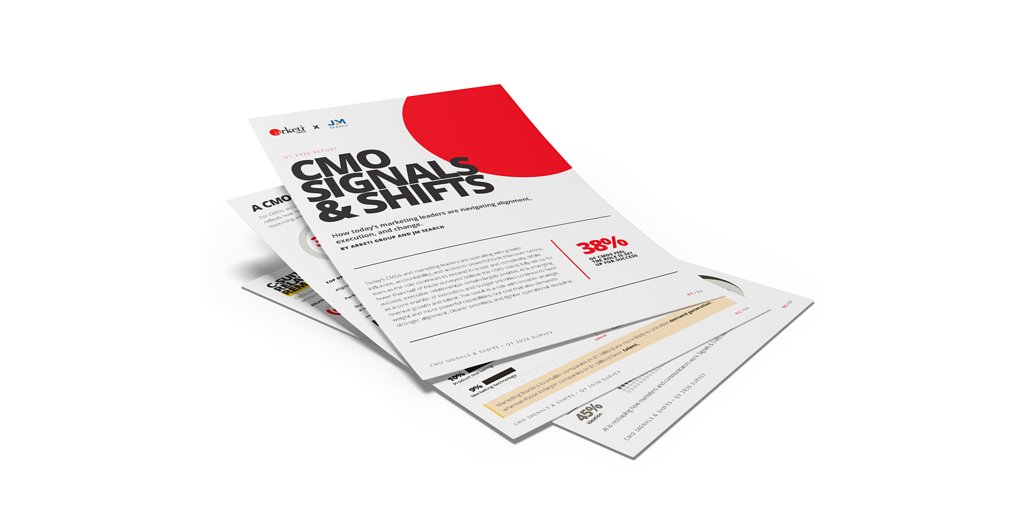
- Only 38% of active CMOs believe their role is structured for success.
- 79% of CMOs are moderately or very reliant on AI to achieve their 2026 objectives.
- 56% of CMOs have no interest in becoming a CEO.
Experts conclude that while CMOs have expanded influence and AI adoption, structural misalignment and lack of organizational support hinder their ability to succeed in their evolving roles.
CMO Paradox: More Power, More AI, But Success Remains Elusive
ATLANTA, GA – May 04, 2026 – Chief marketing officers are wielding more influence, leading digital transformation with artificial intelligence, and enjoying stronger C-suite relationships than ever before. Yet, a new report reveals a stark paradox: a significant majority feel their roles are fundamentally not set up for success.
According to the CMO Signals & Shifts: Q1 2026 Report released by B2B agency Arketi Group and executive search firm JM Search, only 38 percent of active CMOs believe the role is structured to succeed. This finding highlights a critical disconnect between the expanding responsibilities of modern marketing leaders and the organizational support they receive.
The Widening Gap Between Responsibility and Enablement
The modern CMO is no longer just a brand steward. The role has expanded to encompass revenue generation, talent development, and company-wide transformation, placing marketing at the epicentre of business growth. However, this increased accountability is not always matched by the necessary structural support or strategic alignment.
“CMOs today carry unprecedented responsibility across revenue, brand and transformation,” said Mike Neumeier, CEO of Arketi Group, in the report's release. The research underscores this point, revealing that 67 percent of marketing leaders cite alignment with the CEO and the broader C-suite as the single most important driver of their success. Without it, even the most skilled CMO can struggle to make an impact.
This challenge is not isolated. Broader industry analysis from firms like Gartner and Deloitte consistently points to mounting pressure on CMOs to deliver measurable ROI amidst tight budgets and economic uncertainty. The Arketi and JM Search findings crystallize this pressure into a clear sentiment of structural inadequacy, suggesting that for 62 percent of marketing leaders, the job's design itself is a primary obstacle.
This sentiment persists even as CMOs take a highly pragmatic approach to their resources. When faced with a hypothetical 20 percent budget cut, 45 percent of respondents said they would protect revenue marketing and demand generation above all else. Conversely, with a 20 percent budget increase, their top priority remains the same, with 32 percent choosing to double down on revenue-focused initiatives, followed by talent investment at 16 percent.
AI Becomes the Engine, But Who’s Driving?
One area where CMOs are unequivocally leaning in is artificial intelligence. The report shows that AI has moved swiftly from a tool for experimentation to essential marketing infrastructure. Adoption is now universal among survey respondents, with a striking 79 percent stating they are moderately or very reliant on AI to achieve their 2026 objectives.
The primary applications of this technology are focused on efficiency and scale. Content creation leads the way, with 80 percent of marketing leaders using AI for this purpose. It is followed by research (57 percent), and a tie between analytics/reporting and ideation (both at 45 percent). This widespread integration confirms what other industry analyses have suggested: AI is becoming the new operating system for marketing departments, automating routine tasks to free up teams for more strategic work.
However, access to tools is only the first step. The true competitive advantage lies in execution and strategic integration. “With nearly eight in 10 CMOs already reliant on AI, the real differentiator is how well organizations support leaders in operationalizing these tools at scale,” noted Scott May, a Principal at JM Search and a former CMO.
This points back to the central paradox of the report. While CMOs are rapidly adopting powerful new technologies to drive growth, their ability to maximize the return on these investments may be capped by the same structural and alignment issues that leave them feeling ill-equipped for success.
The C-Suite Disconnect: All Aboard, But Few Want to Captain
Despite feeling that their roles are structurally challenged, CMOs report overwhelmingly positive relationships with their executive peers. The survey found that relationship strength is highest with the Chief Financial Officer (84 percent reporting good or very good relationships), followed closely by the CIO/CISO (82 percent), CHRO (81 percent), and Chief Revenue Officer (80 percent). The crucial relationship with the CEO also remains strong, with 77 percent of CMOs describing it as good or very good.
This high level of collaboration and camaraderie makes the report's next finding particularly surprising: most CMOs have no desire to take the helm. A majority of marketing leaders—56 percent—say they have no interest in becoming a CEO. Furthermore, only 36 percent feel they are ready to assume the chief executive role, and just 40 percent believe more CMOs will make that leap in the next two years.
This reluctance to pursue the top job challenges the traditional narrative of C-suite ambition. “The data shows many CMOs are focused on impact, not necessarily chasing the next title,” said Katie Droke, a Principal at JM Search. This suggests a shift in executive motivation, where the complexity and cross-functional nature of the modern CMO position—acting as a "growth architect"—is seen as a destination in itself, rather than a stepping stone.
The findings prompt a deeper consideration for how companies develop their leadership pipelines. "Seeing how Marketing consistently sits at the center of growth and transformation, that data should prompt companies to consider the ways marketing leaders are supported and developed as overall go-to-market and revenue leaders,” Droke added.
A Disciplined Approach to Budgets and Purpose
The pragmatic mindset of today's CMO extends beyond budgets and into the complex arena of social issues. The report indicates that marketing leaders are taking a disciplined, credibility-first approach to purpose-led marketing. An overwhelming 70 percent of respondents believe companies must be able to speak credibly based on demonstrated actions before taking a public stance on an issue.
Similarly, 69 percent agree that organizations should only speak out when there is a clear business or values-based reason to do so. Employee pressure alone is not seen as a sufficient catalyst, with fewer than half of executives believing it justifies public engagement. This measured stance reflects a sophisticated understanding of brand risk and the importance of authenticity in an era of heightened public scrutiny.
This blend of strategic pragmatism, technological adoption, and a focus on measurable impact paints a picture of a highly evolved and resilient leader. Despite the structural frustrations, the core appeal of the marketing discipline remains incredibly strong.
“One final data point worth pausing on: when asked whether they would choose marketing again if they were starting over, 85 percent of respondents said yes,” Neumeier highlighted. This powerful affirmation suggests that while the path may be challenging and the role imperfectly designed, the opportunity to drive growth and shape brands continues to make marketing a compelling and rewarding career.