
- 500 applicants from 7 countries participated in the AI BACKLOT initiative.
- 4 original short films (Lightcone, N.I. (Neng Gong Zhi Ren), Tri-Head, Bicycle Kids) produced in just one month.
- World's first Industry Observation Report on AI-Film Hybrid Creation released, providing a detailed playbook on human-AI collaboration.
Experts would likely conclude that China's AI BACKLOT initiative successfully demonstrates a practical, collaborative model for integrating AI into filmmaking, offering a transparent and data-driven approach that contrasts with the adversarial stance seen in Hollywood.
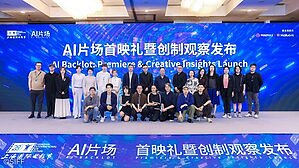
China's AI Film Gambit: Shanghai's BACKLOT Moves From Theory to Practice
SHANGHAI, June 19, 2026 – While Hollywood grapples with the existential anxieties and hard-won contractual lines drawn around artificial intelligence, the 28th Shanghai International Film Festival (SIFF) is running a different kind of script. Here, AI is not a specter haunting the writers' room but a credited collaborator on the call sheet. The festival's pioneering "AI BACKLOT" initiative, co-launched with Shanghai-based AI powerhouse Hailuo AI (MiniMax), has moved the global conversation from the theoretical to the tangible, transforming the technology from an abstract threat into an on-site production tool.
For years, the discourse around AI in cinema has been bifurcated, oscillating between utopian promises of democratized creativity and dystopian fears of mass job displacement. SIFF’s project cuts through the noise with a clear-eyed objective: to create a practical, reference-worthy industry sample. By embedding AI directly into professional filmmaking workflows, the initiative is building a real-world case study on how human artists and intelligent systems can co-create, addressing challenges from character development and emotional storytelling to budgeting and visual effects.
From Black Box to Glass Box: A New Production Model
The core of the AI BACKLOT is its hands-on, transparent methodology. Following a global open call that drew nearly 500 applicants from seven countries, the program established four cross-border creative teams. The structure was novel: a "1+1 model" pairing professional filmmakers with AIGC (AI-Generated Content) creators. Their mandate was to produce four original short films—Lightcone, N.I. (Neng Gong Zhi Ren), Tri-Head, and Bicycle Kids—in just one month.
What sets this experiment apart is its radical transparency. At the project's premiere on June 14, SIFF didn't just screen the final films. It laid the entire creative process bare. Attendees were given an unprecedented look under the hood, with access to original footage, storyboards, the specific AI prompts used, and a trail of revision materials. This open-source approach to creative decision-making effectively turns the opaque "black box" of AI generation into a "glass box" for industry-wide observation.
This effort was formalized with the release of the world's first Industry Observation Report on AI-Film Hybrid Creation. Compiled by the Communication University of China, the report documents the full production cycle, providing the global film industry with a detailed playbook on the successes and friction points of human-AI collaboration. It’s a move designed to replace speculation with data, offering a granular view of how AI was leveraged not as an auteur, but as a tireless assistant, a visual sketch artist, and a rapid prototyping engine.
The Engine Room: Hailuo AI and China's Tech Ambition
Powering this initiative is Hailuo AI, the advanced multimodal AI from Shanghai-based MiniMax. Founded in 2022, MiniMax has rapidly emerged as a key player in China's race for AI dominance, specializing in models that can understand and generate language, speech, music, and video. The technology deployed in AI BACKLOT is not a generic tool but a sophisticated suite of specialized models. These include variants like a "Director" model capable of interpreting natural language commands for cinematic camera movements and a "Subject" model designed to maintain crucial character consistency across multiple generated shots—a notorious challenge in AI video.
The project is more than a technological showcase; it's a strategic play, backed by supportive digital cultural policies from the Lingang New Area, Shanghai's hub for high-tech development. By fostering this initiative, China is not just participating in the global AI conversation but actively seeking to shape it. The ambition is to establish a practical "Chinese case study" that can influence emerging international workflows and standards. The significant global interest in the project suggests this strategy is already finding a receptive audience, positioning Shanghai as a pragmatic and innovative hub for the future of filmmaking.
Navigating the Human-Machine Frontier
Throughout the project, organizers and participants have been careful to frame AI's role precisely. "Digital technology empowers rather than replaces human creativity," stated Tong Ying, Deputy Director of the Shanghai International Film & TV Festival Center. This sentiment was echoed by celebrated veteran director Huang Jianxin, the initiator of AI BACKLOT, who stressed that while the technology iterates at a breathtaking pace, "human storytelling, aesthetic judgment and creative vision remain at the heart of film art."
This collaborative framing provides a stark contrast to the more adversarial climate that culminated in the landmark 2023 Hollywood strikes. The Writers Guild of America (WGA) and Screen Actors Guild (SAG-AFTRA) fought for, and won, critical protections that establish consent, compensation, and creative authority as non-negotiable pillars when dealing with AI. Their agreements were born from a deep-seated fear that studios would use AI to undermine labor, devalue writers, and create digital replicas of actors without fair remuneration.
AI BACKLOT offers a different model for engagement. Instead of negotiating boundaries from opposing sides, it creates a sandbox where both sides can define the relationship together. The "1+1" teams are a direct answer to the replacement question, hardwiring human-machine partnership into the production DNA. While the Hollywood unions built necessary firewalls, SIFF is building a shared workshop. Both approaches seek to preserve human value, but they represent fundamentally different strategies for navigating a technology that is simultaneously a tool, a collaborator, and a potential disruptor.
The two-day public exhibition at the Shanghai Film Art Center further broadened the dialogue, inviting visitors to explore open sets, test AI tools, and participate in live production challenges. This public-facing component underscores the project’s mission to demystify AI and engage the wider community in the future of storytelling. By meticulously documenting its process and openly sharing its findings, the AI BACKLOT initiative is contributing a vital, practical chapter to a global story that is still being written, proving that the most compelling role for AI in cinema may be as a supporting actor, not the star.