
- Global data center electricity demand is projected to more than double by 2030.
- AI could soon consume as much energy as the entire nation of Japan.
- AI facilities may see power demand fluctuate by hundreds of megawatts in seconds, with ramp rates exceeding 1,000 megawatts per second.
Experts agree that the AI revolution's success hinges on developing specialized energy infrastructure capable of handling its unprecedented power demands and volatility.
AI's Power Paradox: The Race to Build a New Class of Energy Grid
NEW YORK, NY – June 18, 2026 – Behind the ethereal intelligence of AI lies a brute-force physical reality: an insatiable and volatile hunger for electricity. As the world rushes to deploy generative AI, a silent crisis is brewing not in algorithms, but in the aging electrical grids and data center architectures struggling to power them. Global data center electricity demand is on track to more than double by 2030, with some projections suggesting AI alone could soon consume as much energy as the entire nation of Japan. This isn't just a matter of more power; it's about a fundamentally different kind of power demand that our current infrastructure was never designed to handle.
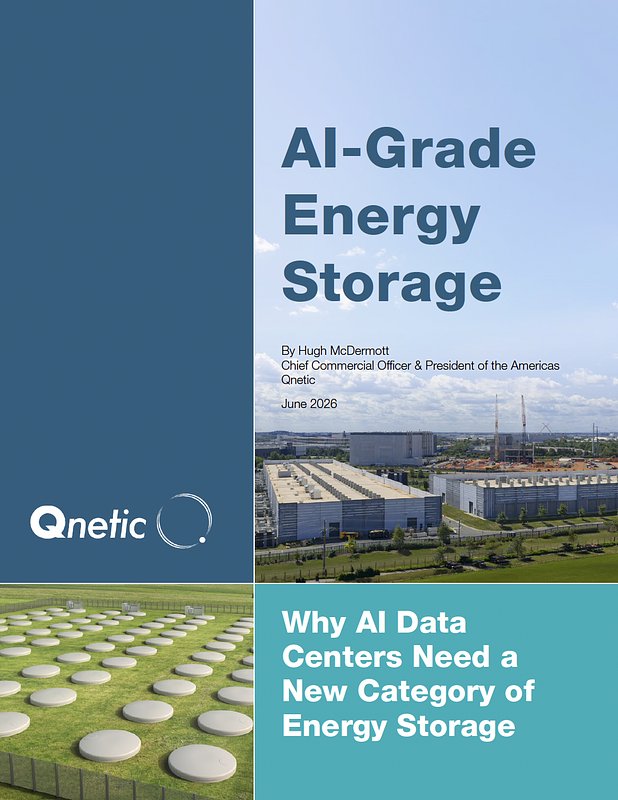
This explosive growth is forcing a radical rethinking of energy infrastructure. The problem has become so acute that one energy technology firm, Qnetic, has moved to define an entirely new category of infrastructure: “AI-Grade Energy Storage.” It’s a bold marketing stroke, but one that pinpoints a genuine and critical vulnerability in the AI revolution. The future of AI may not be limited by silicon or software, but by the stark reality of watts and amperes.
A New Profile of Power and Pain
For decades, the energy industry has focused on predictable loads and the slow, rolling waves of renewable energy integration. AI shatters this paradigm. Unlike traditional computing workloads, training and inference clusters create wildly dynamic power profiles. A gigawatt-scale AI facility can see its power demand fluctuate by hundreds of megawatts in mere seconds, with ramp rates potentially exceeding 1,000 megawatts per second. To the grid, this looks less like a stable customer and more like a massive, unpredictable lightning storm.
“Over the last decade, energy storage has been largely optimized around renewable integration and peak shifting,” said Michael Pratt, CEO of Qnetic, in a recent announcement. “AI changes the problem.”
This volatility sends shockwaves through the entire power system. It stresses transformers, risks tripping breakers, and introduces harmonic distortions that can degrade power quality for everyone connected to the grid. Data center operators, who live and die by uptime, are finding that their traditional Uninterruptible Power Supply (UPS) systems, typically reliant on lithium-ion batteries, are ill-suited for this new reality. These batteries degrade quickly under the frequent, high-intensity cycling demanded by AI workloads and carry the ever-present risk of thermal runaway—a catastrophic failure mode unacceptable when co-located with billions of dollars in computing hardware.
Industry analysts confirm the urgency. Reports from Gartner project that AI-optimized servers will surpass conventional servers in energy use by 2027. In high-density states like Virginia, data centers could account for nearly half of all electricity demand within the decade. As one independent grid consultant noted, “We are asking a 20th-century grid to support a 22nd-century computing load. The physics simply doesn’t work without a new intermediary layer.”
The 'AI-Grade' Specification
Into this gap steps Qnetic, attempting to define the very terms of the solution. The company’s new white paper outlines six core characteristics for what it calls AI-grade energy storage:
- Millisecond response times to instantly absorb and dispatch power.
- Unlimited daily cycling without performance degradation.
- High-power output to handle extreme, volatile computing demand.
- Multi-hour energy storage capacity for sustained support.
- Operational lifetimes measured in decades, matching the lifespan of the data center itself.
- Intrinsic safety with no risk of thermal runaway.
This specification is a direct challenge to the two dominant categories of energy storage: traditional battery energy storage systems (BESS) and long-duration energy storage (LDES). While lithium-ion BESS offers fast response, its lifespan withers under the relentless cycling AI requires. Conversely, many LDES technologies are designed for storing energy for many hours or days but lack the instantaneous power and rapid cycling capabilities.
By defining this new category, Qnetic is not just promoting its own technology; it's attempting to set the standard for a burgeoning, multi-billion-dollar market. The signal is clear: the off-the-shelf solutions that powered the cloud computing boom will not suffice for the AI era.
A Mechanical Solution for a Digital Problem
To meet its own stringent definition, Qnetic is championing a technology that is both surprisingly old and radically new: the flywheel. Once a workhorse of the industrial revolution, modern flywheel energy storage systems bear little resemblance to their iron ancestors. Qnetic’s systems use advanced composite rotors, weighing several tons, levitating on magnetic bearings and spinning at tremendous speeds inside a vacuum-sealed container. They store energy mechanically, in the form of rotational inertia, rather than chemically.
This mechanical nature is the key to their suitability for AI. A flywheel can charge and discharge almost instantaneously, thousands of times a day, with no degradation in capacity. Its 30-year operating life aligns with the infrastructure it supports, and because it contains no chemical reactants, the risk of thermal runaway is eliminated. Qnetic claims its technology can provide multi-hour storage, a significant leap from traditional flywheels, which were typically used for short-burst power quality applications.
These systems act as a critical buffer, absorbing the violent power swings from AI servers and presenting a smooth, predictable load to the grid. For data centers incorporating on-site renewables or microgrids, they become the essential heart of the system, balancing generation with the chaotic demands of computation.
The Race Beyond Batteries
Qnetic may be vocal, but it is not alone in recognizing this opportunity. The race to power AI is igniting innovation across the energy storage sector. Competitors are coming forward with a range of solutions, each vying to become the new standard.
Some firms are developing advanced battery chemistries, such as ultra-fast charging batteries that promise microsecond response times and thousands of cycles with minimal degradation. Others are promoting hybrid systems that pair the instant response of supercapacitors with the sustained energy of batteries, attempting to get the best of both worlds. Even advanced lead and new sodium-ion batteries are being re-engineered and positioned as safer, more resilient alternatives to lithium-ion for the data center environment.
This emerging competitive landscape underscores the scale of the challenge. The ultimate winner may not be a single technology, but a new design philosophy where data centers are built as integrated energy systems. The question is no longer just how to cool the chips, but how to create a power architecture that is as resilient, responsive, and intelligent as the AI it enables.
“The question is no longer how much energy we can store,” Pratt concluded. “It's how quickly, safely and reliably we can deliver that energy in an environment where demand changes constantly. That's the challenge AI-grade energy storage is designed to solve.”