
- $500 million: BCG's largest commitment to AI-driven social impact by 2030.
- 20 organizations: Initial cohort receiving AI tools and training from Anthropic.
- $1.5 billion: Total invested in social impact projects by BCG since 2020.
Experts would likely conclude that BCG's $500 million AI initiative is a strategic investment to position itself as a leader in applied AI, blending philanthropy with long-term commercial advantage.
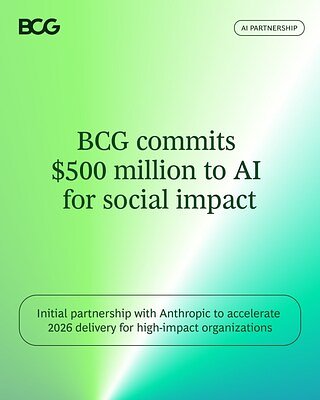
BCG's $500M AI Gambit: Charity, Strategy, or the Future of Consulting?
BOSTON, MA – June 4, 2026 – In a world awash with corporate pledges, Boston Consulting Group has just dropped a figure that demands attention: $500 million. Earmarked for AI-driven social impact by 2030, the announcement is, on its surface, a landmark commitment to philanthropy. But to view this move through the lens of charity alone is to miss the far more compelling strategic undercurrent. This isn't just about giving back; it's about defining the next phase of influence, capability, and the very role of a consulting giant in an era of intelligent machines.
The headline commitment, BCG’s largest of its kind, aims to close the resource gap for non-profits and philanthropies working on society's most intractable problems. The initial salvo involves a partnership with the AI safety and research company Anthropic, which will provide its frontier models and hands-on training to a cohort of 20 social impact organizations this year. As BCG's CEO, Christoph Schweizer, stated, "AI is the defining strategic priority of our time." That statement is the key to unlocking the true nature of this half-billion-dollar gambit.
Deconstructing the Half-Billion-Dollar Play
To understand the significance of the $500 million, one must look at it not as an expense, but as an investment in strategic capital. This is not a sudden pivot to altruism. It’s an acceleration of a long-term strategy, building on the more than $1.5 billion the firm has already invested in social impact projects since 2020. This is a calculated move by a firm that trades in strategic clarity to cement its position at the apex of the most significant technological transformation since the internet.
In the current market, every CEO is being pushed to articulate an AI strategy, yet many struggle to demonstrate real value from their investments. Research shows a widening chasm between companies that are "AI-future built" and those that are not. BCG is positioning itself as the bridge across that divide. By committing to solve complex, messy, and under-resourced social problems—from poverty reduction to public health—the firm is creating the ultimate case study. If they can successfully deploy AI to improve learning outcomes for millions or optimize resource delivery in humanitarian crises, the logic follows, imagine what they can do for a Fortune 500 company’s supply chain.
The social sector, in this context, becomes a high-stakes proving ground for BCG's "applied AI" methodology. It’s a place to refine its frameworks, test its "10-20-70" approach—which dedicates 70% of effort to people and processes—and build a deep reservoir of expertise that is directly transferable to its commercial clients. This initiative is as much about building a portfolio of success as it is about building a better world.
The Frontier of Philanthropy
The partnership with Anthropic marks a critical evolution in corporate social impact. The era of simply writing a check is over. The new currency of influence is capability transfer. For the 20 organizations in the initial cohort, and the many to follow, this means access to tools that have been, until now, the exclusive domain of big tech and deep-pocketed corporations.
"The organizations taking on the world's hardest problems should have access to powerful AI, along with a team that can help them actually put it to work," said Elizabeth Kelly, Anthropic’s Head of Beneficial Deployments. Her statement underscores the shift from passive funding to active enablement. Providing "Claude credits and hands-on training" means equipping non-profits with the means to create their own solutions—to analyze field data in real-time, to personalize educational content for at-risk students, or to model climate impact on vulnerable communities with unprecedented granularity.
BCG's role is to be the human intelligence layer, the strategic translators who can help a local health clinic or an international education non-profit articulate a problem in a way that AI can solve. The firm has a track record here, having previously developed a Social Impact Assessment with SOS Children's Villages to empirically measure the social and economic benefits of their work. Applying that same rigor to AI deployment will be crucial. The promise of delivering "breakthrough impact" will be tested against measurable outcomes, turning abstract goals into quantifiable progress and providing a blueprint for how frontier technology can serve humanity's most pressing needs.
The Consultant's New Mandate
This initiative also reflects a profound shift within the consulting industry itself. As AI begins to automate routine data analysis and report generation, the traditional value proposition of firms like McKinsey, Accenture, and Deloitte is being reshaped. Leadership now requires more than just sharp analysis; it demands demonstrated mastery over the implementation of complex, transformative technologies.
BCG's commitment is a clear signal that it sees its future role not just as an advisor to business, but as a systems integrator for society. By tackling global challenges, the firm elevates its brand, attracts a generation of talent that demands purpose-driven work, and develops an intimate understanding of the societal risks and rewards of AI. This expertise becomes an invaluable asset for its corporate clients, who are increasingly judged on their environmental, social, and governance (ESG) performance and their own social license to operate.
While competitors also have "AI for Good" programs, BCG's move to dedicate a specific, substantial fund of $500 million is a strategic escalation. It creates a gravitational center for talent, partners, and clients, positioning the firm as the definitive leader in applying AI to systemic problems. This is how a consulting firm, in the age of AI, builds a moat—not with proprietary data, but with proprietary experience in solving the hardest problems.
Navigating the Ethical Minefield
Of course, deploying powerful AI into sensitive social sectors is fraught with peril. The risks of perpetuating bias, violating privacy, and creating opaque systems that affect people's lives are immense. A failed AI project in a commercial setting might result in lost revenue; in a social impact context, it could mean denying aid to those who need it most or entrenching systemic inequality.
BCG is not naive to these dangers. The firm’s emphasis on “responsible AI” and its internal code of conduct are its stated safeguards. The strategy of weaving together human and technological capabilities, with a heavy emphasis on people and process, is a deliberate attempt to keep humans in the loop and mitigate the unintended consequences of automation. Accountability, according to the firm's leadership, rests on building trust by minimizing harm from the outset.
The success of this $500 million commitment will therefore not be measured solely by the breakthroughs it enables, but also by the disasters it avoids. The true test will be whether BCG and its partners can navigate this ethical minefield with the same strategic acumen they apply to a corporate merger, ensuring that the transformative power of AI is harnessed not just for impact, but for equitable and just impact. In doing so, the firm is making a bet that the most valuable commodity of the next decade won't be data or algorithms, but the trust required to wield them wisely.