
AskNicely's AI Aims to End Dashboards with Conversational CX Insights
- $30 billion: The global customer experience management market is projected to surpass this value by 2028.
- 5 points: The AI can identify drops in Net Promoter Score (NPS) and provide actionable insights.
- Seconds: The tool aims to reduce the time between insight and execution from days to mere seconds.
Experts would likely conclude that AskNicely's conversational AI represents a significant evolution in CX management, offering a more accessible and immediate way to interpret customer feedback and drive actionable insights, though it faces competition in an increasingly AI-driven market.
AskNicely's AI Challenges Dashboards with Conversational CX
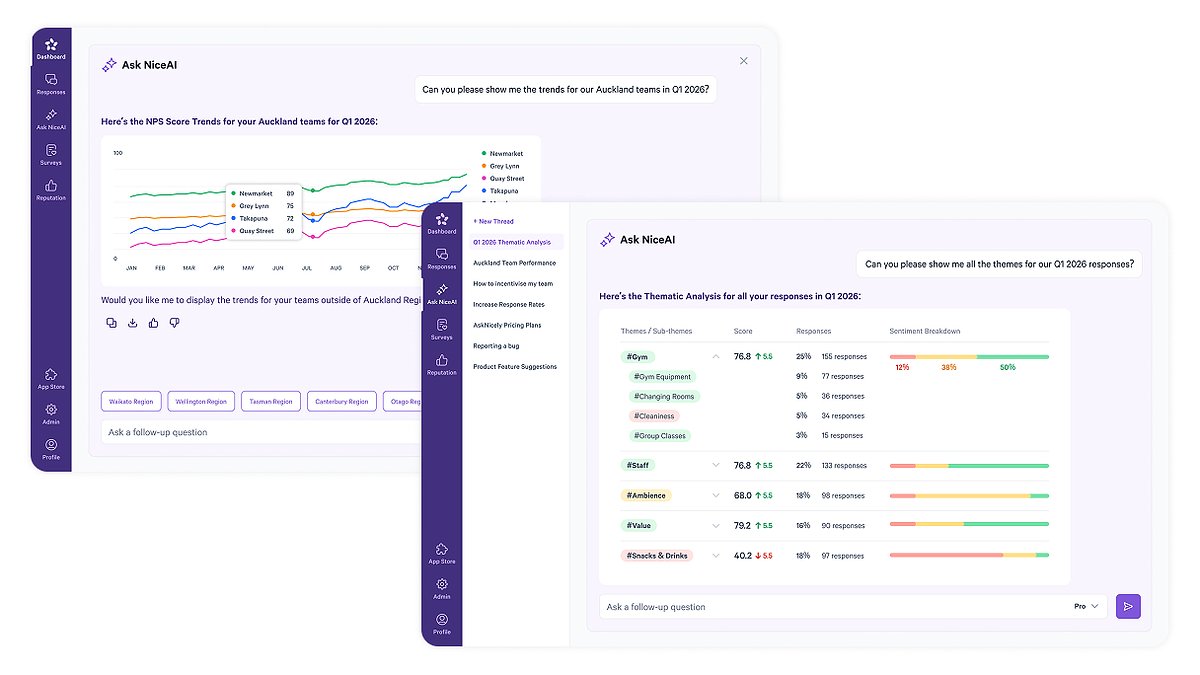
PORTLAND, OR – March 30, 2026 – AskNicely, a provider of customer experience (CX) software, today launched Ask NiceAI, a conversational artificial intelligence tool designed to fundamentally change how service businesses interpret and act on customer feedback. The new interface, built into the company's existing platform, allows managers to ask plain-language questions about their customer data and receive cited answers, visualizations, and immediate action plans, aiming to close the gap between insight and execution from days to mere seconds.
This move positions the company in a direct challenge to the traditional paradigm of CX management, which has long relied on complex dashboards, spreadsheets, and teams of analysts to decipher customer sentiment.
From Data Overload to Directed Action
For years, multi-location businesses like franchise groups, retail chains, and healthcare networks have faced a paradox: they are drowning in customer feedback yet struggle to act on it effectively. Data from surveys, review sites, and frontline reports often resides in disconnected silos, making it difficult to spot trends or identify root causes for issues like a sudden drop in a region's Net Promoter Score (NPS).
Ask NiceAI aims to cut through this complexity. Instead of requiring a manager to filter data or build a custom report, the system allows them to simply ask, “Why did NPS drop in Denver this month?” or “What are our top-performing locations praised for?” The AI then queries the underlying data—spanning surveys, reviews, and location-specific information—and synthesizes a response. This includes not just the "what" (e.g., "NPS dropped by 5 points") but the "why" ("Customers are citing long wait times") and the "what now" (a suggested action plan to address the issue).
“Most companies don’t have a feedback problem, they have a response problem,” said Tony Ward, CEO of AskNicely, in the announcement. “We built Ask NiceAI so that insight doesn’t sit in dashboards waiting to be interpreted. Managers can ask a question in the middle of a meeting and leave with a clear, data-backed plan. That fundamentally changes the speed of decision-making.”
This conversational approach represents a significant evolution from the static reports that have dominated the industry. It’s a move toward a more dynamic, accessible form of business intelligence, tailored for operators who need answers on the fly, not at the end of a quarterly review cycle.
Navigating a Crowded and AI-Driven Market
The launch comes as the global customer experience management market, projected to surpass $30 billion by 2028, becomes increasingly saturated with AI-powered solutions. Industry giants like Qualtrics and Medallia have invested heavily in AI, offering sophisticated text analytics, predictive modeling, and automated insights. Qualtrics Assist for CX, for instance, also provides suggested actions, while competitors like Birdeye offer "location-aware AI" for multi-location brands.
However, AskNicely is betting that the simplicity and immediacy of a conversational interface will be its key differentiator. While other platforms provide powerful analytical tools, they can still present a learning curve or require specialized knowledge to operate effectively. Ask NiceAI’s core value proposition is its accessibility. By allowing any manager, from the C-suite to the frontline, to become their own data analyst through simple conversation, the company hopes to democratize access to actionable insights.
This strategy targets a specific pain point for distributed enterprises: the enablement of local managers. An area manager overseeing dozens of stores doesn't have time to become a data scientist. Providing them with a tool that can instantly tell them which locations are struggling with cleanliness and which are excelling at customer service empowers them to intervene with targeted coaching and resources. This focus on operationalizing feedback at the local level is crucial for maintaining brand consistency and driving growth across a wide network. By turning feedback into a coaching tool, the platform directly connects CX metrics to performance management and, ultimately, revenue.
Empowering the Human Element in an AI World
The rise of AI in the workplace often sparks conversations about job displacement, but AskNicely’s framing of Ask NiceAI focuses on augmentation. The goal is not to replace managers but to equip them with a powerful assistant, automating the tedious work of data aggregation and analysis so they can focus on higher-value tasks: leading their teams, coaching employees, and implementing creative solutions to customer problems.
This aligns with a broader industry trend viewing AI as a collaborative partner. As AI handles routine and analytical tasks with superhuman speed and accuracy, the human role shifts toward areas requiring empathy, strategic thinking, and complex problem-solving. A manager who is no longer bogged down in spreadsheets can spend more time on the floor observing operations or personally following up with a detractor to resolve an issue.
The future of CX management is shaping up to be a blend of artificial intelligence and human intuition. Tools like Ask NiceAI provide the data-driven foundation, identifying patterns and suggesting pathways. It is then up to the human leaders to apply context, motivate their teams, and execute those plans in a way that feels authentic to their brand and genuinely serves their customers. By closing the loop between customer voice, data analysis, and frontline action, the platform promises to make customer experience less of a reactive, problem-solving discipline and more of a proactive, growth-driving engine for the entire organization.