
- 60% of data breaches involve a third-party or supply chain component
- Security teams rate their confidence in learning about a critical vendor breach within 24 hours at 5 out of 10
- Vendor Monitoring updates refresh as often as every 30 minutes
Experts agree that continuous, actionable monitoring of vendor risks is critical to modern security strategies, as traditional point-in-time assessments fail to address dynamic threats.
Whistic Links Breach Alerts to Action, Targeting Vendor Risk Blind Spots
SALT LAKE CITY, UT – March 24, 2026 – In a move aimed at closing critical security gaps in the digital supply chain, AI-first third-party risk management (TPRM) provider Whistic today announced the launch of Vendor Monitoring. The new capability, built natively within its platform, directly confronts a pervasive industry problem: security teams finding out about breaches at their third-party vendors far too late.
Unveiled during the RSA Conference 2026, the feature provides continuous breach detection, including monitoring of dark web activity, and integrates alerts directly into existing vendor risk management workflows. This approach is designed to transform passive alerts into immediate, trackable action, a significant departure from the siloed tools that often leave security teams scrambling to connect the dots after an incident.
The Widening Cracks in Supply Chain Security
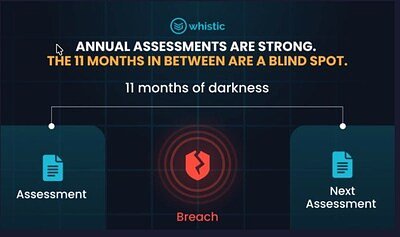
Enterprise security leaders have long struggled with the limitations of traditional, point-in-time vendor assessments. While annual questionnaires and compliance checks provide a necessary baseline, they create a static snapshot in a threat landscape that is anything but. The period between these assessments represents a significant blind spot where a vendor’s security posture can degrade or be compromised without warning.
This gap is more than theoretical. Industry data consistently shows that a majority of data breaches, with some estimates exceeding 60%, involve a third-party or supply chain component. The consequences of these breaches are severe, leading to financial loss, reputational damage, and regulatory penalties. Yet, confidence in preventing them remains alarmingly low. According to interviews Whistic conducted with its own customers, security teams rated their confidence in learning about a critical vendor breach within 24 hours at a stark 5 out of 10.
This uncertainty is compounded by the operational realities facing most governance, risk, and compliance (GRC) teams. Often understaffed and overwhelmed by a sprawling ecosystem of hundreds or even thousands of vendors, these teams are buried in manual processes. The result is a reactive posture, where risk management becomes an exercise in compliance rather than a proactive defense strategy. The need for a more dynamic, continuous approach has become a critical business imperative.
From Alert Fatigue to Actionable Intelligence
Whistic’s Vendor Monitoring aims to address this challenge by fundamentally changing how breach information is delivered and managed. Unlike standalone monitoring products that populate a separate dashboard with a firehose of alerts, Whistic embeds breach notifications directly within the corresponding vendor’s profile. This is the same centralized location where a security team already manages assessment history, risk scoring, and compliance documentation.
The system continuously scans for breach-related activity, with updates refreshing as often as every 30 minutes. When a potential incident is detected—such as compromised credentials appearing on a dark web forum—an alert is generated directly within the platform. From that single notification, a GRC analyst can immediately initiate a response. This could involve updating the vendor's risk status, creating a tracked issue for remediation, or launching a targeted, ad hoc security assessment to investigate the specific exposure, all without switching applications.
“Assessments alone are insufficient, and monitoring without action is not acceptable,” said Juan Rodriguez, CEO of Whistic, in the company's announcement. “The gap between knowing about a risk and actually doing something about it is where vendor risk programs break down. Vendor Monitoring is built to close that gap, not by adding another alert dashboard, but by turning breach signals into immediate, trackable workflows inside the platform teams already use every day.”
This integrated workflow is the core of the value proposition, designed to combat the “alert fatigue” that plagues security operations and ensure that critical signals don't get lost in the noise.
A Strategic Play in a Crowded Market
The TPRM market is a competitive space, with numerous vendors like Bitsight, Panorays, and UpGuard also offering forms of continuous monitoring and cyber risk ratings. Many of these competitors provide robust external scanning and dark web intelligence. However, Whistic is betting that its deep, native integration of alerts into a comprehensive management workflow will be a key differentiator.
The sentiment from security professionals seems to validate this strategy. The desire to consolidate tools and streamline operations is a powerful driver of purchasing decisions. As one Sr. InfoSec and GRC Analyst at a LegalTech company noted in a statement shared by Whistic, “Continuous monitoring is a must-have for our program. I want it integrated into Whistic rather than using multiple software solutions. That's what my leadership expects.”
This demand for a unified platform reflects a broader maturation of the TPRM discipline. Organizations are moving beyond simply collecting data toward building efficient, end-to-end programs that cover the entire vendor lifecycle, from onboarding and assessment to ongoing monitoring and incident response.
The Rise of the Agentic TPRM System
The launch of Vendor Monitoring is not an isolated event but a strategic piece of Whistic’s larger platform vision: creating an end-to-end “agentic” TPRM system. The company defines this as a system that leverages AI to automate assessment, continuously monitor for risk, and drive intelligent responses within a single, cohesive workflow.
This new feature arrives on the heels of another recent AI-powered release, Trust Center Capture, which uses AI agents to automatically find and ingest security documentation directly from vendors’ public-facing trust centers. Together, these capabilities illustrate a clear roadmap toward reducing the manual toil that has long defined third-party risk management.
The industry is increasingly looking to artificial intelligence to bring scale and efficiency to security programs. AI can parse vast amounts of unstructured data, identify patterns invisible to human analysts, and automate the repetitive tasks that consume valuable time. By integrating these AI-driven features, Whistic aims to free up security professionals to focus on strategic risk mitigation rather than administrative data collection and correlation.
Vendor Monitoring is now available to existing Whistic customers as a paid add-on and can also be purchased as a standalone product for organizations not yet on the platform. With this launch, the company is making a clear statement that the future of vendor risk management is not just about seeing risk, but about acting on it with speed and precision.