
- Mission Duration: 14 days on the ISS
- Launch Window: No earlier than summer 2027
- Company Investment: Over $1 billion in private capital
Experts view this mission as a critical step in transitioning from government-led to commercial space stations, with Vast positioning itself as a key player in the post-ISS era.
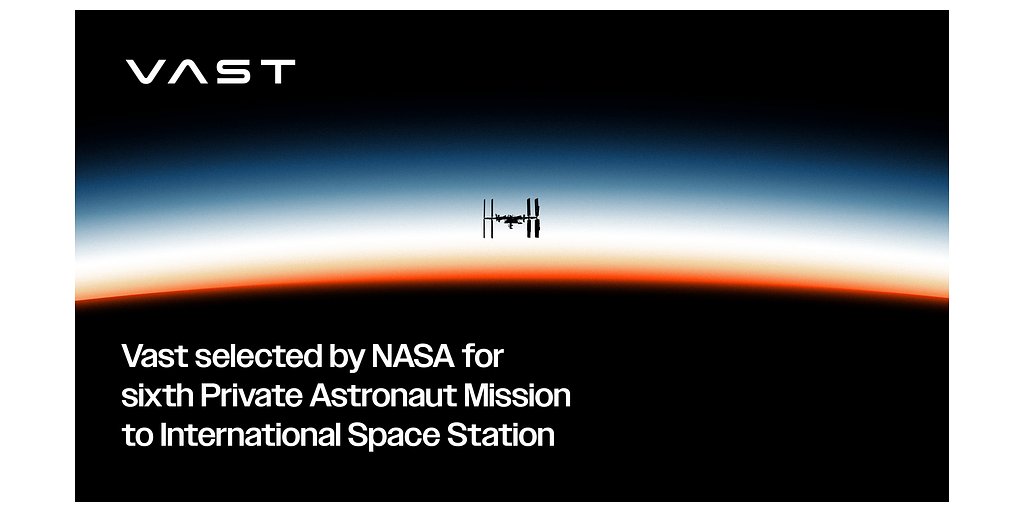
Vast Secures NASA Deal for ISS Mission, Eyes Commercial Orbit
LONG BEACH, CA – February 17, 2026 – In a significant move that underscores the accelerating shift toward a commercialized Low Earth Orbit (LEO), space station developer Vast has been selected by NASA for the sixth private astronaut mission to the International Space Station (ISS). The mission, targeted for a launch no earlier than summer 2027, marks a major milestone for the company as it prepares to become a key player in the post-ISS era.
This will be Vast's first private astronaut mission conducted in partnership with NASA. A crew, yet to be named, will launch from Florida aboard a SpaceX Falcon 9 rocket and Dragon spacecraft, spending up to 14 days on the orbiting laboratory. For Vast, the mission is far more than a single trip to space; it is a critical pathfinder mission designed to build operational expertise in human spaceflight.
“Vast is honored to have been selected by NASA for the sixth private astronaut mission to the International Space Station,” said Max Haot, CEO of Vast, in a statement. “Leveraging the remaining life of the International Space Station with science and research-led commercial crewed missions is a critical part of the transition to commercial space stations and fully unlocking the orbital economy.”
A Stepping Stone to a Commercial Cosmos
The mission serves as an invaluable dress rehearsal. The insights gained from crew selection, training, mission planning, and execution will directly inform the development and operation of Vast's own ambitious projects: a series of private space stations. The company is positioning itself not merely as a visitor to the ISS but as its eventual successor.
The experience will be directly applied to Vast’s proposed Haven-2, a multi-module, continuously crewed station designed to take the baton from the ISS. By managing a complex mission to NASA's station, Vast strengthens its credibility and demonstrates its capabilities, bolstering its candidacy to deliver a commercial replacement for the venerable outpost. This hands-on experience is something that cannot be replicated in simulations, providing a real-world test of the procedures and infrastructure needed to keep humans safe and productive in orbit.
The High-Stakes Race to Replace the ISS
Vast's mission comes at a pivotal moment for space exploration. With NASA planning to deorbit the International Space Station in 2031, the agency is actively cultivating a commercial marketplace in LEO to avoid a gap in American human presence. NASA's strategy is to become just one of many customers for services provided by private stations, a fundamental shift from its role as owner and operator of the ISS.
This strategy has ignited a new space race, with several companies vying to build the first commercially viable orbital destinations. The field is competitive:
- Axiom Space is widely seen as a front-runner, having already flown multiple private missions to the ISS. The company is building modules that will first attach to the ISS before separating to become a free-flying station.
- The Orbital Reef consortium, led by Blue Origin and Sierra Space, envisions a “mixed-use business park” in orbit, though public updates on its progress have been limited.
- Starlab, a venture from Voyager Space and Airbus, is also developing a station with NASA funding, planning an innovative single-launch deployment using SpaceX's Starship.
While a 2023 Government Accountability Office (GAO) report expressed skepticism that a commercial platform would be ready before 2030, citing funding and market challenges, NASA and its commercial partners remain optimistic. They argue that the competitive drive and streamlined commercial frameworks will accelerate development faster than traditional government programs.
Building Haven in Low Earth Orbit
Against this competitive backdrop, Vast is pursuing an aggressive, hardware-rich development path fueled by significant private capital. The company, founded by cryptocurrency pioneer Jed McCaleb, has over a billion dollars in private investment and a workforce of more than 1,000 employees at its Long Beach headquarters.
The first step in its plan is Haven-1, a single-module station now slated for launch no earlier than the first quarter of 2027. While smaller than its competitors' initial plans, Haven-1 is designed to be the world's first standalone commercial space station. In late 2025, the company successfully operated Haven Demo, an in-orbit testbed that validated core station technologies like propulsion and avionics. Manufacturing of Haven-1's flight-ready primary structure is underway, a testament to the company's rapid production pace.
This incremental approach—starting with the smaller Haven-1 before building the larger, modular Haven-2—is central to Vast's strategy. It allows the company to learn, iterate, and generate revenue sooner, all while building confidence for the larger-scale projects to come. The recent investment from In-Q-Tel, the venture capital arm of the CIA, further signals government interest in the company's capabilities.
Science and Commerce in Microgravity
The upcoming 14-day mission is not just about operational experience; it is fundamentally about demonstrating the scientific and commercial utility of LEO. Vast is planning a robust research portfolio with a focus on biology, biotechnology, physical sciences, and human health.
To facilitate this, Vast has a strategic agreement with the Center for the Advancement of Science in Space (CASIS), the organization that manages the ISS National Laboratory. This partnership will help curate a manifest of high-impact science that aligns with national priorities and has commercial potential.
Vast has an open call for research proposals for both its private astronaut mission and the future Haven-1 station. The company is soliciting ideas from academic, non-profit, and commercial entities, seeking experiments in fields ranging from protein crystallization for drug development to advanced materials and plant growth in space. This effort is crucial for building a sustainable business model, proving that there is a robust customer base for the services a private space station can offer, and ultimately unlocking a thriving economy beyond Earth.
Topics & Related
Artificial Intelligence
Automation
Machine Learning
Venture Capital
Software & SaaS
AI & Machine Learning
Private Placement
AI & Software Platforms
Related Company Pulse