
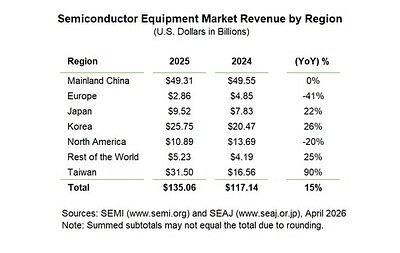
- $135.1 billion: Record global semiconductor equipment investment in 2025, up 15% from 2024.
- 79% of global spending: Asia (China, Taiwan, Korea) dominated equipment billings in 2025.
- 55% surge: Test equipment billings skyrocketed due to AI hardware complexity.
Experts agree that the AI-driven boom in semiconductor equipment investment reflects both the urgent demand for advanced chip manufacturing and a widening geographical divide, with Asia leading the expansion while Western markets lag.
AI Boom Fuels Record $135 Billion Global Chip Equipment Market
MILPITAS, CA – April 07, 2026 – The global semiconductor industry invested a record-breaking $135.1 billion in manufacturing equipment in 2025, a staggering 15% increase from the prior year, as the relentless demand for Artificial Intelligence capabilities triggered an unprecedented expansion of the world’s chip-making infrastructure. A new report from the global industry association SEMI confirms that the surge from 2024’s $117.1 billion was overwhelmingly driven by urgent investments in advanced logic, high-performance memory, and the complex architectures required to power the next generation of AI.
The findings, detailed in the Worldwide Semiconductor Equipment Market Statistics (WWSEMS) report, paint a clear picture of an industry in overdrive, retooling and expanding at a historic pace to build the foundational hardware for an AI-centric future. This massive capital outlay underscores the critical role of equipment manufacturers in enabling the technological leaps promised by AI, from data centers to edge devices.
"Record semiconductor equipment billings of $135 billion in 2025 underscore the scale and urgency of the industry's buildout as AI accelerates demand for leading-edge logic, advanced memory and high-bandwidth architectures," said Ajit Manocha, SEMI President and CEO, in a statement accompanying the report. "From wafer fab investments to the rapid rise of advanced packaging and test, the global ecosystem is expanding capacity and capability to support the next wave of innovation."
The AI Effect: From Wafer Processing to Final Test
Beyond the headline number, the data reveals how profoundly AI is reshaping every stage of chip production. The growth is not uniform; it is concentrated in the most technologically advanced and complex segments of the manufacturing process, which are essential for producing high-performance AI processors.
The front-end of the factory, where circuits are etched onto silicon wafers, saw robust growth. Sales of wafer processing equipment climbed 12%, while other front-end segments grew 13%. This investment is being channeled into cutting-edge tools needed for the latest process nodes. This includes advanced Extreme Ultraviolet (EUV) lithography systems, which are indispensable for creating the microscopic features of sub-2nm chips, and sophisticated etch and deposition tools required for new transistor structures like Gate-All-Around (GAA), a key technology for boosting performance in AI hardware.
However, the most dramatic growth occurred in the back-end, the final stages of manufacturing where chips are prepared for use. Billings for test equipment skyrocketed an astonishing 55% year-over-year. This surge is a direct consequence of the complexity of AI hardware. Components like High-Bandwidth Memory (HBM), which are critical for feeding data to powerful AI accelerators, consist of vertically stacked memory dies that demand far more intensive and sophisticated testing protocols than traditional memory chips. The performance and reliability of the final AI processor depend on this rigorous validation.
Similarly, assembly and packaging equipment sales jumped 21%. This reflects the industry's rapid adoption of advanced packaging techniques, such as 2.5D and 3D integration. These methods allow chipmakers to combine different types of chips—for instance, a logic processor and multiple HBM stacks—into a single, powerful package. This heterogeneous integration is a cornerstone of modern AI accelerator design, enabling faster communication between components and greater overall performance.
A Widening Global Divide in Chip Manufacturing
The 2025 spending data also highlights a dramatic and accelerating geographical shift in the world of semiconductor manufacturing. Investment is increasingly concentrated in Asia, which now represents a larger share of the global equipment market than ever before. Mainland China, Taiwan, and Korea collectively accounted for an unprecedented 79% of all equipment billings, up from 74% in 2024.
Taiwan was the standout growth story, with equipment spending rocketing 90% to a record $31.5 billion. This phenomenal expansion is directly tied to its central role in producing the world’s most advanced AI and High-Performance Computing (HPC) chips. As the home of foundry giants, the island is the epicenter of the capacity buildout for leading-edge logic.
Mainland China, despite a slight 0.5% dip, maintained its top position with nearly $49.3 billion in spending. Its continued high level of investment, largely focused on mature process nodes and select advanced capacity, reflects a sustained national strategy aimed at bolstering its domestic semiconductor industry and achieving greater self-sufficiency.
South Korea also saw strong growth, with spending increasing 26% to $25.8 billion. This was primarily fueled by its leadership in the memory market, particularly the massive investments required to scale up production of HBM and advanced DRAM to meet AI-driven demand.
In stark contrast, Western markets saw significant declines. Equipment spending in Europe fell 41% to just $2.9 billion, its second straight year of contraction amid weakness in its automotive and industrial sectors. North America experienced a 20% drop to $10.9 billion as spending moderated following a period of earlier capacity expansion. While government initiatives like the U.S. CHIPS Act and the EU Chips Act aim to reshore and bolster domestic manufacturing, the 2025 figures show that Asia's dominance in new equipment investment is currently widening, posing long-term strategic questions for global technology supply chains.
Building for Tomorrow Amid New Challenges
The momentum from 2025 shows no signs of slowing. Industry forecasts project that global fab equipment spending will continue its upward trajectory, potentially reaching $156 billion by 2027 as the industry builds out capacity for sub-2nm technologies and the next generation of AI infrastructure. This sustained cycle is driven by a fundamental shift from consumer-volume manufacturing to the infrastructure-grade precision required for data centers and advanced computing.
However, this rapid expansion is not without its challenges. While equipment availability has largely normalized, new bottlenecks are emerging further upstream in the supply chain. Industry analysts point to potential constraints in critical materials like industrial gases and chemical precursors, exposing new vulnerabilities. Furthermore, the industry faces a growing shortage of skilled engineers and subject matter experts capable of operating these increasingly complex facilities and technologies, a talent gap that could temper the pace of future growth.
Topics & Related
Semiconductors
Venture Capital
Software & SaaS
Artificial Intelligence
Machine Learning
Trade Wars & Tariffs
Generative AI
Automation
Revenue
Net Income
EBITDA
Gross Margin
Operating Margin
EPS
Cryptocurrency & Digital Assets
AI & Software Platforms
GPUs
CPUs
Related Company Pulse