
- 450,000 industrial robots deployed in China in 2025 vs. 30,000 in the U.S.
- 2.1 million manufacturing jobs projected to go unfilled in the U.S. by 2030
- 1/3 of U.S. workers fear AI will reduce job opportunities (Gallup poll, February 2026)
Experts agree that coordinated government-industry collaboration is critical to closing the U.S. manufacturing competitiveness gap through robotics adoption, though workforce transition challenges remain significant.
US Taps Robotics Industry to Forge New Industrial Future
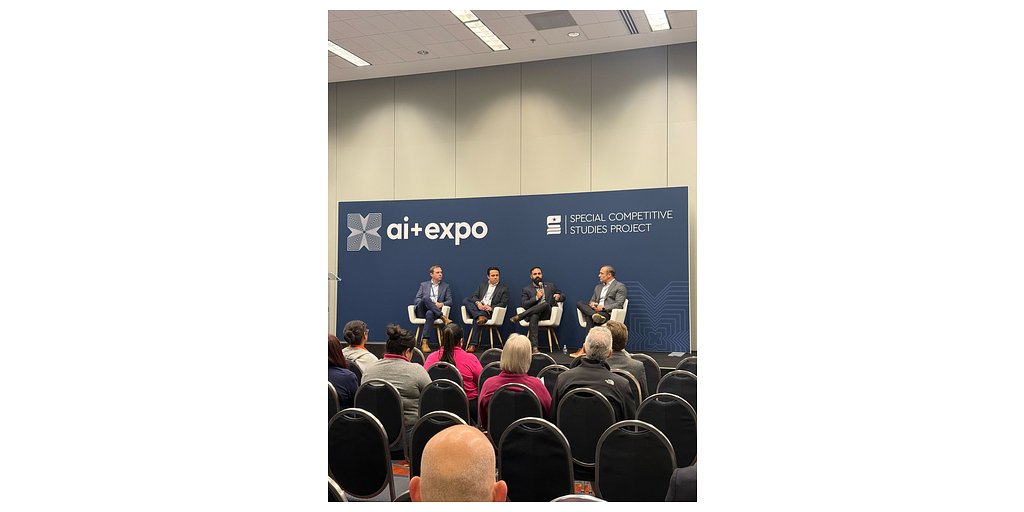
WASHINGTON, DC – May 11, 2026 – In an unprecedented move signaling a major shift in national industrial strategy, a coalition of America's leading robotics companies has launched at the direct request of the White House and key federal agencies. The group, named Robots for America (RFA), unveiled a unified policy platform on May 8th at the SCSP AI+ Expo, aiming to accelerate the deployment of automation across the nation's factories and close a widening manufacturing competitiveness gap.
This is not a typical industry lobby. The coalition's formation was prompted by officials from the Office of Science and Technology Policy, the Department of Commerce, the Small Business Administration, and the U.S. Senate, who called upon the private sector to devise a solution to America's industrial challenges. The launch marks a pivotal moment where government strategy and industry expertise converge to tackle issues of labor shortages, rising operational costs, and intense global competition.
A Coalition Born from a Government Mandate
For years, U.S. manufacturers have navigated the complex and costly landscape of automation largely on their own, a stark contrast to nations that have long implemented coordinated national strategies. The result has been a growing gap, with countries like China deploying 450,000 industrial robots last year compared to just 30,000 in the United States.
"The U.S. has every ingredient it needs to lead the next era of manufacturing,” said Saman Farid, CEO of robotics firm Formic and a founding member of Robots for America. “The companies, the technology, the facilities are all here. What has been missing is a coordinated policy framework that removes the real barriers standing between American manufacturers and the automation they need. That is what Robots for America exists to build.”
The coalition brings together companies at the forefront of "Physical AI," including Formic, Machina Labs, Standard Bots, Dexterity, and Path Robotics. Unlike legacy trade associations, RFA's membership consists of practitioners with direct, on-the-ground experience deploying advanced robotics in U.S. facilities today. This hands-on expertise is intended to form the bedrock of their policy recommendations, ensuring proposals are practical and impactful.
Leveling the Factory Floor for Small Business
A central focus of the RFA's mission is to support the small and mid-size manufacturers (SMEs) that form the backbone of the American supply chain. These firms have been hit hardest by the pressures of a shrinking labor pool—projected to leave 2.1 million manufacturing jobs unfilled by 2030—and the high barrier to entry for automation.
Historically, SMEs have lacked the large upfront capital to purchase robotic systems, the technical expertise to implement them effectively, and the political clout to influence policies that could ease their adoption. Robots for America aims to dismantle these barriers. The coalition's approach is reflected in its founding members; Formic, for instance, operates on a Robotics-as-a-Service (RaaS) model, allowing factories to pay for automation by the hour without massive capital expenditure. Similarly, Standard Bots focuses on making AI-powered robots more affordable and accessible. By advocating for policies that support such models, RFA hopes to democratize access to cutting-edge technology.
The Five-Point Plan for American Robotics Supremacy
RFA's core belief is that American leadership is won on the factory floor through widespread adoption, not in theoretical policy papers. To that end, the coalition introduced an initial five-point policy framework designed for near-term impact:
- Lowering Financial Risk: Proposing mechanisms to reduce the upfront investment burden for manufacturers, particularly when trialing new robotic systems.
- Modernizing the Tax Code: Advocating for changes in how automation is treated under tax law, potentially through revised depreciation schedules or incentives for robotics investments.
- Streamlining Regulations: Working to cut bureaucratic red tape and simplify the permitting and approval processes that can slow down technology deployment.
- Building the Workforce: Developing initiatives for training, upskilling, and reskilling the American labor force to operate and maintain advanced robotic systems.
- Enabling Autonomous Logistics: Pushing for policies that facilitate the integration of autonomous systems throughout the supply chain, from warehouses to delivery.
The urgency of this plan was palpable at the launch event. "It is time for the government to step into the supply chain and set requirements for what manufacturing looks like in 10 to 20 years,” stated Edward Mehr, Founder and CEO of Machina Labs. Echoing this sentiment, Nick Ayala, Director of Strategy and Operations at GrayMatter Robotics, added, “The days of being okay with missed deadlines are over.”
The Human Element: Navigating Workforce Fears and Transformation
While the push for automation promises increased productivity and competitiveness, it also casts a long shadow over the future of labor. The rapid deployment of AI and robotics raises significant concerns, particularly from labor organizations. The AFL-CIO has warned that without worker protections, AI could exacerbate economic inequality and undermine workers' rights. These fears are reflected in the broader public; a February 2026 Gallup poll found that one-third of U.S. workers fear AI will lead to fewer job opportunities.
Experts acknowledge these challenges. The Organisation for Economic Co-operation and Development (OECD) estimates that jobs at the highest risk of automation account for nearly 28% of employment across its member countries. The transition will require a monumental effort in workforce development. While RFA includes "building the workforce" as a key pillar of its platform, the scale of the challenge is immense. Society will need to grapple with significant dislocation as machines handle more repetitive tasks, pushing human workers toward roles that require complex problem-solving, creativity, and critical thinking.
The coalition's success may ultimately depend not just on its ability to influence policy in Washington, but on its capacity to help manage this complex human transition, ensuring that the new era of American manufacturing is one of shared prosperity, not just automated efficiency.