
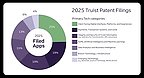
- 63% year-over-year surge in patent applications
- 48% of patents driven by Artificial Intelligence
- $35 million projected cost savings from reduced customer complaints
Experts would likely conclude that Truist's aggressive patenting and AI integration represent a strategic shift toward embedding intelligence across all banking operations, positioning the bank as a leader in financial innovation with a strong emphasis on practical, enterprise-wide AI applications.
Truist's Patent Surge: More Than AI, It’s a Bet on a New Banking DNA
CHARLOTTE, NC – June 11, 2026 – When a top 10 U.S. bank announces a 63% year-over-year surge in patent applications, the market takes notice. When nearly half of those patents are driven by Artificial Intelligence, it signals a strategic shift. But for Truist Financial Corporation, the numbers released today are more than just a flex of technological muscle; they're the blueprint of a fundamental rewiring of the bank's operational DNA.
The headline figures are impressive: a 63% jump in patent filings, a 58% rise in employee inventors, and a coveted spot on the IAM Patent 300® list of top corporate innovators. While these metrics validate Truist's aggressive R&D push, the real story lies behind the numbers—in the strategic fusion of advanced AI with a deeply ingrained culture of human-led innovation. This isn't just about bolting on new tech; it's about building a new kind of bank from the inside out.
The Story Behind the Numbers: A Strategic AI Blueprint
Peeling back the layers of Truist’s announcement reveals a calculated and comprehensive AI strategy. The 48% of filings involving AI are not abstract concepts; they are tangible tools aimed at solving real-world problems across the entire financial value chain. This is a clear move to embed intelligence into every client touchpoint and operational process.
One of the flagship innovations is 'Truist Client Pulse,' an in-house AI system that analyzes millions of client conversations from call centers, chatbots, and social media. This goes far beyond simple sentiment analysis. The patented technology is designed to turn unstructured feedback into actionable, traceable insights, allowing the bank to anticipate client needs and refine products in near real-time. The potential impact is significant, with internal projections suggesting cost savings upwards of $35 million from a projected 10% drop in customer complaints alone.
On the commercial side, the bank recently launched an AI-enabled receivables platform. This system leverages machine learning to automate cash application and reconciliation, a historically manual and error-prone process. By accelerating cash flow and reducing days sales outstanding (DSO) for its business clients, Truist is embedding its value directly into their core financial operations.
These high-profile projects are supported by a raft of other patents that form the connective tissue of an intelligent bank. Filings include systems for advanced transaction management using neural networks to spot anomalies, methods for classifying login attempts to bolster security, and dynamic user interfaces that personalize financial insights. It’s a multi-pronged approach that demonstrates a clear vision: use AI not as a feature, but as the foundational operating system for a digitally empowered, deeply relational bank. This aggressive patenting activity places Truist squarely in the tech arms race alongside giants like JPMorgan Chase and Bank of America, but with a distinct focus on practical, enterprise-wide integration.
The Human Algorithm: Fostering an Innovation Culture
Perhaps the most telling statistic in Truist’s announcement is not the 63% patent increase, but the 58% surge in "teammate participation." This figure reveals the engine behind the innovation boom: a deliberate strategy to democratize invention. While competitors may have larger R&D budgets, Truist is cultivating a different kind of asset—a workforce empowered to identify problems and co-create solutions.
This bottom-up approach is a powerful differentiator. The best ideas for improving processes or client experiences often come from employees on the front lines who deal with operational friction and customer feedback daily. By creating, as CIO Steve Hagerman puts it, "a faster, more direct path from teammate ideas to real impact," Truist is tapping into a distributed network of innovators. Hagerman’s vision of "combining human creativity with the power of AI" is not just a corporate platitude; it’s a functional operating model.
This cultural investment is arguably more difficult to replicate than any single piece of technology. It requires building systems for idea submission, providing legal and technical support for the patenting process, and fostering an environment where experimentation is encouraged. By turning tellers, loan officers, and operations managers into patent holders, the bank is creating a flywheel of continuous improvement. This human-centric approach ensures that the AI being developed is grounded in practical needs, not just theoretical possibilities, making the technology more likely to be adopted and to deliver meaningful outcomes.
Building Digital Trust: The Responsible AI Mandate
For all its potential, the rapid integration of AI into finance is fraught with peril. Issues of data privacy, algorithmic bias, and security are not just technical challenges; they are existential threats to the trust that underpins the entire banking system. Truist appears to be tackling this head-on, framing its innovation push within a strict mandate of responsible development.
"As AI becomes more deeply integrated into financial services, trust must be built into every solution from the start," stated Joy Middleton-Saulny, a Truist AI & Data Executive. This philosophy is backed by concrete action. Among its recent filings is a patent for a "Data privacy management system and method," indicating a commitment to engineering ethical governance directly into its technology stack. This proactive stance on building secure, transparent, and fair systems is critical for earning and maintaining client confidence in an era of automated financial decisions.
The bank’s commitment extends beyond its own walls. The Truist Foundation recently launched an "Inspire Awards Challenge" to support nonprofits helping the workforce adapt to the age of AI. This shows an awareness of the broader societal implications of the technology it is so aggressively pursuing. In the 2026 economic landscape, where customers and regulators are increasingly scrutinizing how their data is used, a demonstrable commitment to responsible AI is not just good ethics—it's a profound competitive advantage. By weaving together technological ambition with a framework of trust, Truist is signaling that the most valuable innovation in banking may not be a single algorithm, but the creation of a system that clients can confidently rely on.