
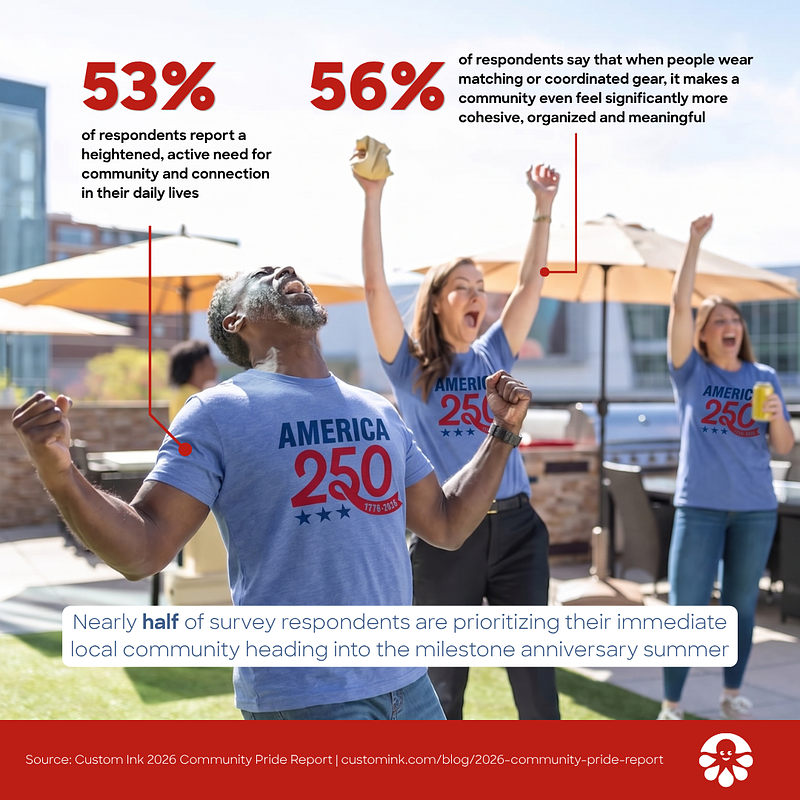
- 53% of Americans report a heightened need for community and connection in their daily lives.
- 56% of event attendees believe wearing matching or coordinated gear makes events feel more cohesive and meaningful.
- 48% of respondents plan to center their America250 celebrations on their immediate local community.
Experts would likely conclude that the 250th anniversary celebrations are fostering a significant shift toward localized, community-driven engagement, leveraging shared visual identity to strengthen social bonds and cohesion.
The Uniform of Unity: How Local Pride is Redefining America's 250th
FAIRFAX, VA – June 15, 2026
As the United States gears up to mark its 250th anniversary, a significant narrative is emerging—and it’s not unfolding on a grand, national stage. Instead, it’s being written on neighborhood streets, in community parks, and at local parades. A new national survey suggests that as Americans prepare to celebrate the semiquincentennial, their focus is turning inward and closer to home. This shift points not to a lack of national pride, but to a powerful, resurgent desire for tangible, real-world connection, with communities leveraging the milestone to strengthen the bonds right outside their front doors.
The Anatomy of a Localized Milestone
A recent report from Custom Ink, an online purveyor of custom apparel and an official licensed merchandise provider for the America250 celebration, provides quantifiable data on this grassroots phenomenon. Their "2026 Community Pride Report," based on a nationally representative survey of nearly 1,700 U.S. adults, reveals a population actively seeking deeper local ties. According to the findings, 53% of Americans report a heightened, active need for community and connection in their daily lives. Consequently, nearly half of the respondents are planning to center their America250 celebrations on their immediate local community.
This trend represents a fascinating decentralization of a national moment. Where past anniversaries might have been defined by singular, monumental events in major cities, the 2026 celebration appears to be a mosaic of countless small-scale gatherings. From block parties and neighborhood potlucks to town parades, Americans are re-channeling national commemoration into local action. It signals a move away from passive observation of a national spectacle and toward active participation in building a sense of place. This isn't just about patriotism; it's about 'place-iotism'—a profound investment in the health and cohesion of one's direct environment.
The 'Visual Psychology of Belonging' in Practice
Buried within the data is a particularly insightful finding that gets to the heart of how these groups are solidifying their newfound or renewed bonds. The survey found that 56% of event attendees believe that when people wear matching or coordinated gear, the event feels significantly more cohesive, organized,and meaningful. The company has termed this the "visual psychology of belonging," and it’s a concept that resonates deeply with the practical challenges of community building.
In essence, a simple, shared visual marker—a t-shirt with a neighborhood logo, a hat with a block name—acts as a powerful social lubricant. It serves as a low-stakes uniform, instantly signaling a shared identity and purpose. "A common symbol like a t-shirt creates an 'in-group' in the most positive sense of the term," explains a sociologist specializing in community dynamics. "It lowers the activation energy required for social interaction. It silently communicates, 'We're all here for the same reason,' transforming a collection of individuals into a visible, unified entity."
This visual alignment turns a group of nearby strangers into a supportive network. The matching shirts at the neighborhood cleanup or the coordinated hats at the town Founder's Day parade do more than just look organized; they provide a tangible, wearable invitation to connect. They become icebreakers, conversation starters, and, ultimately, lasting artifacts of a shared experience.
Beyond the T-Shirt: A Commercial Catalyst for Connection
While the trend is rooted in a genuine societal need, its execution has clear commercial dimensions. Custom Ink’s strategic position as an official America250 partner, coupled with this timely survey data, highlights a savvy business model that aligns product with a powerful social current. The company is not merely selling apparel; it is offering a turnkey solution for community identity.
From an analytical perspective, it is crucial to assess the data's source. The survey's sample size of 1,690 is robust and aligns with practices seen in established national polls. However, as a company-commissioned report, its findings naturally support the firm's core business. Yet, this alignment doesn't invalidate the trend itself. Rather, it demonstrates a successful case of a company identifying and serving a nascent market need. "This isn't just about selling shirts; it's about selling an identity package to communities that are hungry for it," noted one market analyst. "The return on investment is measured in both social cohesion and sales revenue."
The report also identified a "corporate track," which found that business leaders are applying the same logic to their organizations. The desire for cohesion and visual identity is just as potent in the workplace, where custom gear is used to bolster team spirit, streamline event organization, and foster a sense of belonging among employees. This indicates the trend’s applicability extends far beyond civic celebrations.
A New Blueprint for Community Resilience
Ultimately, the surge in hyper-local gatherings and the adoption of visual unity tools are more than just a passing phenomenon tied to a single holiday. It represents a practical, human-centered strategy for rebuilding social fabric in an era of digital isolation. It is a resilient model because it is distributed, low-cost, and driven by the very people it serves.
"We don't have the budget for a massive fireworks display, but we can organize a fantastic potluck and design a great t-shirt that everyone loves," shared a neighborhood association leader from suburban Chicago. "It's more achievable and, frankly, it feels more meaningful for the people who actually live on our street." Her experience encapsulates the broader trend: communities are discovering that the most powerful resources for connection are often the ones they can create themselves.
As the nation moves toward its 250th birthday, the most enduring legacy may not be the grand monuments or televised galas, but the countless small, intentional acts of community building taking place in towns and neighborhoods across the country. The matching t-shirt, in this context, becomes more than just merchandise; it is the uniform of a quiet but powerful movement to foster belonging from the ground up.