
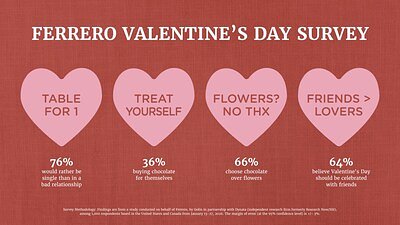
- 36% of North Americans plan to buy chocolate for themselves on Valentine's Day, second only to gifting a romantic partner (56%).
- 76% of respondents would rather be single on Valentine's Day than be in an unhealthy relationship.
- 66% of consumers prefer chocolate over flowers as a Valentine's Day gift.
Experts would likely conclude that Valentine's Day is evolving into a more inclusive celebration of self-love, friendship, and personal empowerment, with chocolate remaining the preferred gift across all relationship statuses.
The Self-entine’s Revolution: How Consumers Are Reclaiming Valentine’s Day
PARSIPPANY, NJ – February 05, 2026 – Valentine’s Day, the long-held bastion of romantic dinners and bouquets of roses, is undergoing a profound transformation. A growing movement, dubbed 'Self-entine's Day,' is seeing consumers redefine the holiday on their own terms, shifting the focus from partnered romance to a broader celebration of self-love, friendship, and personal indulgence. The top beneficiary of this cultural pivot? Chocolate.
A new survey from confectionery giant Ferrero North America reveals that more than one in three North Americans (36%) now plan to buy chocolate for themselves, a practice second only to gifting a romantic partner (56%). This signals a significant evolution in consumer behavior, where treating oneself is no longer an afterthought but a central part of the holiday itself.
A Holiday Reclaimed
The shift extends far beyond simply buying a personal box of truffles. It reflects a deeper change in societal values, prioritizing personal happiness and empowerment over traditional expectations. The Ferrero survey, which polled 1,000 consumers in the U.S. and Canada, found that a striking 76% of respondents would rather be single on Valentine's Day than be in an unhealthy relationship. This sentiment underpins the entire Self-entine's trend: a preference for authentic joy over performative romance.
This empowerment is evident in purchasing habits, with 73% of consumers stating they prefer to buy themselves what they truly want rather than waiting for someone else to get it for them. The celebration of love is also expanding to include platonic relationships. Nearly two-thirds (64%) of those surveyed believe Valentine's Day should be celebrated with friends, not just partners. This has given rise to 'Galentine's Day' celebrations, with 30% of respondents having already participated in such an event and 24% planning to gift chocolate to friends this year.
This trend is not isolated to Valentine's Day but is part of a larger self-care movement that has gained momentum in recent years. Market research shows a consistent rise in self-gifting across all holidays, particularly among younger demographics like Gen Z, who prioritize mental health and well-being. For many, purchasing a small luxury for oneself serves as a reward, a mood-booster, or a simple act of self-appreciation in a hectic world.
Chocolate’s Unbreakable Grip
While the reasons for celebrating may be changing, the preferred gift remains remarkably constant. Chocolate continues its reign as the undisputed king of Valentine's Day, decisively beating flowers in a head-to-head matchup, 66% to 34%. Its appeal is universal, with 82% of consumers agreeing that it can be the centerpiece of a great Valentine's Day, regardless of who the recipient is.
Part of chocolate's enduring power lies in its versatility. The survey notes that while elaborate dinners and experiences become more important in mature relationships, chocolate is considered the most appropriate gift for new and burgeoning romances. Yet, it also serves as the perfect self-gift or token of affection for a friend. As the survey found, 61% of people turn to chocolate as their go-to Valentine's treat, irrespective of their relationship status.
The holiday also brings out some candid confessions. A quarter of respondents admit to having 'rage-eaten' chocolate after a disappointing Valentine's Day, and 21% have bought themselves a gift and pretended it was from a secret admirer. Perhaps most tellingly, 60% confess to waiting for February 15th to buy discounted candy, proving that the love for chocolate often outlasts the love for the holiday itself.
Brands Pivot Beyond Romance
This evolving landscape presents both a challenge and an opportunity for brands, who must adapt their strategies to connect with a consumer base that is no longer exclusively focused on traditional romance. Ferrero appears to be embracing the shift wholeheartedly.
“Self-entine's Day is here, and it's changing how we think about Valentine's Day,” said Chad Stubbs, Chief Marketing Officer for Ferrero North America, in a statement. “It's no longer just for couples—it's for anyone who wants to celebrate, whether that means treating yourself, surprising a friend, or spoiling your partner. Chocolate is the one gift that transcends relationship status and embraces self-gifting without apology.”
This strategy is reflected in the company's diverse portfolio, which includes everything from premium Ferrero Rocher boxes to playful Kinder treats and classic Butterfinger hearts, catering to a wide array of tastes, intentions, and price points. Other retailers are following suit. Major stores have been observed using messaging like “Fit for the whole fam or just you,” explicitly targeting the self-gifting trend. The focus is shifting from generic romantic gestures to personalized and meaningful expressions of care, whether for a partner, a friend, or oneself.
The New Economics of February 14th
The most intriguing aspect of this trend is its economic impact. Despite 63% of North Americans admitting they think Valentine's Day is overrated, they still plan to open their wallets, with projected spending averaging $143.60 per person this year. This seeming contradiction is explained by the diversification of gifting.
While overall participation in the holiday in a traditional sense has seen a slight decline over the past decade, total spending has reached record highs. The growth is fueled not by more extravagant gifts for romantic partners, but by the expansion of the recipient list. Consumers are now budgeting for gifts for friends, family, coworkers, pets, and, of course, themselves.
This fragmentation of the Valentine's Day market means that while the average spend on a significant other remains the highest, the collective spending on these other categories is driving the overall market growth. It confirms that February 14th is successfully transitioning from a narrow, high-pressure holiday for couples into a broader, more inclusive occasion for celebrating all forms of love—starting with the self.
Topics & Related
CPG & FMCG
Related Company Pulse