
- 30 years of collaboration: ITRI's European presence has evolved from a technology scout to a strategic partner, with cooperation agreements in 14 European nations.
- 100+ joint R&D projects: Facilitated by ITRI's European offices, fostering deep reciprocal collaboration.
- €10 billion TSMC factory in Dresden: A visible sign of Taiwan-EU synergy in semiconductor production.
Experts would likely conclude that the 30-year Taiwan-Europe tech partnership exemplifies how long-term trust and strategic alignment can drive innovation, resilience, and shared progress in an increasingly fragmented global landscape.
The Quiet Bridge: How a 30-Year Taiwan-Europe Tech Pact Shapes Our Future
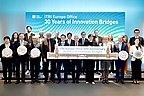
BERLIN, GERMANY – June 15, 2026 – While a celebratory technology forum in Berlin last week marked the 30th anniversary of the Industrial Technology Research Institute's (ITRI) European presence, the event signified something far more profound than a simple milestone. It was a testament to one of the most successful, yet understated, international collaborations of our time—a partnership that has quietly evolved from a simple scouting mission into a strategic engine shaping the technological future of two continents. This is the story of how tangible results, built on three decades of trust, are forging a resilient path for innovation in an increasingly fragmented world.
From Scout to Strategic Partner: A 30-Year Evolution
When ITRI, Taiwan's premier applied research institution, first established its Europe Office in Germany in 1996, its mission was clear: to act as a "technology scout," identifying European innovations that could bolster Taiwan's burgeoning industrial capabilities. Thirty years later, that role has been fundamentally transformed. The Berlin office, and now a newer one in London, serves as a pivotal hub for deep, reciprocal collaboration.
The numbers alone are impressive: cooperation agreements with partners in 14 European nations, support for Taiwanese participation in over 20 Horizon Europe programs, and the facilitation of nearly 100 joint R&D projects. But these metrics only hint at the true nature of the relationship. "The 30th anniversary of the ITRI Europe Office marks the deepening of Taiwan–Europe technology cooperation and reflects ITRI's transformation from a technology scout to a strategic partner for the European innovation ecosystem," said ITRI Chairman Tsung-Tsong Wu at the Berlin event. He stressed that such progress hinges not just on technical prowess, but on "mutual trust built over time."
Nowhere is this more evident than in ITRI's relationship with Germany's Fraunhofer-Gesellschaft, Europe's largest applied research organization. Their collaboration predates the European office itself, beginning in 1992. The recent renewal of another five-year MoU is not a mere formality; it's a strategic expansion building on joint efforts in healthcare and green energy to tackle new frontiers in AI and robotics. As Johann Feckl of Fraunhofer noted, "The long-standing partnership between Fraunhofer and ITRI is a strong example of how trust, continuity, and a shared commitment to the future create lasting impact."
Building Europe's Future, Together
This partnership is no longer just about bolstering Taiwan's industry; it's about co-developing solutions for Europe's most critical challenges. ITRI’s agenda is strategically aligned with the EU's core R&D priorities, positioning Taiwan as an indispensable contributor to Europe's technological sovereignty and industrial transformation.
In the push for digital innovation, the collaboration is paramount. As the EU strives to achieve the goals of its Chips Act—doubling its global semiconductor production share to 20% by 2030—it leans heavily on Taiwanese expertise. The €10 billion TSMC factory in Dresden is the most visible sign of this synergy, but the R&D collaboration runs deeper. ITRI is actively working on next-generation AI chiplets and silicon photonics, while its new partnership with the UK's National Physical Laboratory (NPL) aims to co-develop international semiconductor measurement standards, a critical step in lowering trade barriers and ensuring quality across a resilient supply chain.
The alignment extends to sustainability. With both Taiwan and the EU committed to achieving net-zero emissions by 2050, ITRI’s work in green energy and circular economy technologies provides a powerful engine for joint progress. This shared goal transforms the relationship from a simple economic exchange into a mission-driven alliance. From biomedicine, a key pillar of the Fraunhofer MoU, to space technology, where ITRI recently signed an agreement with the UK's ADS Group to build a bilateral space supply chain, the institute is woven into the fabric of Europe's most ambitious technological endeavors.
The Mechanics of Mutual Success
The success of this model lies in its ability to translate high-level strategy into tangible impact. It's a blueprint for turning applied research into real-world commercial and societal value. One government program, the A+ Corporate Innovation and R&D Enhancement program, has funneled over US$44 million in joint funding into 86 projects since 2014, generating an estimated US$132 million in industrial output—a threefold return on investment.
These are not abstract figures. They represent concrete innovations like the work of AiQ Smart Clothing, a Taiwanese firm that collaborated with Germany's RWTH Aachen University. Together, they developed a fully automated process for producing washable smart electronic textiles. This breakthrough, born from cross-continental expertise, has already attracted orders for over 300,000 units from nine international brands, demonstrating a direct path from lab to market.
This model thrives on combining complementary strengths. Europe brings deep expertise in fundamental science, human-centered design, and international standards, while Taiwan offers world-leading capabilities in ICT, rapid prototyping, and commercialization. By creating a framework for these strengths to converge, ITRI acts as a powerful catalyst, accelerating innovation cycles and ensuring that groundbreaking research doesn't languish in academic journals.
Charting the Next Frontier
Looking ahead, the partnership is set to expand its geographic and technological horizons. ITRI is actively cultivating deeper ties in France, the Netherlands, and across Central and Eastern Europe, recognizing new hubs of innovation. The focus is shifting towards the next wave of disruptive technologies. Drones, advanced robotics, and low Earth orbit (LEO) satellites are explicitly named as future growth areas for collaboration.
Just this month, ITRI was instrumental in facilitating an MoU between the European 6G Smart Networks and Services Industry Association (6G-IA) and the Taiwan 6G Industry Forum (6GIF), laying the groundwork for joint development of next-generation communications. This proactive engagement demonstrates a core tenet of the partnership: to not only participate in technological trends but to anticipate and shape them. In a world defined by geopolitical shifts and supply chain realignment, this 30-year bridge of trust and collaboration between Taiwan and Europe offers more than just economic benefits; it provides a model for shared progress and technological resilience.