
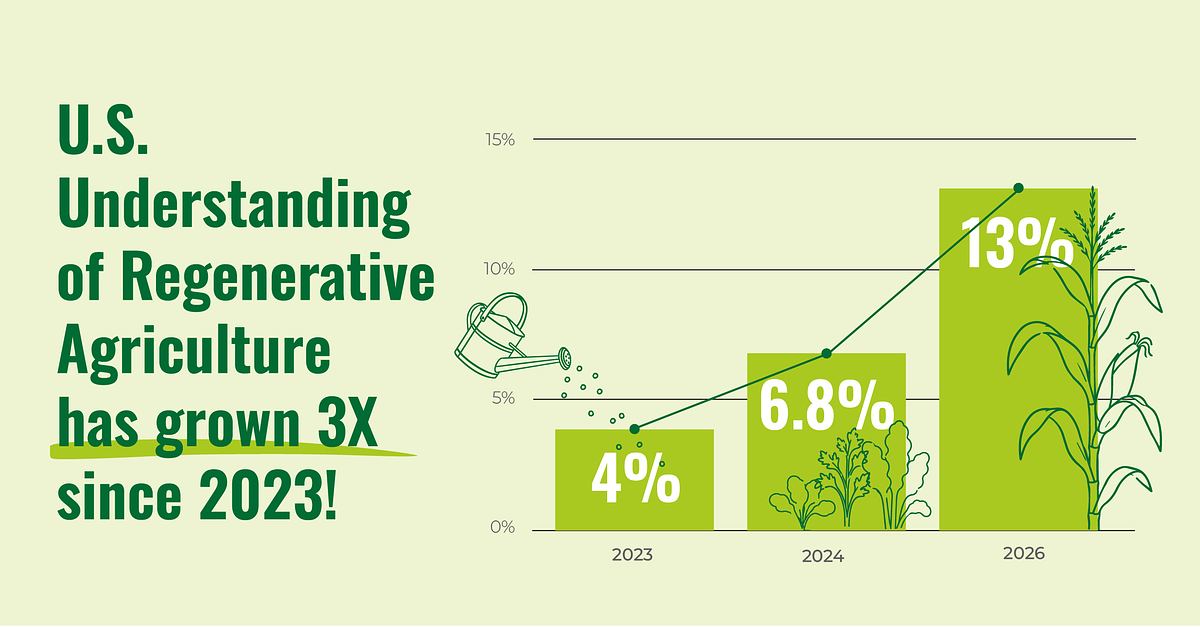
- Consumer understanding of regenerative agriculture has nearly doubled in one year, from 7% in 2025 to 13% in 2026.
- 72% of respondents prioritize personal health benefits over environmental concerns in food purchases.
- 66% of consumers report confusion over food labels, despite 60% actively reading them.
Experts agree that the shift toward regenerative farming is being driven by a growing consumer focus on personal health and nutritional benefits, rather than solely environmental concerns, creating both opportunities and challenges for the food industry.
The Me-First Revolution: Personal Health, Not Planet, Drives Farming's Future
LOS ANGELES, CA – June 18, 2026 – A significant shift is underway in the American food landscape, but its primary driver isn't what you might expect. While climate change and environmental sustainability have long dominated conversations around food systems, a new study reveals a more personal motivation is capturing the public’s attention: individual health.
A comprehensive national study released today by Kiss the Ground, a non-profit at the forefront of the regenerative agriculture movement, shows consumer understanding of the practice has nearly doubled in just one year, jumping from 7% in 2025 to 13% today. This rapid acceleration, part of a threefold increase since 2023, suggests the concept of farming in a way that restores soil health and biodiversity is moving from the fringe toward the mainstream. Yet, the data indicates this momentum isn't just about saving the planet; for most, it's about saving themselves.
The 'Me-First' Mindset in the Grocery Aisle
The report, based on a survey of over 2,000 U.S. adults conducted with Hierophant Insights and Strategy, uncovers a powerful "me-first" mindset driving purchasing decisions. For the third consecutive year, personal health benefits (cited by 72% of respondents) and food freshness (76%) overwhelmingly outranked broader environmental concerns (32%) as the top motivators for shoppers.
This trend highlights a growing consumer intuition: the health of the soil is directly linked to the nutritional quality of food, and ultimately, to personal well-being. Nearly a third of Americans (30%) now state that securing more nutrients is their top priority while grocery shopping. This "soil-to-health" connection is transforming from a niche talking point among nutritionists into a tangible market force.
"We are seeing a fundamental recalibration of value in the food industry," noted one independent market research analyst specializing in consumer trends. "For years, the sustainability narrative was abstract. Now, consumers are making a direct, personal connection: healthier soil means more nutrient-dense food, which means a healthier me. That's a proposition with immediate, tangible value."
This shift is further evidenced by a growing desire for transparency. The study found that over half of U.S. adults (52%) believe it is important to know their food's origin. This isn't just passive curiosity; it's translating into action. In the past year, 31% of Americans purchased food directly from a farmer, and a notable 18% engaged in conversations with producers about their farming practices.
Lost in the Label Labyrinth
Despite this surging interest, a significant hurdle threatens to stall the movement's progress: widespread confusion in the supermarket aisle. The study reveals a frustrating paradox—while 60% of consumers actively read food labels, a staggering 66% report being confused by them.
The primary culprits are ambiguous, unregulated marketing terms like "fresh" and "natural." Research from 2025 by the same organization found that 88% of consumers prioritize these vague labels over credible, regulated certifications like "organic" or "regenerative." This creates a "label labyrinth" where consumer intent is high, but the ability to make informed choices is low.
A key part of the problem is the lack of a standardized, federally regulated definition for "regenerative agriculture." This ambiguity opens the door to "greenwashing," where brands can leverage the term's positive connotations without committing to the holistic practices—such as no-till farming, cover cropping, and rotational grazing—that define the approach.
In response, a multi-pronged effort to create clarity is emerging. Third-party certifications like Regenerative Organic Certified (ROC) are gaining traction by offering rigorous, audited standards that give both retailers and consumers confidence. Companies like Lotus Foods, the world's first rice company to achieve ROC Gold certification, are demonstrating that verifiable claims are possible. "Audited, transparent standards are becoming the gold standard for trust," explained a food industry legal expert. "Brands that can prove their regenerative claims will have a distinct competitive advantage."
Is Regenerative Agriculture at a Tipping Point?
With awareness nearly tripling in three years and a global market for regenerative products projected to exceed $37 billion by 2035, Kiss the Ground suggests the movement is approaching a "tipping point" for mainstream adoption. The organization aims to push understanding to 25% of the population by 2030, a threshold they believe will trigger systemic changes in supply chains and policy.
The evidence for this momentum is compelling. Beyond consumer awareness, major corporations like Nestlé are launching large-scale initiatives to transition their supply chains toward regenerative practices. The primary barrier to adoption, according to the new study, is not price—only 12% of respondents cited cost as a reason for not buying regenerative products. The main obstacle is a knowledge gap, with 45% stating they simply "don’t know enough yet."
This is where the educational and storytelling efforts of groups like Kiss the Ground become critical. By moving beyond doomsday environmental narratives and focusing on positive, health-centric storytelling, the organization has helped reframe the conversation.
“We all want to maximize our health and enjoy food. Now, the connection to how and where the food is produced is growing meaningfully,” said Evan Harrison, CEO of Kiss the Ground, in the press release. To bridge the gap between awareness and action, the non-profit offers public resources like purchasing guides and a digital farm map that connects consumers directly with local regenerative producers. “Our focus has now shifted to activating our 20 million person audience to support regenerative farms and products,” Harrison added.
While the path to transforming a global food system remains fraught with challenges, from standardizing labels to scaling up farmer support, the engine of consumer self-interest is proving to be a powerful accelerator. The regenerative movement's future may depend less on appealing to our sense of global responsibility and more on satisfying our fundamental desire for personal health.