
- 43% reduction in energy consumption at Mengniu Dairy's 'Lighthouse Factory' through automation and digitalization.
- 17-year project converting desert into organic pasture for sustainable dairy production.
- First global dairy 'Lighthouse Factory' recognized by the World Economic Forum.
Experts would likely conclude that China's agri-food sector is making significant strides in sustainability through technological innovation and policy alignment, but scaling these efforts to meet global ESG investment standards remains a critical challenge.
From Desert to Dairy: China's Agri-Food Sector Courts Global ESG Capital
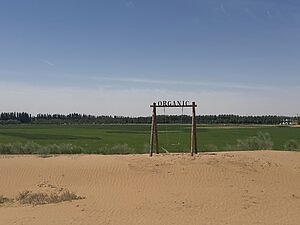
BEIJING – June 18, 2026 – In China's arid northwest, a startlingly green pasture presses against the edge of the ochre-colored Ulan Buh desert. This improbable oasis, carved from a region once known as the "Sea of Death," is more than an ecological marvel; it's a strategic exhibit in China's campaign to attract global environmental, social, and governance (ESG) investment into its massive agri-food industry.
This scene was a key stop on a recent fact-finding mission organized by China Asset Management Co. (ChinaAMC), one of the nation's largest asset managers. The firm guided a delegation of international investors and NGOs through a carefully curated tour of China’s sustainable agriculture ambitions. The goal: to demonstrate that the country is not just talking about sustainability but is building it, from hyper-efficient factories to reclaimed deserts. As international regulations like the EU's Deforestation Regulation (EUDR) and China's own ambitious "Dual Carbon" targets reshape global supply chains, the trip aimed to prove that Chinese firms are ready for the transition, transforming sustainability from a line item into a competitive advantage.
The Showcase: A 'Lighthouse' in the Desert
The delegation's journey into Northwestern China provided a powerful display of industrial and ecological engineering. The centerpiece was a visit to Mengniu Dairy's sprawling production base in Ningxia, a facility the World Economic Forum has officially recognized as a 'Lighthouse Factory'—the first in the global dairy industry. This designation is reserved for sites demonstrating leadership in adopting Fourth Industrial Revolution technologies to drive growth without increasing their environmental footprint.
Inside the world's largest single liquid milk production base, automation and digitalization reign. According to company data, these advancements have slashed overall energy consumption by a staggering 43%. For the visiting investors, it was a tangible demonstration of green transformation at an industrial scale. The dialogue with Mengniu executives and their suppliers was not just a presentation but an exchange on the critical issues of deforestation and greenhouse gas emissions, giving delegates a firsthand look at a top-tier Chinese firm's operational commitment to ESG principles.
The tour then moved from the factory floor to the desert's edge. The delegation witnessed the fruits of a 17-year project by a major Mengniu supplier that has painstakingly converted vast tracts of the Ulan Buh desert into a thriving organic pasture. By planting saxaul trees and alfalfa, the company created an isolated, fertilizer-free oasis. This wasn't just about appearances; it's the source of feed for cows on a modern ranch featuring automated milking and climate-controlled facilities. The stark visual contrast between the lush green fields and the adjacent sand dunes served as a potent symbol of the potential for large-scale ecological restoration.
The Roundtable Reality: Cracking the 'Bankability' Code
While the desert oasis and Lighthouse Factory offered compelling visuals, the most critical part of the trip may have occurred far from the fields, in a conference room in Shanghai. At an ESG Investor Roundtable at Shanghai Jiao Tong University, the conversation pivoted from what is possible to what is fundable.
The central theme was the stubborn problem of "bankability." The agri-food system is a major source of methane, a potent greenhouse gas. While technologies to reduce these emissions exist—from advanced livestock feed to better manure management—they face immense commercial hurdles. As delegates at the roundtable made clear, the primary obstacle is a lack of reliable data and verification.
Many agricultural abatement projects are small, geographically scattered, and lack the robust monitoring, reporting, and verification (MRV) mechanisms needed to prove their environmental performance to skeptical investors. Without this data, it's impossible to accurately price the environmental benefit. The consensus was stark: green financial instruments like green loans and bonds can only be deployed at scale when the impact of these projects is precisely quantified and transparently verified. Representatives from the Climate Bonds Initiative (CBI) were on hand to present blueprints for exactly this, underscoring the global effort to create financial structures that can channel capital into verifiably effective climate solutions in agriculture.
A Top-Down Tailwind: Policy Meets Practice
These corporate and financial maneuvers are not happening in a vacuum. They are unfolding under the powerful influence of China's national policy. The country's "Dual Carbon" targets—aiming for a carbon peak by 2030 and neutrality by 2060—have created a powerful top-down mandate for decarbonization across all industries. This is reinforced by tightening ESG disclosure requirements and a national biodiversity strategy that aligns with global concerns.
Mengniu, for instance, has publicly committed to its own 2030 peak and 2050 carbon neutrality goals, along with a "zero deforestation" pledge for its supply chain by 2030. These corporate targets are a direct response to the national agenda and the demands of the international market. For asset managers like ChinaAMC, this regulatory landscape creates a fertile ground for active stewardship. Their role extends beyond simple investment; it involves actively engaging with companies to set science-based targets, improve data disclosure, and build the capacity to meet global ESG standards.
The Stewardship Test: Bridging Data and Dollars
Ultimately, the success of this entire endeavor rests on bridging the gap between impressive physical assets and the abstract data demanded by global finance. ChinaAMC, which became the first full-service asset manager in China to sign the UN Principles for Responsible Investment (PRI) back in 2017, is positioning itself as a crucial part of this bridge. The trip was designed to do more than just show off success stories; it was an exercise in building trust and transparency.
"What we witnessed was not only Chinese agri-food businesses' ESG achievements, but also a replicable methodology that converts sustainability into business competitiveness," said Shirly Xu, ChinaAMC's ESG research head. Her statement captures the core thesis being presented to the world: that in the new global economy, green practices and profitability are two sides of the same coin.
For the international investors on the trip, the key takeaway is one of cautious optimism. The potential is undeniable, and the on-the-ground commitment appears real. Yet, the challenge of scaling these isolated oases of sustainability into a continent-spanning, fully "bankable" ecosystem remains. The work of translating the green of the pasture into the black ink of a verified, investment-grade report is the next great task in China's agricultural revolution.