
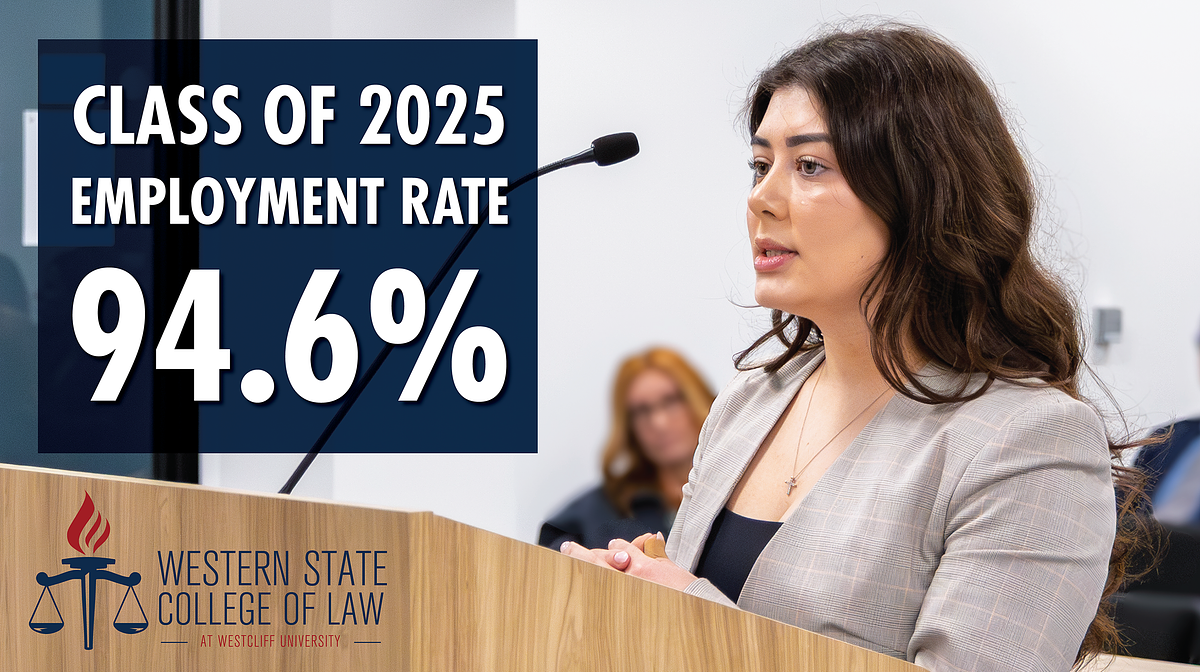
- 94.6% employment rate for Western State College of Law's Class of 2025, surpassing the national average of 87.7%. - 85.2% bar pass rate for the same class, significantly higher than California's statewide average of 30.8%. - 68.2% first-time bar pass rate, nearly double the statewide average of 43.9%.
Experts would likely conclude that Western State College of Law's success stems from its integrated support systems, practical training, and targeted bar preparation, making it a model for legal education reform.
The Law School Formula: How One School Is Beating the Odds
TUSTIN, CA – June 17, 2026 – In the high-stakes world of legal education, where success is often measured by two critical outcomes—bar passage and employment—Western State College of Law has posted numbers that demand attention. The institution recently announced that a staggering 94.6% of its Class of 2025 secured employment, a figure that not only continues a sharp upward trend for the school but also significantly outpaces the national average of 87.7% for graduates in full-time, long-term jobs requiring bar passage or a J.D. advantage.
This employment success is no accident. It is intrinsically linked to another remarkable achievement: an 85.2% overall bar pass rate for the same graduating class. In a state with one of the nation's most notoriously difficult bar exams, these results represent more than just a good year. They point to a deliberate and effective strategy, a tangible difference in an educational landscape often criticized for being disconnected from the practical realities of the legal profession. While many institutions talk about student success, Western State appears to have built a replicable system for achieving it, offering a compelling case study in how to prepare lawyers for the 21st century.
Beyond the Numbers: A Strategy of Deliberate Support
The impressive statistics are the result of a foundational philosophy that prioritizes student-focused infrastructure. As Dean Marisa Cianciarulo stated, “At Western State, student success is measurable.” This philosophy manifests in a robust network of support systems designed to guide students from their first day of class to their first day on the job.
At the heart of this system is the school's Academic Success Program (ASP). Far from a remedial afterthought, the ASP is an integrated component of the curriculum, providing workshops, one-on-one tutoring, and skills development from the outset. The institution specifically recognized the work of Professor Tania Shah and the ASP team, an acknowledgment that underscores the vital role these support professionals play. This proactive approach aims to demystify the law school experience and equip students with the tools to master challenging legal concepts, rather than waiting for them to struggle.
This individualized support extends directly to the bar exam. The school’s approach, described as a combination of “doctrinal instruction to individualized bar preparation and experiential learning opportunities,” treats the bar not as a final, terrifying hurdle, but as the culminating step in a long-term training process. By providing personalized feedback and targeted preparation, the institution directly addresses the unique challenges of the exam, a strategy whose effectiveness is borne out by the results.
Forging Lawyers in the Real World
One of the most significant shifts in modern legal education is the growing demand for practical skills. For decades, law schools were criticized for producing graduates who were well-versed in legal theory but ill-equipped for the daily tasks of a practicing attorney. Western State has built its reputation by directly confronting this critique, emphasizing hands-on legal education beginning in the first year.
Students are not just confined to the classroom. They participate in Moot Court and Mock Trial advocacy competitions, honing their litigation and oral advocacy skills in a simulated but high-stakes environment. More importantly, they gain direct, real-world experience through the school's extensive law clinics and externships. In these programs, students work with actual clients under the supervision of seasoned faculty, providing legal services in areas like family law, immigration, or consumer protection. They may also work alongside judges in judicial chambers or contribute to the work of government agencies and non-profits.
This commitment to experiential learning does more than just pad a resume; it builds confidence and competence. It transforms abstract legal principles into tangible tools used to solve real human problems. Graduates who have drafted a brief, interviewed a client, or argued before a judge are infinitely more valuable to employers than those who have only read about it. This focus on practical readiness is a key driver behind the school’s exceptional employment rate, as graduates can demonstrate immediate value to law firms and legal organizations.
Mastering the Nation's Toughest Bar Exam
Nowhere is Western State’s success more pronounced than in its bar passage results, particularly when contextualized against the backdrop of the California Bar Exam. The February 2026 exam saw a sobering statewide overall pass rate of just 30.8%. Even among first-time takers, the statewide average was a modest 43.9%. In this challenging environment, Western State’s first-time takers achieved a 68.2% pass rate, a figure that is not merely better, but in a different league entirely.
This outcome is the ultimate validation of the school’s integrated support model. Passing the bar is the gateway to the legal profession, and the institution’s ability to consistently guide a high percentage of its graduates through that gate is perhaps its most crucial function. The high pass rate demonstrates that the rigorous academic curriculum, combined with the intensive, individualized bar preparation offered through the ASP and other programs, creates a powerful synergy. Students aren't just taught the law; they are taught how to pass the test that will allow them to practice it.
This success creates a virtuous cycle. Strong bar passage rates lead to strong employment outcomes, which in turn attract motivated students, further strengthening the institution's profile and its ability to invest in the very programs that generate success.
An Anchor in the Orange County Legal Community
Western State’s recent achievements are not an overnight phenomenon but the latest chapter in a long and storied history. As the oldest law school in Orange County, the institution has been a cornerstone of the regional legal community for 60 years. Its impact is deeply woven into the fabric of the local bar, with an alumni network that includes over 150 individuals who have been elevated to the bench.
This deep-rooted local presence provides an invaluable, if less quantifiable, advantage to its graduates. A robust alumni network, particularly one that includes a significant number of judges and senior partners at local firms, creates unparalleled opportunities for mentorship, networking, and employment. For graduates seeking to build a career in the dynamic Southern California legal market, these connections can make all the difference.
The institution’s consistent production of practice-ready lawyers has made it a reliable talent pipeline for the region’s law firms, public service agencies, and corporate legal departments. Its sustained success reinforces its role not just as an academic institution, but as a vital contributor to the local economy and the administration of justice in Orange County and beyond. The data shows a clear upward trajectory in employment, from 87% for the Class of 2023 to today's 94.6%, indicating a strategy that is not only working but is being refined and improved year after year.