
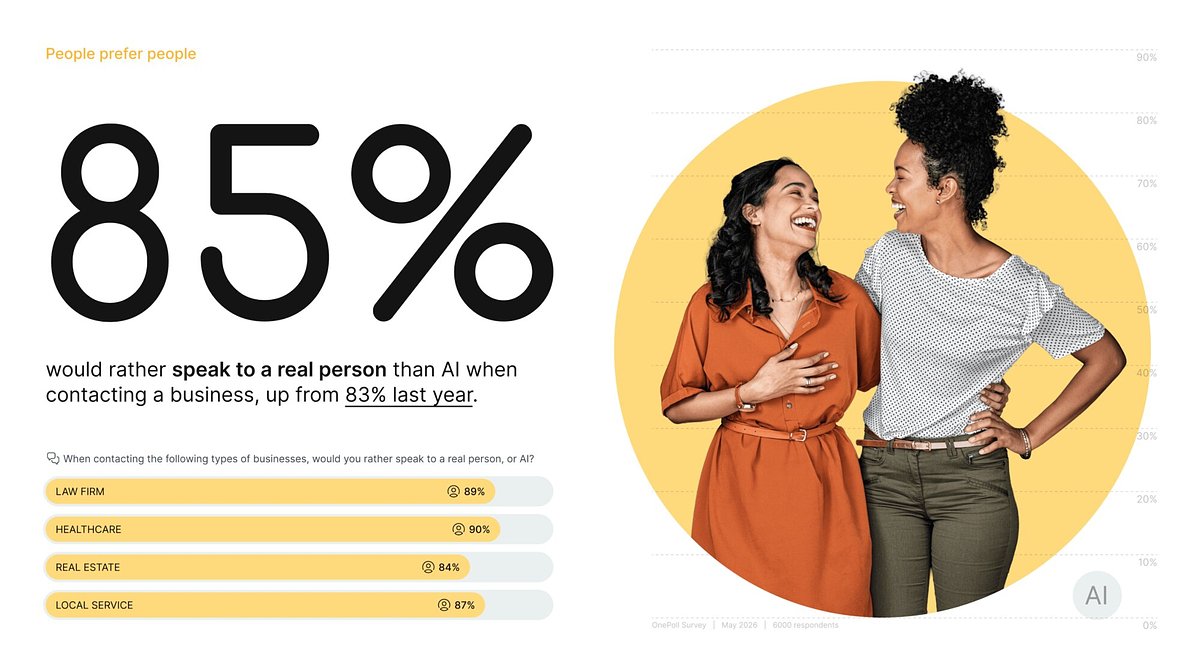
- 85% of customers prefer speaking to a real person over AI, up from 83% six months prior.
- 59% of respondents are frustrated by AI interactions, a rise from 54%.
- 73% of customers say they would be more loyal to companies that guarantee human service.
Experts agree that while AI can handle simple tasks, customers overwhelmingly value human interaction for complex or emotionally charged issues, making a hybrid 'augmented intelligence' model the most effective strategy for customer service.
The Human Comeback: Customers Reject AI Bots for a Real Connection
PORTLAND, Ore. – May 13, 2026 – While businesses across the globe double down on artificial intelligence, a growing wave of consumers is pushing back, demanding a human touch. New research reveals a significant and accelerating backlash against AI in customer service, with frustration mounting and trust in automated systems eroding.
A comprehensive study of 6,000 consumers across the United States, United Kingdom, and Canada shows that the push for automation may be coming at a steep cost to customer loyalty and satisfaction. The report, released by business services leader AnswerConnect, compared attitudes from late 2025 to the spring of 2026 and found a clear trend: people want to talk to people. The findings indicate that 85% of customers would rather speak to a real person than interact with an AI, an increase from 83% just six months prior. Conversely, preference for AI has dwindled from 7% to a mere 5%.
A Growing Disconnect
The data paints a picture of a widening gap between corporate strategy and consumer desire. As companies invest billions in AI chatbots and automated support systems to drive efficiency, customer frustration is boiling over. The survey found that 59% of respondents are now frustrated by their interactions with AI agents, up from 54% previously. More tellingly, nearly a third of customers (31%) now say they will simply hang up if they are connected to a bot, a clear signal of rejection.
"Businesses are racing to automate, but customers are pushing back," said Natalie Ruiz, CEO of AnswerConnect, in a statement accompanying the report. "What we're seeing now is a clear shift. People aren't just frustrated by AI, they're actively rejecting it in favor of human interaction."
This rejection is not just a matter of preference; it's directly impacting customer trust and loyalty. According to the research, 57% of consumers report their trust in a business would decrease if it relied predominantly on AI for customer service, a notable rise from 53%. Furthermore, an overwhelming 70% believe the quality of customer service would get worse if humans were removed from the equation, up from 65%. For businesses, the most critical metric may be loyalty: 73% of customers said they would be more loyal to companies that guarantee service from real people, a significant jump from 69% in the previous survey.
The AI Paradox: Calculating the True Cost
The trend highlights a potential "AI Paradox" for business leaders. The pursuit of cost savings and efficiency through automation—a key driver of AI adoption—may be creating a negative return on investment by alienating the very customers they aim to serve. While AI can reduce labor costs, the hidden expenses of customer churn, brand damage, and lost loyalty can quickly outweigh the benefits.
Broader industry analysis supports this sentiment. Reports from firms like Pega and Salesforce have consistently shown that while customers accept AI for simple, transactional tasks, they overwhelmingly demand human intervention for complex, nuanced, or emotionally charged issues. When a customer is already stressed or frustrated, being forced to navigate an unhelpful chatbot often exacerbates the problem, turning a manageable issue into a brand-damaging experience.
"AI isn't failing because of the technology, it's failing because it removes what customers value most: being understood," Ruiz noted. "When businesses replace people with bots, they risk losing not just satisfaction, but loyalty and revenue."
The Rise of Augmented Intelligence
The answer, according to many industry experts, isn't to abandon AI altogether but to fundamentally rethink its role in the customer experience. Instead of replacing human agents, the most successful strategies are now focusing on 'augmented intelligence'—a hybrid model where AI empowers and supports its human counterparts.
In this human-in-the-loop framework, AI acts as a powerful assistant. It can handle initial data gathering, transcribe calls in real-time, analyze customer sentiment, and instantly provide human agents with relevant information, previous interaction histories, and potential solutions from a vast knowledge base. This allows the human agent to focus less on administrative tasks and more on what they do best: active listening, complex problem-solving, and providing empathetic, personalized support.
Technology providers are already shifting their focus to this model. Major platforms from Genesys, Zendesk, and Salesforce are increasingly centered on agent-assist tools that enhance human capabilities. The goal is to create a seamless experience where routine queries are handled efficiently by automation, while any complex or sensitive issue is smoothly escalated to a highly-equipped human agent who has all the context needed to resolve the problem effectively.
Transforming the Future of Service Work
This strategic shift from replacement to augmentation has profound implications for the labor market. While fears of mass job losses due to AI have been prevalent, this evolving approach suggests a transformation of customer service roles rather than their elimination. The demand is shifting away from agents who perform repetitive, script-based tasks and toward individuals with strong soft skills: empathy, critical thinking, and advanced communication.
The agent of the future will be a more skilled, more valued problem-solver, elevated by AI tools to handle higher-stakes interactions. This necessitates a corporate commitment to reskilling and upskilling the existing workforce, training them to work collaboratively with new technologies. As AI handles the mundane, the human role becomes more strategic, focusing on building relationships and fostering the customer loyalty that the AnswerConnect report shows is increasingly tied to genuine human connection. The companies that thrive will likely be those that recognize technology's best use is not to replace its people, but to unleash their full potential.