
- 76% of organizations scaling AI for customer satisfaction see improvements of 25% or more
- 80% of companies deploying AI for employee productivity report gains of 25% or greater
- Pioneers like Bosch and Johnson & Johnson report ROI between 200% and 2,500% with agentic workflows
Experts agree that leading enterprises are shifting from AI-driven efficiency gains to full-scale business transformation, with those embracing agentic workflows achieving superior results.
AI's New Era: Firms Ditch Efficiency for Total Business Transformation
MIAMI, FL – January 28, 2026 – A seismic shift is underway in corporate artificial intelligence strategy, as leading enterprises move beyond using AI for simple efficiency gains and instead leverage it to achieve sweeping, transformational change. A new study from The Hackett Group reveals that top-performing organizations are no longer just automating old processes; they are fundamentally reimagining their operating models, creating a significant and rapidly widening competitive gap.
The findings, detailed in the firm's 2026 Enterprise Key Issues Study, show that the conversation around AI has evolved from incremental improvements to a complete overhaul of how work gets done. This move is yielding dramatic results in customer experience, risk management, and overall business productivity, signaling a new phase of AI maturity.
From Automation to Reinvention
For years, AI in the enterprise was synonymous with rules-based automation aimed at cutting costs and speeding up repetitive tasks. The new study indicates this approach is now legacy thinking. The true value, and the focus of leading companies, lies in using AI's cognitive capabilities to structurally reshape the business.
“What distinguishes these leading organizations is how they are leveraging AI to redesign work,” said Kyle McNabb, a principal at The Hackett Group, in the report's announcement. “They are moving beyond historical rules-based automation approaches and leveraging the multiplier effect of AI’s cognitive automation to structurally reshape their operations, workforce, and enterprise performance.”
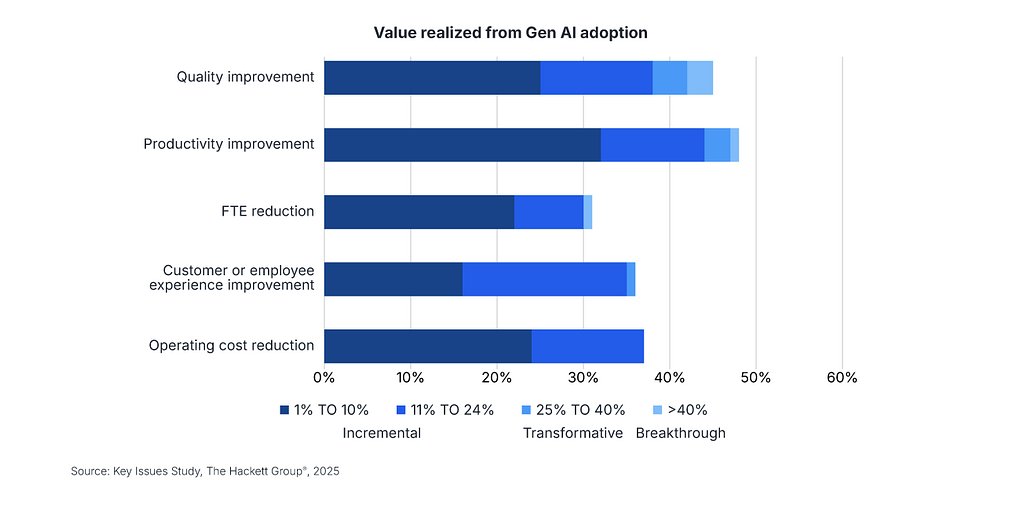
This isn't just a theoretical shift. The data shows remarkable real-world impact. Of the organizations scaling AI to improve customer satisfaction, a staggering 76% are seeing improvements of 25% or more. Similarly, among the 69% of companies deploying AI to boost employee productivity, 80% are reporting gains of 25% or greater. These figures point not to minor tweaks, but to a fundamental re-engineering of core business functions designed around a human-AI partnership.
The Rise of the Agentic Enterprise
Central to this transformation is the emergence of the 'agentic enterprise,' a model where autonomous AI agents and human employees collaborate in sophisticated workflows. An 'agentic workflow' moves beyond a human giving a simple command to a tool. Instead, humans set strategic goals, and intelligent AI agents break down those goals into sub-tasks, execute them, adapt to challenges, and work towards the final objective with a degree of autonomy.
This concept represents the next frontier of work. In this model, the human role elevates from a task-doer to an 'agent boss'—a strategist, overseer, and ethical guide who directs AI counterparts. Industry analysis from firms like Gartner and Deloitte supports this vision, predicting explosive growth in the agentic AI market. However, they also caution that success depends on redesigning operations, not simply automating broken processes. Organizations that fail to rethink their workflows before deploying agents risk project failure and wasted investment.
Other industry reports confirm this trend. A 2025 global survey on AI from McKinsey & Company found that while most organizations are still experimenting, 'AI high performers' are already redesigning workflows to transform their businesses, not just optimize them. This alignment across multiple research sources underscores the critical importance of embracing a transformative mindset.
A Widening Competitive Chasm
The Hackett Group's study delivers a stark warning: a clear separation is emerging between companies that recognize AI as a catalyst for transformation and those that still see it as a simple efficiency lever. This is not a gentle slope but a widening chasm that may soon become impossible for laggards to cross.
“As cognitive automation and agentic workflows mature, that gap will widen – rewarding organizations that act decisively to reimagine their operating models, and making it increasingly difficult for others to catch up,” commented Andy Warzecha, another principal at the firm.
This division is evident across industries. While some sectors see pioneers like Bosch, Johnson & Johnson, and Roche Turkiye reportedly achieving returns on investment between 200% and 2,500% by deploying agentic workflows, other sectors are lagging significantly. A recent study from Tata Consultancy Services, for instance, found that 85% of retailers have not even begun to plan for multi-agent AI systems. This disparity highlights the uneven pace of adoption and the danger for companies in slower-moving industries who may underestimate the speed at which their competitors are advancing.
Building the Future-Ready Firm
To avoid being left on the wrong side of the digital divide, organizations must act with urgency and strategic clarity. The path to becoming an agentic enterprise isn't about buying more software; it's about building a new foundation.
The Hackett Group's research identifies several key actions that distinguish performance leaders. These include anchoring the enterprise strategy in a clear assessment of AI opportunities, building robust process intelligence to identify high-impact areas for transformation, and strengthening governance to manage the complexities of autonomous systems.
Crucially, leaders take a pragmatic, problem-specific approach rather than trying to solve all data, talent, and ethics challenges at once. By focusing on high-impact collaborations between human talent and AI agents, these companies are unlocking new levels of value, from dramatically reduced cycle times to profoundly improved customer and employee experiences.
The message is clear: the era of treating AI as a tactical, IT-led initiative is over. For business leaders, the challenge is no longer whether to adopt AI, but how quickly they can rewire their organizations to harness its transformative power. Those who continue to focus only on incremental gains risk building their future on a foundation that is already obsolete.
Topics & Related
Artificial Intelligence
Agentic AI
Automation
Customer Experience
Machine Learning
Generative AI
Digital Twins
Industry 4.0
Employee Engagement
Upskilling & Reskilling
Revenue
EBITDA
AI & Machine Learning
Software & SaaS
Fintech
Cloud & Infrastructure
Acquisition
ChatGPT
Claude
Gemini
Related Company Pulse