
- $15 million in recent funding secured by Shifters AI.
- AI-native ecosystem enabling one operator to supervise multiple robots.
- TRUST robots designed for hazardous environments like disaster zones and industrial sites.
Experts would likely conclude that Shifters AI's 'Robots Go First' approach represents a significant advancement in ground autonomy, with potential to revolutionize high-risk operations while raising critical ethical and regulatory questions.
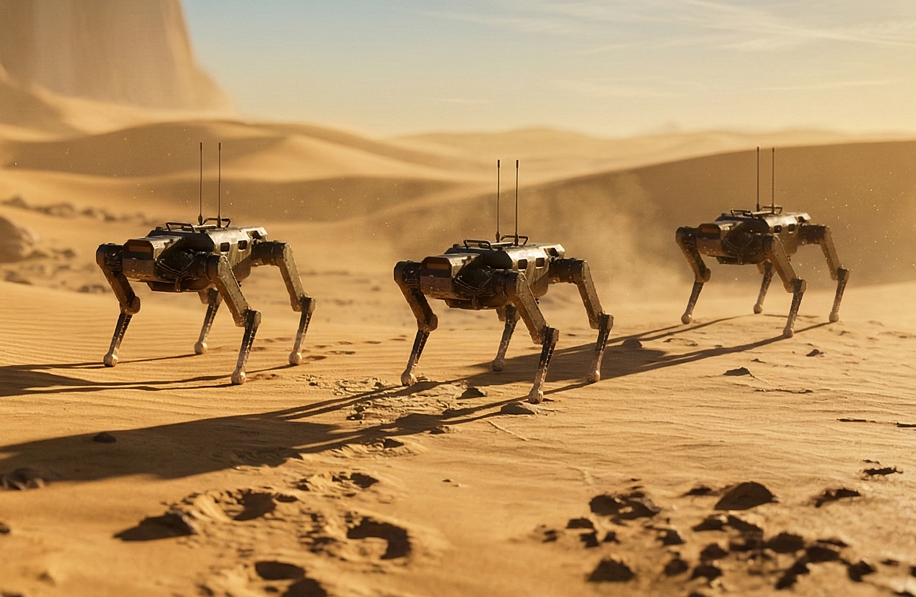
The Dawn of Robotic Teams: Shifters AI Reimagines Ground Autonomy
PARIS, FRANCE – June 15, 2026 – Amid the polished displays of advanced weaponry and defense technology at Eurosatory 2026, a Washington, D.C.-based company is quietly signaling a fundamental shift in how we approach danger. Shifters, a global technology firm, is not debuting another drone or a better remote-controlled vehicle. Instead, it is unveiling an entire ecosystem built on a simple but profound mission: “Robots Go First.” This isn’t just a catchy slogan; it’s the operating principle behind an AI-native ground autonomy platform designed to send coordinated teams of robots into hazardous environments before a single human is put at risk.
The public debut of Shifters’ product suite—comprising a command layer, an orchestration engine, and a rugged robotic platform—marks a pivotal moment. It represents a leap from the one-to-one relationship of a human controlling a single machine to a new paradigm: one human supervising an intelligent, collaborative team of them. As we stand at this technological crossroads, we must examine not only the machinery but the structural changes it heralds for national security, emergency response, and the very definition of a frontline.
A Revolution in Risk
For decades, the promise of robotics in high-stakes environments has been hampered by the limitations of remote control. An operator, often miles away, navigates a lone robot through a keyhole view, a process that is slow, cognitively demanding, and prone to failure when connectivity is lost. Shifters’ CEO and co-founder, Ofer Balin, frames the problem clearly: “The next leap in ground robotics is not a better remote-controlled machine. It is the ability for one operator to supervise coordinated robotic teams that can enter, sense and operate in dangerous environments before people are exposed.”
This is the core of the “Robots Go First” revolution. The goal is to transform dangerous-entry assessments, whether in a collapsed building after an earthquake, a contaminated industrial site, or a hostile urban structure. Instead of sending in a first responder or soldier, a team of quadruped robots under the TRUST family name can map the area, detect threats, and relay a comprehensive operational picture. This shifts the initial burden of risk from human to machine.
The applications are as broad as they are critical. In disaster zones, these teams can navigate rubble to search for survivors where it’s too unstable for rescue workers. For critical infrastructure like ports and power plants, they can perform persistent perimeter security patrols. In industrial settings, they can conduct inspections in hazardous or inaccessible areas, all while a human operator oversees the mission from a safe distance, providing high-level intent rather than micromanaging every step.
Beyond Remote Control: The AI-Native Ecosystem
What enables this leap is the integrated, AI-native design of Shifters’ ecosystem. It’s a three-part solution to what the company’s President and CTO, Assaf Chaprak, calls a “systems challenge.” He notes, “Terrain, perception, communications, power, payloads and decision-making have to work together in real time.”
At the heart of the system is RITA (Robotic Intent To Action), the operator-command layer. This is the AI brain that translates a human’s high-level goal—for example, “secure this perimeter” or “search this building for heat signatures”—into a series of coordinated actions for the robotic team. It’s the difference between driving a car and telling a chauffeur your destination.
Orchestrating the team’s execution is ARENA (Autonomous Robotic Execution and Nexus Architecture). This layer ensures the robots work together, navigating complex terrain, sharing sensory data, and adapting their formation and tasks as the mission evolves. If one robot loses connection or encounters an impassable obstacle, ARENA can reroute the team to ensure the mission continues.
Finally, TRUST (Tactical Robot for Unmanned Safety & Security Tasks) provides the physical platform. These rugged, AI-native quadruped robots are built to traverse the difficult, degraded, and unpredictable environments where they are needed most. The choice of a legged platform over wheels or tracks is a deliberate one, prioritizing mobility in the complex, unstructured terrain that defines real-world danger zones.
The New Arms Race: Capital and Competition
The significance of this technological shift has not been lost on investors. Shifters recently secured $15 million in funding, a sign of confidence from venture firms like Aurelius Capital and Ace Capital Partners. This capital infusion arrives as the market for autonomous defense and security solutions is surging, driven by a combination of geopolitical instability and rapid technological advancement. As Alon Lifshitz, founding partner at Aurelius Capital, stated, “In defense technology, the hardest companies to build are the ones that have to move from breakthrough technology to field-ready products.” The investment signals a belief that Shifters has the operational and technical depth to make that difficult transition.
The competitive landscape is formidable, populated by well-known names like Boston Dynamics. Yet the field is also in flux. Sarcos, once a major player in defense hardware, recently pivoted to focus entirely on AI software, rebranding as Palladyne AI Corp. This industry trend underscores Shifters' strategy: that true value lies not just in the robotic hardware, but in the intelligent software stack that grants it autonomous, collaborative capabilities. Shifters is betting that its integrated, AI-native approach to supervised autonomy will become the new industry standard.
The Human in the Machine
The specter of autonomous machines operating in high-stakes environments inevitably raises profound ethical questions. As robotic systems become more capable, the line between tool and agent blurs, forcing a difficult conversation about accountability and control. International bodies like the United Nations are already debating the need for legally binding instruments to govern autonomous systems in warfare by 2026.
Shifters’ model of “supervised autonomy” is a direct attempt to navigate this complex ethical terrain. By design, the system preserves human oversight and mission control. The AI is a powerful tool for execution and adaptation, but the strategic and ethical decision-making—the intent—remains firmly in human hands. One source familiar with the system's development philosophy emphasized this point, stating, “We have developed a system that is not intended to replace human judgment, but rather to be operated by humans who remain responsible.”
This approach aligns with evolving doctrine, such as the U.S. Department of Defense policy requiring that commanders and operators exercise appropriate levels of human judgment over the use of force. By positioning the robot as a force multiplier that enhances human capability rather than replacing human accountability, Shifters is charting a course that may prove to be not only technologically superior but ethically necessary. The systems that hold our world together are fraying in many places, and while technology can’t mend every tear, deploying it to protect human life is the most vital mission of all.