
- 99% first-pick success rate with zero programming for bin-picking solution
- PolyScope X introduces Logic Programs to reduce or replace external PLCs
- MiR1200 Pallet Jack is the first commercial Physical AI product available for immediate purchase
Experts would likely conclude that Teradyne is strategically positioning itself as a leader in practical AI-driven industrial automation, offering tangible solutions that address real-world manufacturing challenges.
Teradyne Moves Beyond AI Hype, Unveils Production-Ready Factory Robots
NOVI, MI – June 11, 2026 – While the technology industry remains captivated by the conceptual promises of artificial intelligence, Teradyne Robotics is making a decidedly pragmatic pivot. At the upcoming Automate 2026 trade show, the company, which owns collaborative robot (cobot) pioneer Universal Robots (UR) and autonomous mobile robot (AMR) leader Mobile Industrial Robots (MiR), will pull back the curtain on a suite of what it calls “production-ready” Physical AI applications. The message is clear: the era of speculative AI in manufacturing is over, and the era of deployable, value-generating intelligent automation has begun.
“The demos we are presenting are real and deployable,” stated Jean-Pierre Hathout, President of the Teradyne Robotics Group, in a press release. This statement cuts through the market noise, signaling a strategic focus on tangible solutions that businesses can implement immediately. The company is putting its money where its mouth is, highlighting its first commercial Physical AI product, the MiR1200 Pallet Jack, as an application that manufacturers can purchase today to automate tasks in the often chaotic and unstructured environments of warehouses and production floors.
Redefining Automation with 'Physical AI'
Teradyne’s concept of “Physical AI” is a deliberate distinction from the generative AI models that dominate headlines. It refers to AI systems that perceive variability in the physical world, make real-time decisions, and act reliably within dynamic environments. This is a direct response to a long-standing challenge in industrial automation: traditional robots excel at repetitive tasks in highly controlled settings but falter when faced with the “messy reality” of modern manufacturing, where parts may be misaligned, bins are unstructured, and workflows are constantly changing.
“With physical AI deployed with UR and MiR robots, we are providing solutions enabling automation to work with the world as it is, not as we wish it to be,” Hathout explained. This philosophy addresses a critical pain point for manufacturers grappling with high-mix, low-volume production, persistent labor shortages, and the need for greater operational resilience. By enabling robots to adapt to inconsistency, the company aims to unlock automation for a vast range of tasks previously deemed too complex or impractical for machines, from intricate electronics assembly to dynamic material handling.
This move positions Teradyne not just as a hardware provider, but as a problem-solver for the unpredictable nature of human-centric workplaces. The financial implication is significant: instead of requiring businesses to invest heavily in re-engineering their entire production line to be robot-friendly, Physical AI allows robots to integrate into existing, imperfect human workflows, drastically lowering the barrier to entry and accelerating the return on investment.
The Software Backbone: PolyScope X Takes Center Stage
The engine driving this strategic shift is PolyScope X, Universal Robots’ next-generation software platform. Billed as the foundational layer for its Physical AI advancements, the platform is more than an incremental update; it represents a fundamental re-architecting of how users interact with and deploy robotic systems. While retaining the core motion-control foundation that made UR a market leader, PolyScope X introduces a modern technology stack designed for the demands of intelligent automation.
Key to its capability is the introduction of Logic Programs, a form of PLC-style background logic that allows the robot to coordinate and control multiple work cell components in parallel. For system integrators and plant managers, this is a game-changer. It has the potential to reduce or entirely replace the need for external Programmable Logic Controllers (PLCs) in many deployments, simplifying work cell design, reducing hardware costs, and streamlining control architecture. This logic runs independently of program pauses or safety stops, ensuring a more robust and integrated system.
Furthermore, with native support for ROS 2 (Robot Operating System 2) and a containerized application environment, the platform opens the door for developers to build and deploy complex AI applications directly on the robot. “Automation today requires more than just a robot - it demands a platform that can adapt, integrate, and evolve with the needs of modern manufacturing,” Hathout noted. By creating a secure, future-proof, and AI-ready software backbone, Teradyne is building an ecosystem that encourages innovation while ensuring industrial-grade reliability and cybersecurity.
From Data Centers to Factory Floors: A New Ecosystem in Action
Teradyne’s “production-ready” claims are substantiated by a diverse array of demonstrations developed with a growing ecosystem of partners. These applications provide a compelling look at the immediate, real-world value of Physical AI.
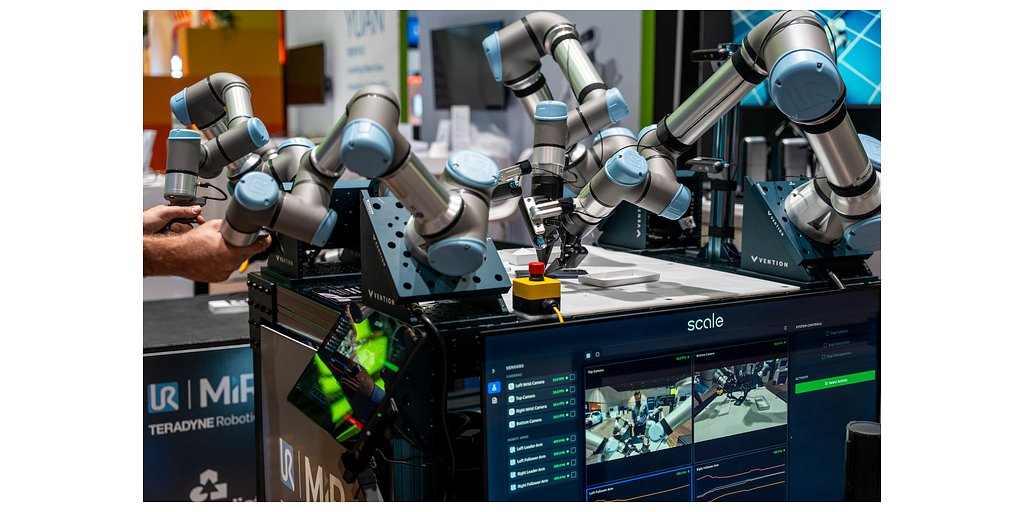
A strategic focus is the infrastructure powering the AI revolution itself. The UR AI Trainer, developed with data-labeling giant Scale AI, allows an operator to physically guide a robot through a task, such as packaging a smartphone. The system captures high-fidelity, force-aware data to train sophisticated AI models, which can then be deployed directly to the factory. With integrations for training NVIDIA’s GR00T foundation model and testing in the NVIDIA Isaac Sim framework, Teradyne is positioning its robots as essential tools for building and scaling AI. This is further evidenced by a demo from partner Cambrian, which uses a UR robot and an AI vision system to meticulously insert copper cables into high-density server racks—a tedious, error-prone task crucial for the global build-out of AI data centers.
On the factory floor, the focus is on simplifying complex tasks. Partner Vention will showcase a bin-picking solution that uses a UR12e and 3D vision to achieve a 99% first-pick success rate with zero programming. This directly tackles one of the most notoriously difficult challenges in automation. Similarly, Trener Robotics’ Acteris platform allows operators to set up new machine-tending jobs by communicating with a UR robot via a simple chat interface, reducing setup time from hours to minutes. These innovations directly address the industrial skills gap by lowering the technical expertise required to deploy and manage automation.
Other demonstrations highlight the robots' ability to learn and adapt. AICA will show a UR robot learning a complex polishing and buffing task from a single human demonstration, matching the operator's speed and applied force. Meanwhile, a palletizer from beRobox (PALTZ) uses AI vision to adjust a UR20's movements on the fly, correctly picking up boxes even if they have shifted. These examples prove that Physical AI is not just about executing pre-programmed commands more effectively; it's about giving machines the intelligence to perceive, reason, and react to their environment.
The Competitive Landscape and the Bottom Line
Teradyne is not alone in the race to integrate AI into robotics. Industry giants like ABB, FANUC, and KUKA are all investing heavily in intelligent automation, while NVIDIA provides the powerful processing backbone for many of these advancements. However, Teradyne's strategy appears uniquely focused on packaging these advanced capabilities into a cohesive, accessible, and immediately deployable platform.
By emphasizing a robust software foundation with PolyScope X and cultivating a rich ecosystem of specialized partners, the company is aiming to create a 'plug-and-play' experience for complex AI. The business case is compelling: manufacturers can now automate tasks that were previously off-limits, improve quality through adaptive processes like autonomous sanding and polishing, and increase throughput with intelligent logistics systems like the MiR600 and the AI-enabled Pallet Jack. This shift moves the conversation from the theoretical potential of AI to measurable improvements in efficiency, quality, and operational flexibility.
Ultimately, Teradyne Robotics' showcase at Automate 2026 is less a technology demonstration and more a business proposition. It is a calculated move to capture the next wave of industrial automation by providing practical solutions to today’s problems, proving that the greatest innovation is one that delivers tangible value to the bottom line.