
- Flight Time: Over 50 minutes
- Range: 11 kilometers
- Revenue Growth: Year-over-year surge from $1.6 million to $15.5 million
Experts would likely conclude that the Hellcat represents a significant advancement in battlefield-ready drone technology, combining real-world combat lessons with modular, interoperable design to address urgent global defense needs.
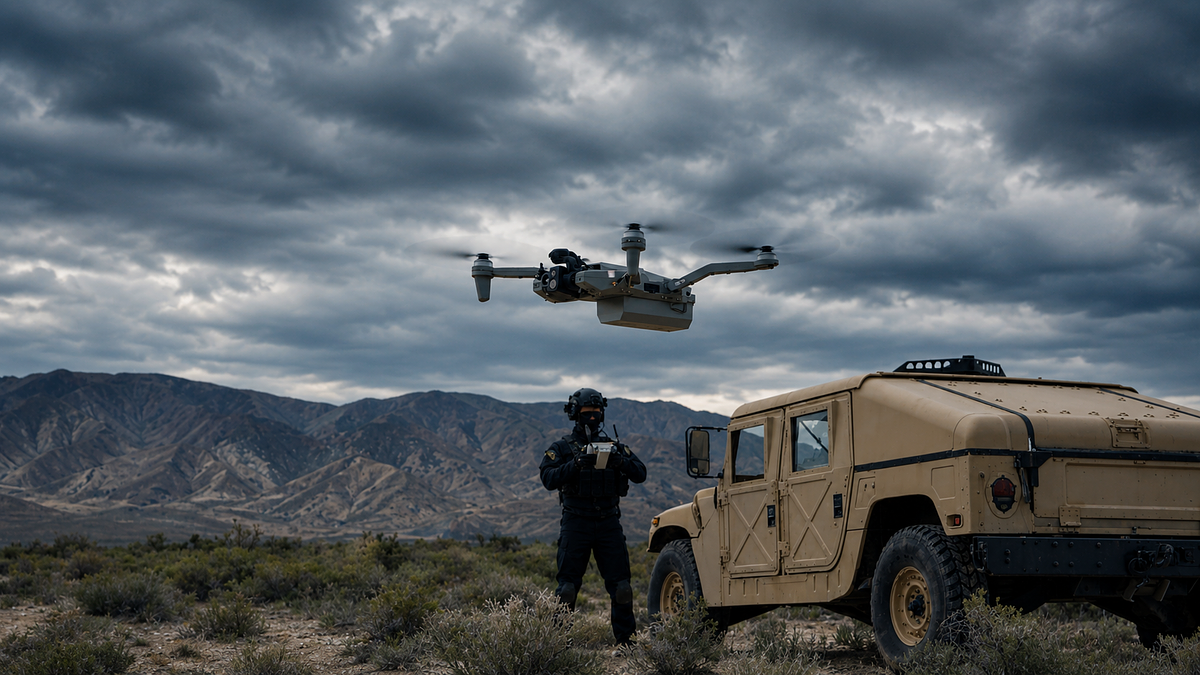
Red Cat's Hellcat: Forged in Conflict, Designed for Global Resilience
SALT LAKE CITY, UT – June 15, 2026
Red Cat Holdings, a U.S. provider of robotic defense solutions, today unveiled the Hellcat, a new small unmanned aircraft system (sUAS) that embodies the brutal lessons of modern warfare. Launched at Eurosatory 2026, Europe’s preeminent defense expo, the Hellcat isn't just another drone. It represents a fundamental shift in defense procurement and design philosophy: technology forged not in sterile labs, but tempered by the immediate, life-or-death feedback from active warfighters.
Built on the company's proven Black Widow platform—itself designed for the U.S. Army's rigorous Short Range Reconnaissance program—the Hellcat is a direct response to the rapidly evolving, high-stakes environments that define 21st-century conflict. It is a testament to a new paradigm where resilience and adaptability are no longer just features, but the very foundation of performance and permanence in the defense sector.
The New Blueprint for Battlefield Adaptation
The most compelling aspect of the Hellcat is its origin story. Red Cat executives have been clear that its development was not merely inspired by recent conflicts but was shaped directly by them. The company cites an “ongoing partnership with Ukraine” and “extensive feedback gathered directly from warfighters in the field” as core to the drone’s design.
“It’s been an ongoing honor to work side by side with Ukrainian drone experts in theater, continuously transforming our ISR drones to meet the ever-evolving demands of the battlefield,” said Jeff Thompson, Chief Executive Officer of Red Cat. This close-quarters collaboration moves beyond theoretical requirements, embedding real-world operational necessities into the platform’s DNA.
The result is a system purpose-built for contested environments where technological superiority is fleeting. The Hellcat’s baseline configuration includes critical capabilities like GPS-denied operation from the moment it's powered on and a backup recovery mode that functions without satellite signals. These are not niche add-ons; they are essential survival traits in a landscape saturated with electronic warfare, a lesson learned painfully on the front lines. With over 50 minutes of flight time and an 11-kilometer range, the drone offers the endurance and reach necessary for meaningful reconnaissance, while its field-repairable, rucksack-portable design acknowledges the logistical realities of forward-deployed units.
A Strategic Play for Global Interoperability
While its battlefield-honed features are impressive, the Hellcat’s true strategic value lies in its architecture. The system is built on Modular Open Systems Architecture (MOSA) principles, a design philosophy that is rapidly becoming the gold standard for Western military hardware. This approach is Red Cat’s answer to a persistent challenge in coalition warfare: interoperability.
Instead of a closed, proprietary system, MOSA allows customers to configure the drone’s command-and-control links, payloads, and software to meet their specific needs and integrate with their existing military infrastructure. For allied nations, this is a game-changer. It means they can adopt a state-of-the-art American drone without being locked into a single ecosystem or facing a costly and complex integration process. This flexibility is precisely what government buyers from across Europe and allied nations, congregating at Eurosatory, are seeking.
By launching Hellcat on this international stage, Red Cat is making a deliberate global play. It is positioning itself not just as a supplier to the U.S. military, but as a key partner for allied nations looking to modernize their sUAS capabilities. This strategy directly addresses the growing demand for adaptable, battle-tested systems that can be deployed by coalition forces with minimal friction. In a market crowded with competitors like Skydio and AeroVironment, this focus on open architecture and global partnership provides a powerful competitive moat.
Building an All-Domain Ecosystem
The Hellcat is not a standalone product but a crucial component of Red Cat's broader vision for an integrated, all-domain robotic force. The company’s “Family of Systems” includes not only aerial drones like the Black Widow and Hellcat but also the Blue Ops Variant 7 Uncrewed Surface Vessel (USV). This strategic portfolio-building demonstrates an understanding that future conflicts will be won by seamlessly connecting assets across air, land, and sea.
The Hellcat’s ability to integrate with different command-and-control systems is key to this vision. An operator could theoretically use a single interface to manage a swarm of Hellcat drones providing aerial reconnaissance for a Variant 7 USV conducting a maritime mission. This network-centric approach, where data flows freely between platforms to create a comprehensive operational picture, multiplies the effectiveness of each individual unit. It is this pursuit of an integrated, resilient ecosystem that signals Red Cat’s ambition for permanence in the market.
The Financial Underpinnings of Ambition
This ambitious strategy is backed by an aggressive growth plan. Red Cat's recent financial performance paints a picture of a company in a full-scale investment phase. While it posted a significant operating loss in its most recent quarter, its revenue surged from $1.6 million to $15.5 million year-over-year. This explosive growth is fueled by significant capital, including $225 million raised in a recent stock offering.
The company has built out production capacity to support up to $1 billion in revenue, a bold move that anticipates massive demand for its systems. The launch of Hellcat is a clear effort to start converting that capacity into contracts. By targeting the global market and emphasizing a modular, adaptable platform, Red Cat is betting that the lessons of the Ukrainian battlefield have created an urgent, worldwide demand for exactly what it is offering.
By unveiling the Hellcat, Red Cat has done more than launch a new product; it has presented a clear thesis on the future of defense technology, where resilience is built through collaboration and permanence is achieved through integration.