
- Global Drone Battery Market: Valued at over $1.4 billion in 2024, projected to more than double by the early 2030s
- Mercedes-Benz Test Vehicle: Achieved 1,200 km (745 miles) range on a single charge using Factorial’s batteries in 2025
- Temperature Range: Factorial’s batteries perform reliably from -30°C to 45°C (-22°F to 113°F)
Experts view Factorial’s expansion into the drone market as a significant leap forward, leveraging proven automotive battery technology to overcome critical endurance and safety barriers in unmanned aerial systems.
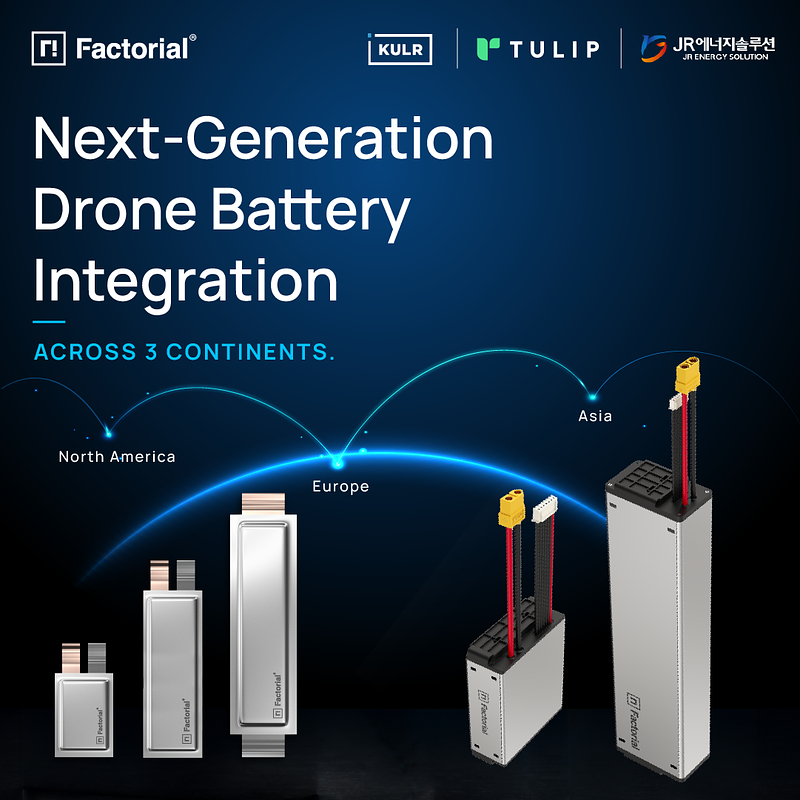
Factorial’s Global Push to Unleash Next-Gen Drone Power
BOSTON, MA – May 21, 2026 – By Sam Lidman
Factorial Inc., a U.S. leader in solid-state battery technology, today announced a major strategic expansion into the drone market, launching a series of partnerships with key system integrators across North America, Europe, and Asia. The move aims to replace the conventional lithium-ion batteries that currently constrain unmanned aerial systems (UAS) with Factorial’s next-generation solid-state and lithium-metal technology, promising a new era of endurance, power, and reliability for commercial, industrial, and defense drones.
This global initiative positions the company, already a powerhouse in the electric vehicle sector with partners like Mercedes-Benz and Stellantis, at the forefront of solving one of the most significant bottlenecks in the rapidly growing drone industry. As missions demand longer flight times and more complex capabilities, the limitations of current battery technology have become a critical barrier. Factorial's announcement signals that a solution is not just on the horizon, but actively being deployed.
Breaking the Endurance Barrier
The global drone battery market, valued at over $1.4 billion in 2024 and projected to more than double by the early 2030s, has long been dominated by lithium-polymer (LiPo) batteries. While cost-effective, these power sources present significant drawbacks. Commercial and consumer drones are often limited to flight times of just 20 to 30 minutes, require frequent battery swaps, and suffer performance degradation in extreme temperatures. Furthermore, the risk of thermal runaway and fire remains a persistent safety concern.
Factorial’s technology is engineered to directly address these pain points. Unlike conventional batteries that force a trade-off between energy density (for range) and power density (for performance), Factorial's proprietary platforms deliver both. This eliminates the need for compromise, enabling drones with:
- Extended Range: The high energy density of Factorial's cells promises to dramatically increase flight duration, making long-endurance surveillance, persistent monitoring, and large-area mapping missions far more feasible.
- High Power Output: The technology provides exceptional pulse power, essential for rapid vertical takeoffs, sustained high-speed flight, and carrying heavier payloads.
- Broad Temperature Window: Validated in automotive applications to perform reliably in temperatures ranging from -30°C to 45°C (-22°F to 113°F), the batteries are suited for missions in harsh environments, from arctic cold to desert heat.
The viability of this technology isn't just theoretical. It has been rigorously proven in the automotive world, one of the most demanding applications for battery performance. In 2025, a test vehicle from Mercedes-Benz equipped with Factorial’s batteries achieved an astounding 1,200 km (over 745 miles) of range on a single charge. Similarly, lab tests with automotive giant Stellantis confirmed high energy density, fast-charging capabilities, and robust performance across over 600 cycles. By leveraging this proven success, Factorial is making a confident leap from roads to skies.
A Global Alliance for Strategic Skies
At the core of Factorial’s strategy is a network of specialized partners chosen to accelerate integration and deployment across key geopolitical regions. This triple-continent approach ensures that the technology is adapted to meet regional standards and market needs while building a resilient global footprint.
In the United States, Factorial is collaborating with KULR Technology Group, a company renowned for its thermal management and battery safety solutions used by NASA. KULR's expertise is critical for optimizing Factorial's cells for the rigorous and often extreme environments of defense and high-stakes industrial operations.
Across the Atlantic in the Netherlands, Tulip Tech B.V. is spearheading the European integration. Tulip Tech specializes in high-performance, aerospace-grade battery packs and is a key player in Europe's push for a secure, non-Chinese drone component supply chain. Their work will be foundational for introducing Factorial-powered drones to the European commercial and defense markets.
In the Asia-Pacific region, a hub for advanced UAS development, JRES is leading integration efforts. This partnership provides Factorial with a crucial foothold in a strategically important market for both commercial and industrial drone manufacturing and deployment.
This global network is further strengthened by Factorial's backing from IQT (In-Q-Tel), the not-for-profit strategic investor that serves the U.S. national security community and its allies. IQT's involvement underscores the geopolitical significance of this technology. Advanced, reliable, and domestically-produced power sources for drones are seen as vital for maintaining a technological edge and ensuring supply chain security for critical defense and intelligence assets.
From Automotive Triumphs to Aerial Applications
Factorial's move into the drone sector is a calculated step in a broader multi-sector strategy. Having established its credibility with some of the world's largest automakers, the company is now demonstrating the versatility of its FEST® and Solstice™ platforms. This expansion validates the technology's potential to become a cross-industry standard for high-performance energy storage.
"Solid-state and lithium metal technology isn't a promise anymore, it's a platform, and we are defining what the next generation of flight looks like," said Siyu Huang, CEO of Factorial, in a statement. Her comments reflect a market that is moving past exploration and into active deployment.
This momentum was on public display at the recent XPONENTIAL 2026 conference, where partners KULR and Tulip Tech demonstrated the first battery packs powered by Factorial cells. While the competitive landscape for advanced drone batteries includes other solid-state developers and mature semi-solid-state technologies, Factorial's combination of proven automotive validation, strategic national security backing, and a ready-made global integration network provides a formidable advantage.
By building this ecosystem with integrators, supply chain leaders like POSCO Future M and Philenergy, and strategic investors, Factorial is not just selling a battery; it is architecting a new standard for unmanned systems. This initiative is poised to unlock new capabilities and redefine the operational limits for a technology that is becoming increasingly integral to the global economy and national security.