
- 314,000+ international buyers attended the 139th Canton Fair, the highest in its 69-year history.
- 25% of products featured independent intellectual property rights, with 23% new products and 22% green products on display.
- Guangdong's exports surged 38% year-on-year in Q1 2026, with high-tech sectors like 3D printers and drones seeing massive growth.
Experts view the Canton Fair's record attendance and China's shift toward high-tech, innovation-driven exports as a strong indicator of the country's evolving role as a global leader in advanced manufacturing and supply chain stability.
Canton Fair Record Signals China's High-Tech Export Transformation
GUANGZHOU, China – May 07, 2026 – The 139th Canton Fair, which concluded on May 5, shattered previous attendance records for overseas buyers, sending a powerful signal about the resilience of China's trade engine and its accelerating shift toward high-value, technology-driven manufacturing. The China Foreign Trade Centre confirmed that more than 314,000 international purchasers from 220 countries and regions attended the 15-day event, the highest number in the fair's storied 69-year history.
This massive turnout, a 1.1% increase from the previous session, is being interpreted by analysts as a firm vote of confidence in China's supply chain stability and innovative capacity. Held across a sprawling 1.55 million square meters, the fair hosted over 32,000 exhibitors, including nearly 3,900 first-time participants, all vying for the attention of global business.
The New Face of 'Made in China'
Long regarded as a barometer for China's foreign trade, this year's fair provided compelling evidence that the label 'Made in China' is being redefined. The focus has decisively moved beyond low-cost production to an ecosystem centered on innovation, proprietary technology, and sustainability. Of the 4.65 million products on display, a quarter featured independent intellectual property rights, while new and green products accounted for 23% and 22% of exhibits, respectively.
This evolution was most apparent in the fair's new and expanded exhibition zones. For the first time, organizers introduced nine specialized sections for cutting-edge industries, including consumer and agricultural drones, smart wearables, advanced display technologies, and integrated housing solutions. These zones attracted nearly 670 specialized companies and were a hub of activity for buyers seeking the next wave of technological products.
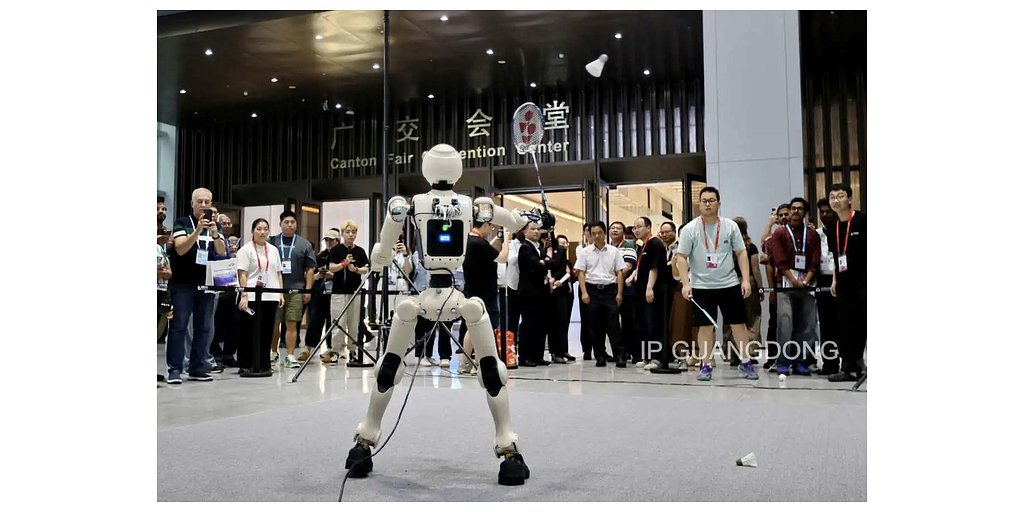
AI-powered applications made a notable debut, with demonstrations of robotic patrol systems and advanced drones capturing significant attention. One exhibitor showcased a bipedal humanoid robot, the 'PHYBOT C2', capable of playing badminton, illustrating the growing integration of artificial intelligence into consumer and industrial products. More than 600 product launch events were held throughout the fair, and showcases dedicated to future industries saw a 30% increase compared to the autumn 2025 session.
Further evidence of this strategic pivot is the dramatic rise of Chinese-owned brands. In the first quarter of 2026, exports from Guangdong's self-owned brands surged by an impressive 38% year-on-year, now constituting 26.6% of the province's total export value. This reflects a conscious move away from Original Equipment Manufacturer (OEM) models toward building internationally recognized brands with higher value-added potential.
A Barometer of Global Trade Confidence
The record influx of international merchants underscores a broader trend of robust global demand for Chinese goods, even amidst a complex geopolitical environment. The fair's success reinforces China's role as a stabilizing force in global supply chains, providing a reliable and increasingly innovative source for products and components.
The fair's performance is mirrored by the staggering trade figures posted by its host province and the nation at large. In the first quarter of 2026, Guangdong's foreign trade recorded year-on-year growth for the 11th consecutive quarter, with its total import and export volume hitting a record 2.54 trillion yuan. This performance propelled the province to rank first nationwide in total trade volume, national share, and contribution to China's overall trade growth.
Nationally, China's foreign trade surged 15% year-on-year in the first quarter to a historic high of 11.84 trillion yuan, the fastest quarterly growth rate in five years. Guangdong's export growth of 14.3% and import growth of 27.8% outpaced the strong national average, highlighting its crucial role as the country's primary economic engine.
Guangdong's Engine Powers National Growth
As China's manufacturing heartland, Guangdong province is at the forefront of this industrial upgrade. The province's first-quarter exports reached 1.53 trillion yuan (approx. US$211 billion), driven by exceptional growth in high-technology sectors. The data reveals a clear picture of where China's export strengths are rapidly developing.
Exports of 3D printers from Guangdong skyrocketed by an astonishing 136.9% in the first quarter, accounting for over 88% of the national total. Drone exports jumped 51.2%, representing 93% of China's drone exports, while digital cameras saw a 60.2% increase. This dominance in key emerging tech categories demonstrates how provincial industrial policy is aligning with national goals to lead in advanced manufacturing.
Mechanical and electrical products continue to form the backbone of the province's exports, accounting for over 70% of the total in the first four months of 2026. Within this category, high-tech products like industrial robots, CNC machine tools, and other advanced manufacturing equipment are showing consistent double-digit growth, fueling both domestic industrial upgrades and international sales.
Navigating a Complex Global Landscape
The success of the Canton Fair is also a testament to China's successful market diversification strategy. While trade with traditional partners remains strong, growth with emerging markets is accelerating. In the first quarter, China's trade with countries participating in the Belt and Road Initiative (BRI) grew by 14.2%, accounting for over half of the nation's total trade. Buyer attendance and deals from BRI partner countries were a significant component of the fair's success.
Similarly, trade with ASEAN, Latin America, and Africa saw double-digit growth, reflecting a broadening of China's economic partnerships. This diversification helps insulate its trade from regional volatility and geopolitical friction, ensuring more resilient growth.
As the 139th Canton Fair closes its doors, it leaves behind a clear message: China is not just a participant in global trade but a key driver of its evolution. By connecting a record number of global buyers with an increasingly innovative and high-tech manufacturing base, the event continues to fulfill its historic mission as a vital bridge for international commerce, a role that will be celebrated as it approaches its 70th anniversary in the autumn.