
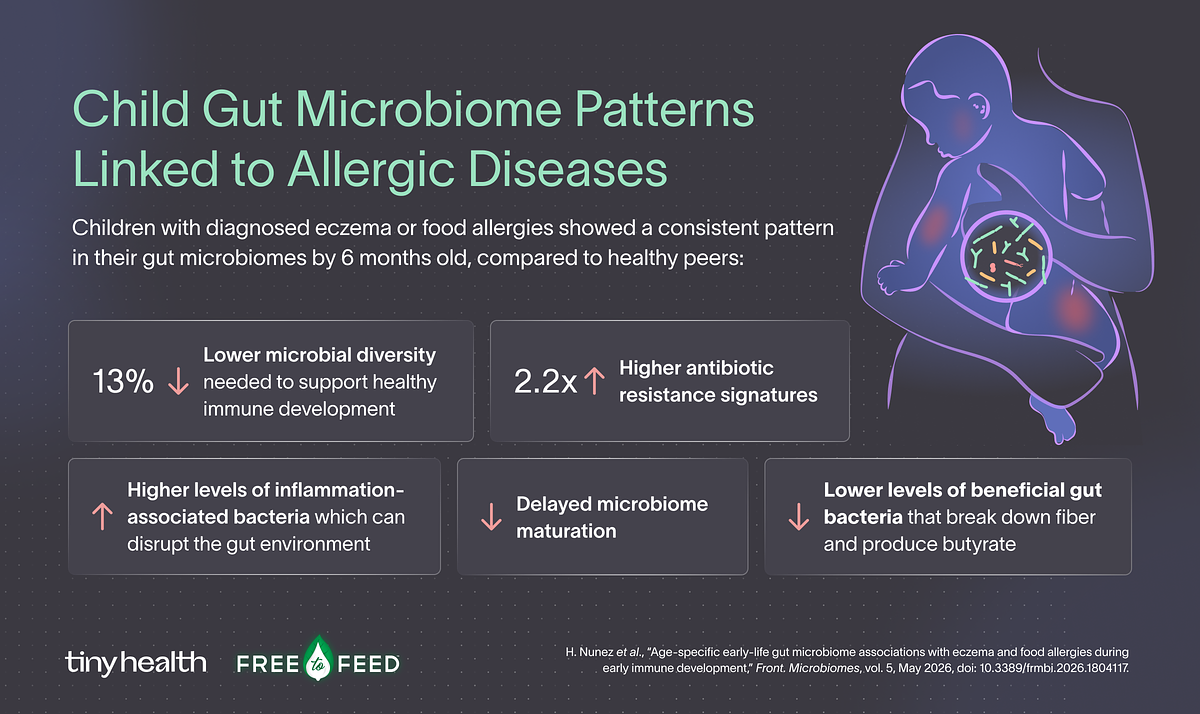
- 13% lower microbial diversity in infants with allergies compared to healthy peers.
- 2.2 times higher antibiotic resistance signatures in allergic infants.
- 83% reduction in eczema risk with personalized gut health support in C-section babies.
Experts agree that early gut microbiome analysis could revolutionize infant allergy prevention, offering a proactive approach to immune system development.
The 6-Month Warning: Microbiome Science Tackles Infant Allergies
AUSTIN, TX – June 02, 2026 – For the one in four American children with a diagnosed allergic condition, the journey often begins with the itchy, inflamed skin of eczema in infancy. This first step can trigger a cascade known as the “atopic march”—a progression to food allergies, hay fever, and asthma. For decades, parents and clinicians have been largely reactive, managing symptoms as they appear. A new study, however, suggests the first warning signs may appear months earlier, not on the skin, but deep within the gut.
Research published today in the peer-reviewed journal Frontiers in Microbiomes reveals that the gut microbiome of infants destined to develop eczema or food allergies begins to diverge from their healthy peers as early as six months of age. The study, a collaboration between precision microbiome platform Tiny Health and infant feeding advocacy group Free to Feed, provides a potential roadmap for an entirely new paradigm: one of proactive intervention, armed with data, to rewrite a child’s allergic story before it fully begins.
The Six-Month Signal
While the gut microbiomes of all infants appear largely similar in the first few months, the new research identified a critical turning point. Between six and twelve months, a distinct and persistent microbial signature emerges in allergic children. This isn't just a minor variation; it's a pattern of delayed development and imbalance that has profound implications for the maturing immune system.
Researchers analyzed stool samples from 97 children and found that those with physician-confirmed allergies exhibited, on average, 13% lower microbial diversity. This suggests their internal ecosystem was maturing more slowly, failing to build the resilient, varied community needed for healthy immune function. “This study gives us a clearer picture of how the gut microbiome differs in children with eczema or food allergies,” said Kimberley Sukhum, PhD, Chief Science Officer at Tiny Health. “By defining these early microbiome patterns and when they begin to diverge, we can better understand opportunities for early intervention.”
The divergences are specific and measurable. Allergic infants showed lower levels of beneficial bacteria known for producing butyrate—a critical short-chain fatty acid that nourishes the gut lining and helps regulate the immune system, preventing it from overreacting to harmless triggers like food. Concurrently, they had higher levels of inflammation-associated bacteria. The study also found that these infants carried 2.2 times higher signatures for antibiotic resistance, a marker often linked to a less stable gut environment. This body of evidence points to a gut that is under-equipped and over-inflamed, creating fertile ground for the development of allergic disease.
This work builds on a previous randomized controlled trial by Tiny Health, which found that personalized gut health support could cut the odds of eczema in C-section babies by a staggering 83%. Together, the studies fortify the argument that the first 1,000 days of life are a critical window not just for observation, but for action.
The Business of Bugs: Translating Science into Solutions
The science is compelling, but its real-world impact hinges on translating complex data into actionable tools for families. This is the frontier where companies like Tiny Health are building their business. Founded in 2020 by Cheryl Sew Hoy, who was driven by her own daughter’s struggles with eczema, the company is at the forefront of the burgeoning pediatric precision health market.
Instead of older, less detailed 16S sequencing, Tiny Health employs shotgun metagenomic sequencing. This clinical-grade technology allows for a high-resolution analysis of the entire genetic material in a sample, identifying over 120,000 microbes—including bacteria, fungi, and viruses—and assessing their functional capacity. This data is then processed through a proprietary AI pipeline, which compares an individual’s microbiome against one of the world's largest longitudinal datasets to spot deviations and generate personalized action plans.
The market is responding. Since its 2022 launch, the company has seen 25% month-over-month growth and recently closed an $8.5 million Series A funding round. In a powerful vote of confidence, 25% of that funding came from its own customers—parents who found value in the platform. This demonstrates a clear demand for solutions that move beyond the “guesswork and generic advice” that Dr. Trill Paullin, CEO of Free to Feed, says families are tired of.
Free to Feed tackles the problem from a different angle, focusing on education, advocacy, and direct support for parents navigating food reactivity, particularly while breastfeeding. With a patented technology in development for detecting allergens in breast milk, both companies are part of a growing industry focused on empowering parents with data-driven tools, transforming a reactive healthcare problem into a proactive wellness opportunity. The challenge, as Tiny Health’s CEO admits, is educating a market that isn’t yet searching for “proactive baby gut health,” a hurdle common to any disruptive technology.
Empowering Parents in a New Era of Prevention
For parents navigating the anxieties of infant health, these findings offer something more valuable than just data: hope. The atopic march is not just a clinical term; it's a stressful, often exhausting journey of elimination diets, sleepless nights, and a constant search for triggers. The ability to identify risk months before the first serious flare-up of eczema or a frightening allergic reaction to food could fundamentally change that experience.
“Families come to us because they're tired of guesswork and generic advice. They want answers built around their child’s specific situation,” noted Dr. Paullin. This research helps define a window where microbiome support may meaningfully shape immune development, and that gives us something concrete to keep studying.”
This new focus on the microbiome aligns with other recent shifts in allergy prevention. Guidelines from major health organizations have already pivoted dramatically, now recommending the early introduction of allergens like peanuts for many infants—a complete reversal of previous advice. Microbiome monitoring and support could represent the next logical step in this proactive strategy, offering a personalized way to prime the immune system for success.
By understanding the specific microbial deficiencies or overgrowths in their child, parents and practitioners could theoretically implement targeted interventions, from specific probiotics and prebiotics to dietary adjustments, long before the immune system is mis-wired. The goal is to build a robust, balanced gut ecosystem that is less prone to the inflammatory responses that underpin allergic disease.
“We started Tiny Health because we believed the microbiome holds answers that families aren’t getting anywhere else,” said Cheryl Sew Hoy, CEO and Founder of Tiny Health. “This research with Free to Feed brings us closer to a future where parents and clinicians can identify early signs of allergy risk and personalize support before allergic disease becomes part of a child’s story.”