
- 52% of companies execute fewer than one in four AI-driven prescriptions, highlighting the 'execution gap'.
- 90% reduction in physical footprints and complex cabling with software-defined controls.
- 10x faster industrial application development with SUPCON's AppBuilder tool.
Experts agree that SUPCON's 'Zero-Touch Operations' roadmap addresses a critical industry challenge—the 'execution gap'—by integrating AI-driven insights with real-time autonomous controls, marking a pivotal step toward fully autonomous industrial plants.
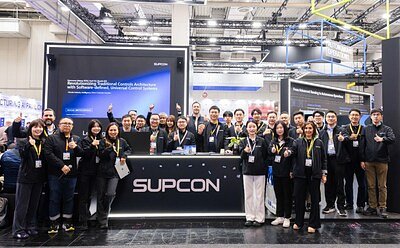
SUPCON Charts Course for 'Zero-Touch' Autonomous Industrial Plants
HANNOVER, Germany – May 05, 2026 – Industrial automation leader SUPCON today unveiled a comprehensive roadmap for what it calls “Zero-Touch Operations,” presenting a future where industrial plants can run autonomously. At the prestigious Hannover Messe 2026, the company showcased a suite of new technologies, including agentic AI and software-defined controls, designed to bridge the critical gap between generating data and executing actions in real time.
For years, the process industry—spanning sectors like oil and gas, chemicals, and power generation—has invested heavily in digital transformation, amassing vast quantities of operational data. Yet, a persistent challenge has been translating this data into timely, reliable, and automated actions. SUPCON’s presentation framed this challenge as the industry’s “execution gap,” a primary barrier to realizing the full potential of AI and Industry 4.0.
“Industrial AI has reached a critical turning point. It is no longer just about generating insights, but about embedding them within closed-loop controls to achieve peak performance,” said Kenneth Lim, Director of Strategy and Marketing at SUPCON International Business, during the event. “Our role is to provide the industry with an open, reliable foundation that allows our customers to scale at their own pace, ensuring that today's investments remain future-proof for decades of innovation ahead.”
A Widening Chasm: The Industrial 'Execution Gap'
The problem SUPCON aims to solve is not theoretical; it is a well-documented and costly reality for manufacturers worldwide. The “execution gap” refers to the disconnect between AI-generated recommendations and their actual implementation on the factory floor. While plants are saturated with sensors and analytics platforms, the final step—acting on the insights—often remains a manual, slow, and inconsistent process.
Recent industry research underscores the severity of this issue. Some studies indicate that a staggering 52% of companies execute fewer than one in four AI-driven prescriptions. Even among digitally mature organizations, execution rates struggle to surpass 50%. The reasons are complex, ranging from a lack of trust in AI recommendations and conflicts with immediate production priorities to a simple inability to process insights and translate them into control system commands quickly enough. This gap costs industries billions in unrealized efficiency gains and is widely seen as the defining challenge for the current generation of industrial AI.
SUPCON’s strategy directly confronts this chasm by creating an integrated ecosystem where data flows seamlessly from sensor to decision and back to execution, forming a continuous, self-optimizing loop.
An Integrated Architecture for Autonomy
At the heart of SUPCON's vision is not a single product but a unified foundation built on several key technological pillars, designed to work in concert to enable Autonomous Operating Plants (AOP).
First is the Universal Control System (UCS), a move towards software-defined controls. This revolutionary architecture decouples control logic from specific hardware, promising to reduce physical footprints and complex cabling by up to 90%. Beyond the significant cost and space savings, this directly supports corporate sustainability goals by lowering the carbon footprint associated with large-scale hardware installations.
Feeding this system is an open data infrastructure built on two components. The company highlighted its adoption of Ethernet-APL, a high-speed communication standard that brings robust connectivity directly to field instruments in hazardous environments, turning passive sensors into active sources of real-time intelligence. This data is then unified by Tier0, an IIOT platform based on a Unified Namespace (UNS). By creating a single, event-driven source of truth for all operational data, Tier0 is designed to eliminate the costly “integration tax” that plagues projects involving multiple vendors and fragmented systems.
The intelligence layer is powered by the Time-series Pre-trained Transformer (TPT2). Unlike general-purpose Large Language Models, TPT2 is an AI model purpose-built for the unique patterns of industrial time-series data. Pre-trained on vast datasets, it can consolidate previously siloed AI use cases—such as equipment health forecasting, bottleneck analysis, and quality control—into a single, scalable AI layer. This allows the system to learn and predict outcomes with greater accuracy and speed.
Finally, Artificial Intelligence Optimization (AIO) acts as the autonomous decision-making brain. AIO goes beyond traditional control systems by using the insights from TPT2 to feed optimized decisions directly back into the UCS. This closed-loop approach enables the plant to self-optimize for throughput, energy efficiency, and safety simultaneously, without requiring constant manual intervention.
Empowering the Augmented Workforce
While the term “autonomous plant” can evoke images of facilities devoid of human workers, SUPCON presented a vision centered on empowerment, not replacement. The company argued that technology’s role is to liberate engineers and operators from dangerous, mundane, and repetitive tasks, allowing them to focus on high-value creative problem-solving and strategic oversight.
An example showcased was the use of autonomous robots as “mobile sensors” for tasks like leak detection in hazardous areas, protecting human workers while gathering crucial data. Furthermore, the introduction of AppBuilder, an agentic application development tool, demonstrated how factory teams could use natural language to build and deploy industrial applications up to 10 times faster. This shifts the paradigm from costly, specialized customization to rapid, user-centric creation, putting powerful tools directly in the hands of domain experts on the plant floor.
This transition points to a necessary evolution of the industrial workforce. The skills in demand will shift from manual operation to digital fluency, data analysis, and systems thinking. The future industrial worker will be an adept collaborator with AI, supervising intelligent systems, validating their outputs, and intervening when complex, non-routine challenges arise. This human-machine partnership is positioned as the key to navigating the increasing complexity of modern industrial operations.
As SUPCON and its competitors—including established giants like Siemens, Emerson, and Rockwell Automation—race to deliver on the promise of autonomy, the focus is clearly shifting. The industry is moving past piecemeal solutions and toward integrated, open platforms that can manage the entire operational lifecycle. The vision laid out at Hannover Messe 2026 suggests that the journey to a fully autonomous plant is a strategic transformation of technology, processes, and people, built on a unified foundation designed for decades of future innovation.