
- 350 MW of AI capacity: Soluna is in active discussions for 350 MW of AI computing capacity at its Project Kati 2 site.
- 300 MW roadmap: Project Kati 2 has a long-term plan to support over 300 MW of critical IT capacity.
- 500 acres secured: Soluna has already secured over 500 acres of additional land for future projects.
Experts would likely conclude that Soluna's strategic pivot to AI and HPC, leveraging stranded renewable energy, positions the company as a key player in solving the industry's energy crisis, though its financial viability remains a critical factor in long-term success.
Soluna's Green AI Pivot: Powering HPC with Stranded Renewable Energy
ALBANY, N.Y. – March 10, 2026 – Soluna Holdings, Inc. (NASDAQ: SLNH) is rapidly accelerating its push into the power-hungry world of artificial intelligence, a strategic pivot detailed in its latest monthly business update. While continuing to scale its Bitcoin mining operations, the green data center developer is making significant strides in building out massive new facilities designed for AI and High-Performance Computing (HPC), betting that its unique model of using stranded renewable energy can solve the industry's looming power crisis.
The company announced substantial construction progress, new partnerships, and a growing pipeline of projects, signaling a dual-pronged strategy: solidifying its base in digital asset infrastructure while aggressively courting the exponentially growing AI market. This includes the completion of a 6 MW expansion for crypto hosting firm Blockware at its Project Dorothy site and advancing its massive Project Kati campus in Texas.
The Green AI Gold Rush
At the heart of Soluna's evolving strategy is the race to meet the colossal energy needs of AI. As the company’s CEO, John Belizaire, has recently highlighted in industry discussions, the sector is facing an “AI Energy Wall,” where the demand for computational power is outstripping the capacity of traditional energy grids. Soluna aims to be a key part of the solution by developing data centers specifically for this market.
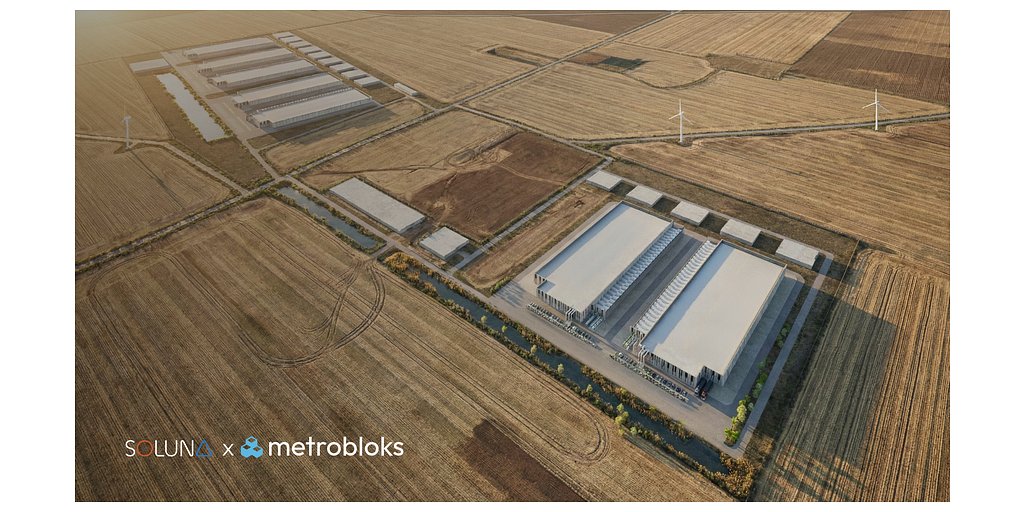
The most significant move in this direction is Project Kati 2 in Willacy County, Texas. The company is co-developing the site with AI infrastructure specialist Metrobloks, planning an initial phase of over 100 megawatts of critical IT capacity. This is just the beginning, with a roadmap to support over 300 MW at the campus. According to the latest update, Soluna is already in active discussions with a growing list of prospective tenants interested in a combined 350 MW of capacity, with negotiations on service agreements and financing underway.
To expedite the project, the company is refining its procurement strategy and plans to issue a new Request for Proposal (RFP) for design services. This will advance the initial phase to a 30% schematic design, a crucial step in finalizing technical specifications for potential customers in the rapidly evolving GPU market. In a sign of commitment and urgency, Soluna has already begun procuring long-lead power equipment for the site.
This push comes as worldwide spending on AI-supporting technologies is projected to soar, with enterprises increasingly embedding AI into their core operations. Soluna is positioning itself to capture a niche but vital segment of this market: sustainable, rapidly deployable computing power.
Powering the Grid, Not Just Processors
Soluna’s core value proposition rests on a symbiotic relationship with renewable energy producers. The company builds its data centers directly adjacent to large-scale wind, solar, or hydroelectric plants, specifically designing them to absorb surplus or “curtailed” energy that the grid cannot otherwise use. This model aims to solve two problems simultaneously: it provides data centers with a source of low-cost, green power, and it offers renewable energy operators a profitable outlet for their excess generation, improving their financial viability and encouraging further green energy development.
This integration is managed by Soluna’s proprietary software, MaestroOS™, which orchestrates the delicate balance between intermittent power supply and the constant demands of high-intensity computing. The software allows the data centers to act as a responsive load, ramping power consumption up or down to help stabilize the local energy grid.
This model is already in practice across its portfolio. Project Dorothy in Texas is a 50 MW campus powered by wind. The expanding Project Kati is also wind-powered. Looking ahead, the company is diversifying its energy sources, with projects like Annie and Fei slated to be co-located with large solar farms. By tackling the problem of wasted energy, Soluna claims its pipeline of projects could eventually displace millions of metric tons of CO2.
Scaling Operations Amid Financial Scrutiny
While the AI pivot represents the future, Soluna’s update shows it is also executing on its existing Bitcoin-focused projects. At its Project Dorothy 1A site, customer deployments are bringing the facility back to full capacity, including a 20 MW fleet upgrade and the completion of an 11 MW deployment for Canaan. Meanwhile, its other Bitcoin hosting sites, Dorothy 1B, Dorothy 2, and Sophie, all reported strong operations with minimal curtailment.
At the massive Project Kati 1 site, construction is moving at a brisk pace. The first 24 MW phase is now fully commissioned and operational, with two subsequent 12 MW phases running ahead of schedule for completion in March. This operational momentum is crucial for generating revenue and demonstrating the company's ability to deliver complex projects.
However, this aggressive expansion comes against a challenging financial backdrop. Trading on the Nasdaq under the ticker SLNH, the company's stock has shown significant volatility. While it has gained ground over the past six months, it has recently seen a decline, and analysts currently hold a consensus “Hold” rating. With recent quarterly revenues missing estimates and a reported negative operating cash flow, investors are watching closely to see if the company’s high-growth, high-spend strategy will pay off. Soluna is burning through cash to build out its footprint, but it projects it will achieve positive EBITDA in 2026, a critical milestone that will test the viability of its long-term vision.
Building the Pipeline for a Digital Future
Soluna is not slowing down. Beyond the immediate construction at Kati, the company is actively advancing a deep pipeline of future projects. It is finalizing Power Purchase Agreements (PPAs) for projects codenamed Rosa, Ellen, and Hedy, and is conducting due diligence on land for these sites as well as for Project Annie. To support future growth, the company has already secured over 500 acres of additional land.
This forward planning is essential as the company works to secure the massive, multi-year contracts typical of the AI and HPC sectors. The successful 6 MW expansion for Blockware and the full deployment for Canaan underscore its ability to serve the Bitcoin hosting market, while the ongoing negotiations for 350 MW of AI capacity at Kati 2 represent a potential company-transforming opportunity.
As Soluna continues to build, it operates at the critical intersection of digital infrastructure and the green energy transition. The company is making a bold wager that its unique ability to convert otherwise wasted renewable power into the computational resources needed for Bitcoin and AI will provide a sustainable and profitable path forward. For Soluna, the challenge is to execute its ambitious construction and development pipeline flawlessly while navigating a financial market that remains cautious about its capital-intensive strategy.
Topics & Related
AI & Machine Learning
Generative AI
ESG
Artificial Intelligence
Clean Energy Transition
Bitcoin
ChatGPT
Revenue
EBITDA
Net Income
Market Capitalization
IPO
Related Company Pulse