
- 1.6T throughput: ENET's new transceiver offers 1.6 terabits per second of total throughput, designed to address AI's data demands.
- $1.5B market projection: Demand for 1.6T optical transceivers is expected to reach over $1.5 billion within five years.
- 7M units in 2026: Industry analysts predict demand for these high-speed modules could reach as many as 7 million units in 2026 alone.
Experts agree that ENET's 1.6T transceiver is a critical step in addressing AI's insatiable data demands, but the industry must also balance speed with power efficiency and sustainability challenges.
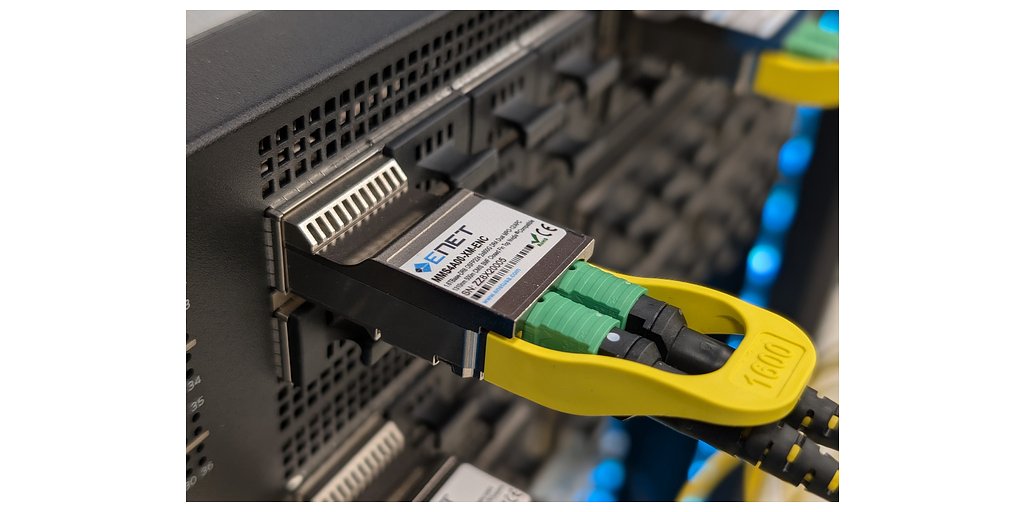
ENET Joins 1.6T Race, Fueling AI's Insatiable Data Demand
ALISO VIEJO, CA – March 05, 2026 – As the artificial intelligence boom places unprecedented strain on the world's digital infrastructure, ENET, a division of NSI Industries, has stepped into the high-speed connectivity arena with the launch of its 1.6T DR8 OSFP224 optical transceiver. The new component is engineered to form the high-throughput backbone for the next generation of AI clusters, high-performance computing (HPC), and hyperscale data centers that are grappling with explosive data growth.
The announcement comes at a critical juncture for the tech industry. AI computing demand is doubling every three to four months, a pace that far outstrips Moore's Law and puts immense pressure on the networks that connect powerful GPU clusters. Without faster, denser, and more efficient interconnects, the progress of AI itself risks hitting a wall. ENET's new transceiver, offering a staggering 1.6 terabits per second of total throughput, is designed to be a crucial part of the solution to this impending data bottleneck.
Building the AI Superhighway
At the heart of the new offering is its ability to handle massive data loads with precision. The 1.6T DR8 OSFP224 operates over eight lanes, each carrying 200G of data using advanced PAM4 electrical signaling, and supports the latest 224G industry standards. This technical configuration is purpose-built for the dense, high-bandwidth fabrics required to link thousands of GPUs working in concert on complex AI training and inference tasks.
“As AI models grow larger and clusters become more complex, networks need to offer consistent, high-speed performance,” said Jason Barrette, VP of Sales and Operations at ENET, in the company's announcement. “Our 1.6T DR8 OSFP224 is designed for demanding GPU interconnects and advanced switching environments, where bandwidth, density, and reliability are crucial for maximizing computing power.”
The component is designed for use in spine, leaf, and accelerator topologies, ensuring strong signal integrity and low error rates over parallel single-mode fiber. It also includes built-in digital diagnostics via CMIS 5.3, allowing network operators to monitor key performance metrics in real time—a vital feature for proactively managing the health of vast, complex network fabrics where a single point of failure can disrupt multi-million dollar AI workloads.
A High-Stakes Market Heats Up
ENET is entering a fiercely competitive and rapidly expanding market. The demand for 1.6T optical transceivers is projected to surge from a nascent market today to over $1.5 billion within the next five years. Industry analysts predict that demand for these high-speed modules could reach as many as 7 million units in 2026 alone, driven almost entirely by the needs of hyperscale data center operators and AI infrastructure.
Major cloud vendors like Meta, Google, and Microsoft are leading this charge, making massive investments to upgrade their data center backbones. Meta, for example, has indicated its next-generation AI data center architecture will rely heavily on 1.6T interconnects and plans to increase its optical module budget by a staggering 90% in 2025 to procure the necessary 800G and 1.6T components.
This lucrative landscape has attracted a host of established and emerging players. ENET will be competing with industry giants like Broadcom, Coherent, and Cisco, who have already demonstrated 1.6T components. Simultaneously, agile manufacturers such as Innolight, Eoptolink, and Accelink are aggressively expanding their production capacity to meet the overwhelming demand, which continues to outstrip supply. ENET's strategy appears to be leveraging its position within NSI Industries' Network Infrastructure division to provide a reliable, high-performance alternative for customers seeking to diversify their supply chain and maximize their IT budgets.
The Density and Power Dilemma
Beyond raw speed, the new generation of transceivers addresses a core challenge for data center operators: the density dilemma. As computing demands grow, operators must fit more processing power into a finite physical footprint. By consolidating the bandwidth of multiple lower-speed links into a single 1.6T port, the OSFP224 form factor allows for denser switch faceplates, enabling more connections and higher overall throughput per rack.
However, this increase in performance and density comes with a significant cost: power consumption. The AI revolution is an energy-intensive one. Some AI training facilities are projected to require over a gigawatt of power—equivalent to a small city—making power availability the single greatest bottleneck for future data center expansion. Each component within the data center, from the GPU to the optical transceiver, contributes to this energy draw.
While 1.6T pluggable modules are more power-efficient on a per-bit basis than their predecessors, the sheer number of them required for large AI clusters presents a formidable challenge to data center power usage effectiveness (PUE) and sustainability goals. The industry is in a constant battle to improve efficiency, as every watt saved can translate into significant operational cost reductions and a smaller environmental footprint.
Beyond Pluggables: The Quest for Ultimate Efficiency
The challenge of power consumption has spurred the industry to look beyond traditional pluggable modules toward a more integrated future. The next frontier in high-speed interconnects involves technologies like Co-Packaged Optics (CPO) and Linear Drive Pluggable Optics (LPO), which promise dramatic reductions in power usage.
CPO involves moving the optical components from a detachable module directly onto the same package as the network switch's main ASIC. By shortening the electrical traces between the chip and the optics to mere millimeters, CPO can slash interconnect power consumption from around 15 picojoules per bit for a pluggable module to as low as 5 pJ/bit, with a roadmap to under 1 pJ/bit. Major players like Nvidia are reportedly planning to introduce CPO in a limited capacity as early as 2025, with large-scale deployment expected across the industry around 2026-2027.
While CPO represents a long-term shift, the current generation of pluggable transceivers, including ENET's new 1.6T offering, remains indispensable. These modules provide the flexibility and immediate bandwidth upgrade path that data centers need today to keep pace with AI's relentless advance. The ongoing evolution of the data center network will likely depend on a hybrid ecosystem where high-performance pluggables serve immediate needs while the industry transitions toward even more efficient, integrated optical solutions.