
- 65%: Forecasted curtailment rate for new solar farms in Victoria and South Australia by 2027
- 4.5%: Average curtailment rate for existing solar farms in Australia
- 1.6MW: IT load capacity of WinDC’s modular AI Factories
Experts view this partnership as a groundbreaking solution to Australia’s renewable energy curtailment problem, positioning the country as a leader in sustainable AI infrastructure and digital sovereignty.
Australia Turns Wasted Green Energy into Global AI Power
SYDNEY, NSW – January 28, 2026 – A landmark partnership announced today is set to transform Australia’s vast renewable energy potential into a global export of artificial intelligence services, tackling one of the nation’s most pressing energy challenges in the process. Australian infrastructure innovator WinDC has joined forces with global network provider Megaport to connect its novel, renewable-powered “AI Factories” to the world.
The strategic alliance will leverage Megaport’s Network as a Service (NaaS) platform to provide global, high-speed access to high-density AI compute located directly at Australian solar, wind, and hydro generation sites. This move pioneers a new category of sustainable AI infrastructure, aiming to position Australia as a leader in clean technology and sovereign compute capabilities.
A Solution to Australia's Energy Paradox
Australia is a world leader in renewable energy generation, but its grid infrastructure has struggled to keep pace. This mismatch creates a significant and costly problem: renewable energy curtailment. When solar and wind farms produce more power than the grid can absorb or transmit, their output is deliberately reduced, wasting clean energy and undermining the financial viability of green projects.
The Australian Energy Market Operator (AEMO) has issued stark warnings about this trend, forecasting that hypothetical new solar farms in Victoria and South Australia could see up to 65 percent of their power curtailed by 2027. Already, existing solar farms across the National Electricity Market average a curtailment rate of 4.5 percent, with wind power curtailment also on the rise. This wasted potential represents billions of dollars in lost value and a major obstacle to the nation’s energy transition.
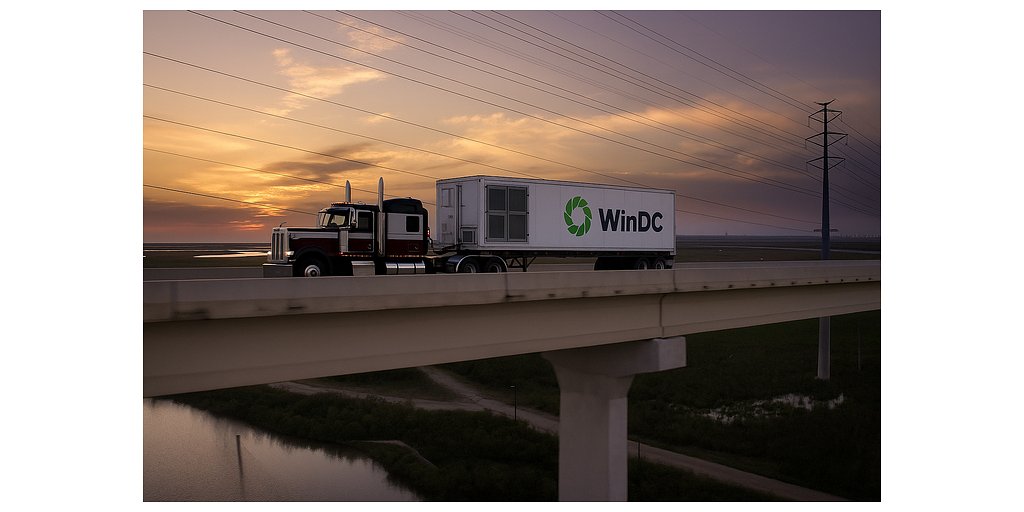
WinDC’s model directly addresses this paradox. Instead of building power-hungry data centers in congested urban areas, the company deploys modular, high-density compute units—dubbed AI Factories—directly “behind the meter” at renewable generation sites. These factory-built ISO containers, delivering up to 1.6MW of IT load, are designed to consume surplus energy that would otherwise be wasted. By turning stranded electrons into valuable computation, WinDC creates a new revenue stream for energy producers and a source of 100% renewable-powered compute for AI workloads.
“WinDC is addressing an urgent and legitimate gap in Australia’s digital infrastructure,” said Michael Reid, CEO of Megaport. “They are turning stranded renewable energy into usable AI compute.”
Forging a Global AI Superhighway
Generating massive amounts of AI compute at remote locations is only half the solution; making it securely and reliably accessible to global customers is the other. This is where Megaport’s role becomes critical. The company's global Software Defined Network (SDN) acts as a high-speed digital superhighway, connecting WinDC’s distributed AI Factories to the rest of the world.
Through Megaport’s NaaS platform, organizations can establish private, low-latency connections from WinDC’s infrastructure to major cloud providers like AWS, Microsoft Azure, and Google Cloud, as well as to their own enterprise networks. This private connectivity fabric, which spans over 1,000 locations in 26 countries, ensures that data-intensive AI training and inference tasks can be run with the security and performance of a local data center, regardless of geographic distance.
This integration effectively bypasses the public internet, offering predictable performance and enhanced security essential for sensitive AI workloads. The model allows an enterprise in Europe or North America to provision and run advanced AI models on Australian solar power with the same ease as connecting to a data center in their own city.
“By connecting WinDC to our global platform, we are making that capability available to thousands of organisations worldwide and giving Australia the opportunity to export clean, sovereign AI,” Reid added. “It is an exciting step forward for Australia’s AI ambitions.”
Redefining AI Infrastructure and Sovereignty
The partnership represents a fundamental shift away from the traditional data center paradigm. For decades, digital infrastructure has been defined by massive, centralized facilities that place enormous strain on urban power grids and water supplies. WinDC claims its decentralized approach allows for AI infrastructure that deploys eight times faster and runs at half the cost of these legacy models, all while operating on 100% renewable energy.
“Australia cannot become a leader in AI without a new approach to infrastructure,” said Andrew Sjoquist, Founder and CEO of WinDC. “WinDC delivers the compute at the source of clean power. Megaport delivers the connectivity that makes it accessible everywhere. Together, we provide a scalable pathway for organisations to run advanced AI workloads on renewable energy, independent of grid congestion or urban infrastructure constraints.”
Beyond the technical innovation, the initiative carries significant geopolitical weight. By building a domestic AI processing capability powered by its own natural resources, Australia is making a strong bid for “sovereign AI.” This reduces reliance on foreign infrastructure for critical data processing, enhancing national security and economic independence in an increasingly digital world. As governments worldwide grapple with data residency and digital sovereignty, this model provides a powerful blueprint for national control over strategic technology assets.
The Path Forward: Opportunities and Hurdles
The timing of this venture aligns with an explosion in demand for AI, which has also brought a sharp focus on the technology's immense energy consumption. As companies face mounting pressure to meet ESG (Environmental, Social, and Governance) targets, the market for “Green AI” is poised for rapid growth. While other green data center projects are underway in Australia, WinDC’s focus on directly monetizing curtailed energy gives it a unique position in a competitive field.
The first of WinDC’s portable data centers are scheduled to arrive in Australia in early 2026, signaling a near-term reality for this ambitious vision. However, the path forward will involve navigating logistical and regulatory challenges. Deploying infrastructure in remote locations requires robust planning, and ensuring consistent, high-bandwidth connectivity via fibre, 5G, or satellite services like Starlink will be crucial for success. Furthermore, the project will need to align with evolving energy market regulations and environmental land use policies.
Despite these hurdles, the customer proposition is compelling. Speaking to the market opportunity, Jonathan Staff, Executive Director at WinDC, said, “Our partnership with Megaport means WinDC’s capabilities are immediately accessible to Megaport customers globally. It has never been easier for organisations to consume Enterprise Green Edge infrastructure and Green AI services. Whether you are neo-cloud, research-driven or running global operations, you can now reach sovereign, renewable-powered compute with the same simplicity as provisioning any other Megaport service.”