
- AI data center racks can draw over 30 kW, with next-generation hardware projected to push densities past 600 kW.
- Cooling systems can account for up to 40% of a data center's total energy usage.
- South Korea's data center operational capacity is projected to reach nearly 1,500 MW in the coming years.
Experts agree that advanced cooling solutions must be integrated into data center design from the outset to manage AI's thermal challenges, ensure operational efficiency, and meet sustainability goals.
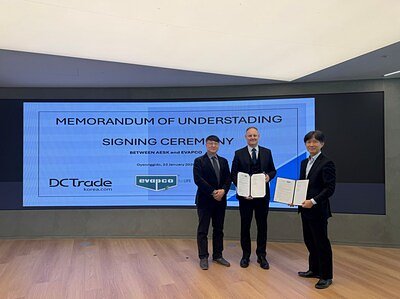
Strategic Alliance to Cool South Korea's Surging AI Data Centers
SEOUL, South Korea – February 11, 2026 – In a move that signals a strategic shift in data center development, Korean consulting specialist DCTradeKorea has announced a formal partnership with global thermal management leader EVAPCO. The Memorandum of Understanding (MOU), signed January 22, aims to tackle one of the most critical bottlenecks in the artificial intelligence revolution: the immense heat generated by next-generation computing.
As AI and cloud computing workloads become more complex, the data centers that power them are facing an unprecedented thermal crisis. This new collaboration intends to embed advanced cooling strategies into the very blueprint of future facilities, moving thermal management from an operational afterthought to a foundational design principle.
The Unseen Crisis: AI's Thermal Challenge
The explosive growth of AI has fundamentally altered the architecture and economics of data centers. Traditional facilities, designed for server racks consuming 5 to 10 kilowatts (kW) of power, are ill-equipped for the demands of modern AI clusters. Racks filled with powerful GPUs can draw over 30 kW, with next-generation hardware projected to push densities past 600 kW—generating heat that conventional air-cooling systems simply cannot manage effectively.
This surge in power density creates significant operational risks, including equipment failure and performance throttling. More critically, it has profound implications for energy consumption. Cooling systems can already account for up to 40% of a data center's total energy usage. As densities rise, this figure is set to skyrocket, threatening both operational budgets and sustainability goals. Industry projections underscore the scale of the challenge, with global data center capital expenditures expected to reach an astonishing $1.7 trillion by 2030, a large portion driven by AI-specific infrastructure needs.
This reality is forcing a paradigm shift. The industry is rapidly moving toward advanced liquid cooling solutions, such as direct-to-chip and immersion technologies, which offer vastly superior heat transfer efficiency. The partnership between a data center brokerage firm and a cooling technology provider highlights a growing recognition that these solutions must be integrated from day one.
A New Blueprint for Infrastructure
The collaboration between DCTradeKorea and EVAPCO represents a novel approach to this challenge. DCTradeKorea, which bills itself as Korea's first specialized data center consulting platform, provides services spanning the entire project lifecycle, from site selection and brokerage to feasibility analysis. By partnering with EVAPCO, a global manufacturer of high-efficiency cooling towers, dry coolers, and other thermal management systems, the consultancy can now offer a much deeper level of technical due diligence at the earliest stages of a project.
According to the announcement, the MOU establishes a cooperative foundation to "more systematically review cooling and thermal management elements" during consulting processes. This means that from the moment a potential data center site is assessed, considerations like cooling design, water usage, and long-term energy efficiency will be central to the analysis. This integrated approach promises a more realistic project review environment, directly influencing a facility's long-term operational costs and its ability to support high-density workloads.
For clients, this translates into infrastructure planning that is not just about securing land and power but about designing a facility that is technically viable, financially sustainable, and future-proofed against the relentless march of technology. It marks a departure from the traditional model where core infrastructure decisions are made before specialized technical experts are brought into the fold.
Cooling Korea's Digital Ambitions
Nowhere is this strategic shift more relevant than in South Korea. The nation is a burgeoning data center hub in Asia, with projections showing its operational capacity could reach nearly 1,500 MW in the coming years. This growth is fueled by the government's strong push into AI and a robust digital economy. However, this ambition is colliding with significant infrastructure and environmental challenges.
South Korea is grappling with power supply constraints, particularly in the metropolitan Seoul area where most data centers are concentrated. The government's Distributed Energy Act, which came into force in 2024, is actively trying to decentralize power consumption. Furthermore, the country is bound by a national goal to achieve carbon neutrality by 2050, putting immense pressure on energy-intensive industries like data centers to improve efficiency and adopt renewable energy sources.
By focusing on energy-efficient cooling from the outset, the DCTradeKorea-EVAPCO partnership directly addresses these regulatory and ESG (Environmental, Social, and Governance) pressures. Offering clients a clear path to lower Power Usage Effectiveness (PUE) and Water Usage Effectiveness (WUE) metrics can become a powerful competitive advantage. It aligns data center development with national policy, helping to enable Korea's AI ambitions in a more sustainable and grid-friendly manner.
The Rise of the Specialist
The agreement is more than just a local business deal; it reflects a broader maturation of the global data center industry. As facilities evolve from being viewed as specialized real estate to critical, complex strategic infrastructure, the demand for deep, niche expertise is growing. The one-size-fits-all approach is no longer sufficient for an industry defined by hyperscale and high-performance computing.
While the data center cooling market is crowded with formidable players like Vertiv, Schneider Electric, and Johnson Controls, the innovative aspect of this MOU lies in its collaborative model. By uniting a market-making consultant with a technology provider, the partnership creates a streamlined channel for deploying advanced solutions where they are needed most: at the project's inception.
The industry will be watching to see if this model of deep specialization and proactive collaboration becomes a new standard. As the digital world continues to expand, the ability to build and operate data centers that are both powerful and efficient will be paramount, and partnerships like this may provide the essential blueprint for future success.