
- Two new Edge AI platforms: SBOX-2625 (workhorse) and ABOX-5221 (thoroughbred) for smart factory automation.
- Security compliance: Adherence to IEC 62443-4-1 standard for cyber resilience.
- AI-powered quality control: ABOX-5221 enables real-time defect detection, reducing scrap rates and rework.
Experts would likely conclude that SINTRONES' dual-platform approach, combining reliable control with high-performance AI analytics and robust security, positions the company as a strong contender in the competitive smart manufacturing sector.
SINTRONES' Two-Pronged Attack on the Factory Floor: Power and Security
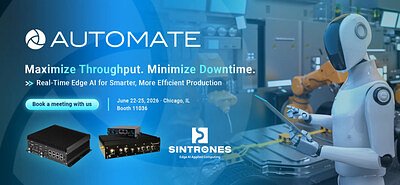
CHICAGO, IL – June 19, 2026 – The factory of the future is no longer a distant concept; it’s a competitive necessity being built today. As manufacturers grapple with relentless pressure to increase efficiency, eliminate defects, and fortify their supply chains, the battle for dominance is moving from the cloud to the concrete floor. This is the world of Edge AI, where intelligence is deployed directly alongside the machinery it controls. Into this fray steps SINTRONES Technology, a Taiwanese provider of rugged computing, armed with a new arsenal set to be unveiled at next week's Automate 2026 conference in Chicago.
The company's announcement of two distinct Edge AI platforms isn't just another product launch; it's a strategic maneuver that reveals a deep understanding of the modern industrial landscape. It’s a story of bifurcated needs—the demand for both foundational, reliable control and high-octane AI analytics—and the critical, non-negotiable layer of security that must underpin it all.
The Workhorse and the Thoroughbred
At the heart of SINTRONES' strategy are two new products, the SBOX-2625 and the ABOX-5221, each engineered for a different, yet complementary, role in the smart factory ecosystem. This isn't a one-size-fits-all approach; it's a targeted deployment of computing power where it's needed most.
The SBOX-2625 is the workhorse. An ultra-compact, fanless computer powered by Intel's N-series processors, it’s designed for the unglamorous but essential tasks of industrial automation: real-time equipment control, process synchronization, and factory-floor connectivity. Its compact form and low power consumption are not merely convenient features; they are critical for integration into crowded, often harsh, manufacturing environments where space and energy are at a premium. This device is the nervous system's steady hand, ensuring production lines run smoothly and efficiently without demanding the processing overhead of more complex AI tasks.
If the SBOX is the steady hand, the ABOX-5221 is the sharp eye. This is the thoroughbred, built for the demanding sprints of AI-powered machine vision. Powered by 14th Gen Intel Core processors and, crucially, an optional NVIDIA RTX discrete GPU, the ABOX-5221 delivers the computational muscle required for real-time, data-intensive workloads. The inclusion of NVIDIA's RTX architecture, with its dedicated Tensor Cores, is a clear signal of intent. This platform is designed to accelerate the complex deep learning models that drive modern quality assurance, from spotting microscopic defects on semiconductor wafers to verifying precision assembly in electronics manufacturing. Its flexible PCIe expansion allows for the integration of specialized hardware like frame grabbers, making it a versatile tool for the most demanding visual inspection tasks.
Translating Processing Power into Profit
For any C-suite executive or plant manager, the question isn't about processors or GPUs; it's about the bottom line. How does this technology reduce downtime, improve yield, and ultimately, increase profitability? This is where the story moves from silicon to strategy.
"Manufacturers are increasingly looking for solutions that can transform production data into actionable insights in real time," said Kevin Hsu, CEO of SINTRONES, in the company’s official announcement. This statement cuts to the core of the value proposition. The ABOX-5221, for example, enables automated optical inspection (AOI) systems to identify process anomalies and defects with a speed and accuracy that surpasses human capabilities. By catching these issues earlier in the production cycle, manufacturers can dramatically reduce scrap rates, minimize costly rework, and enhance overall product quality. This isn't just an incremental improvement; it's a fundamental shift in quality control, moving from reactive sampling to proactive, 100% inspection.
Similarly, the SBOX-2625 contributes directly to operational efficiency. By providing reliable, real-time control and connectivity for factory equipment, it helps maximize uptime and streamline production workflows. In an environment where a single hour of unplanned downtime can cost a large manufacturer hundreds of thousands of dollars, the value of a robust, dependable control unit cannot be overstated. These devices form the bedrock of predictive maintenance strategies, collecting and transmitting the sensor data that AI algorithms use to forecast equipment failures before they happen.
Fortifying the Factory Against Digital Threats
As factories become smarter and more connected, they also become more vulnerable. The convergence of Information Technology (IT) and Operational Technology (OT) has expanded the attack surface for cyber threats, turning industrial control systems into prime targets. A security breach in a factory doesn't just risk data loss; it risks production stoppages, equipment damage, and even physical safety.
This is arguably SINTRONES' most compelling strategic differentiator. The company’s explicit adherence to the IEC 62443-4-1 standard is more than just a certification; it's a declaration of principle. This framework mandates a "secure-by-design" approach, embedding cybersecurity throughout the entire product development lifecycle—from initial concept to final testing and ongoing maintenance.
For manufacturers, this provides a critical layer of assurance. Deploying AI-enabled automation systems from a vendor committed to this rigorous standard means they are not bolting security on as an afterthought but are building their smart factory on a foundation designed for cyber resilience. In a competitive market crowded with hardware from players like Advantech, Moxa, and Axiomtek, this focus on a globally recognized OT security standard could be the deciding factor for risk-averse industrial giants. It addresses one of the biggest hurdles to Industry 4.0 adoption: the fear of insecure integration.
As SINTRONES prepares to showcase these platforms at Automate 2026, it joins a chorus of technology providers promising a new era of manufacturing. But its message is nuanced. It’s a recognition that the future of industrial automation requires not just raw power for AI but also steadfast reliability for control, all wrapped in a verifiable security architecture. The challenge now is to prove that this balanced approach can deliver the productivity, quality, and peace of mind that modern manufacturers so desperately need.