
- 98% peak CO2 capture rate achieved by Carbon Ridge's centrifugal OCCS system during a five-month pilot.
- Up to 75% reduction in equipment size and volume compared to conventional solutions.
- 55% of observations during the trial fell within an 86-98% efficiency range.
Experts would likely conclude that Carbon Ridge's centrifugal OCCS technology represents a significant breakthrough in maritime decarbonization, offering high efficiency and practical viability for existing vessels, though the broader carbon value chain remains a critical challenge.
Shipping’s Carbon Crisis Meets Centrifugal Force: A Decarbonization Turning Point?
SANTA MONICA, CA – June 03, 2026
In the relentless pursuit of maritime decarbonization, the industry has long been caught between the promise of future fuels and the reality of a global fleet powered by carbon. A recent announcement, however, signals a significant operational breakthrough. Independent classification society DNV has officially verified that a novel onboard carbon capture system developed by Carbon Ridge achieved a peak CO2 capture rate of 98% during a five-month pilot on a Scorpio Tankers product tanker. This isn't just another incremental improvement; it's the successful at-sea trial of a new class of technology that could fundamentally alter the economic calculus of emissions reduction for thousands of existing vessels.
The Centrifugal Advantage: Innovation in a Steel Box
The core innovation behind Carbon Ridge’s success lies not just in its impressive capture rate, but in its physical design. The company has pioneered the first maritime deployment of a centrifugal Onboard Carbon Capture and Storage (OCCS) system. Unlike conventional, bulky chemical scrubbers, this technology uses rotational forces to enhance the CO2 absorption process, a feat of engineering that allows for a dramatically smaller physical footprint. According to the company, the system can reduce equipment size and volume by up to 75% compared to conventional solutions.
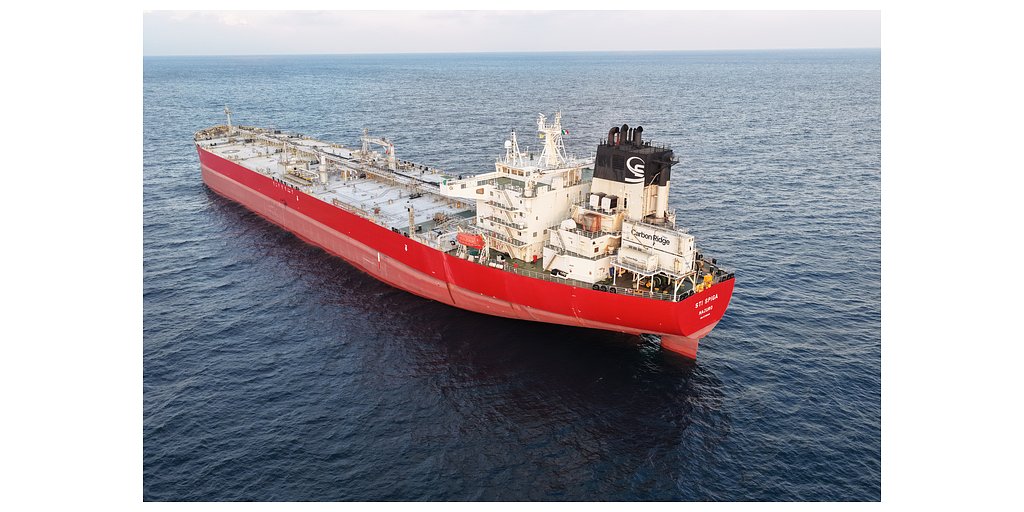
This is the kind of operational innovation that resonates deeply in an industry where every square foot of deck space is prime real estate. For the world’s existing fleet of tankers, bulkers, and container ships, retrofitting large, cumbersome equipment has been a non-starter. Carbon Ridge’s modular, container-sized units, however, are designed for seamless integration. The system was installed on the STI Spiga, a 110,000 deadweight-ton tanker, during a scheduled dry-docking at Turkey's Besiktas Shipyard, demonstrating its viability for the existing fleet.
The practical benefits have not been lost on early adopters. Cameron Mackey, Chief Operating Officer of Scorpio Tankers, a giant in the tanker space, lauded the system's real-world performance. “Their system is both straightforward to install and places a low operational burden on the crew,” Mackey stated, validating two of the most critical metrics for any shipowner considering new technology. For an industry grappling with crew shortages and increasing operational complexity, a low-burden solution is a powerful selling point.
De-Risking Decarbonization: The Power of Independent Verification
The maritime technology landscape is littered with ambitious claims. What sets this development apart is the stamp of approval from DNV. By applying its newly developed Recommended Practice for OCCS verification, the classification society provides the market with a trusted, independent assessment of the technology's capabilities. DNV’s review of methodologies, calculations, and performance data confirmed not only the 98% peak capture rate but also that 55% of observations during the trial fell within a robust 86-98% efficiency range.
This verification is more than a technicality; it’s a crucial de-risking mechanism for the entire industry. As Chara Georgopoulou, DNV’s Head of Onboard Carbon Capture, explained, “Independently verified carbon capture rates will be vital to building out a commercially viable business model for OCCS.” DNV’s role, she added, is to ensure performance reporting is “accurately and consistently applied across the industry” to help the technology scale. By creating a standardized benchmark, DNV provides investors and shipowners the confidence needed to move from pilot projects to fleet-wide deployment.
The Onboard Carbon Trilemma: Balancing Cost, Capture, and Compliance
For shipowners, the decision to invest in OCCS is a complex navigation of what can be called the onboard carbon trilemma: balancing capital expenditure (CAPEX), operational expenditure (OPEX), and the required CO2 capture rate. The initial CAPEX for OCCS can be substantial, with industry estimates running into the tens of millions of dollars per vessel. Furthermore, the systems carry an “energy penalty”—an increase in fuel consumption required to power the capture process—which drives up OPEX.
However, the equation is rapidly changing. As Cameron Mackey noted, “For any shipowner that foresees higher prices or stricter regulations for carbon, Carbon Ridge’s OCCS is an attractive solution.” With the International Maritime Organization targeting a 70% reduction in carbon intensity by 2050 and regions like the EU implementing their own emissions trading schemes, the cost of inaction is escalating. A future with high carbon taxes could make the ROI on OCCS not just viable, but essential for survival. A system that promises high efficiency with a lower operational burden, as validated in the Scorpio trial, becomes a powerful tool for future-proofing a fleet.
From Ship to Sink: The Unfinished Carbon Value Chain
Carbon Ridge’s success aboard the STI Spiga proves the ‘capture’ component of OCCS is technically mature. The company’s ambition, however, extends to providing an “end-to-end carbon solution,” including CO2 transportation, sequestration, and monetization. This is where the next, and perhaps greater, challenge lies.
Successfully capturing CO2 onboard is only half the battle. A global value chain for transporting the liquefied CO2 from ports to permanent geological storage sites is still in its infancy. While the international legal framework exists in the form of the London Protocol, the physical infrastructure—port-side offloading facilities, CO2 pipelines, and certified sequestration sites—is far from ubiquitous. Building this network will require immense investment and multi-stakeholder collaboration on a global scale.
The DNV-verified performance of Carbon Ridge’s technology marks a pivotal moment, proving that highly efficient carbon capture on a moving vessel is no longer a theoretical exercise. The focus of the industry must now expand from the ship itself to the shoreside infrastructure required to complete the carbon journey, turning a technological breakthrough into a cornerstone of shipping’s decarbonized future.