
- First commercial heavy-duty hydrogen station in Canada opens, capable of dispensing at 700 bar pressure.
- $900 million H2 Gateway Program aims to build 20 refueling stations and 3 hydrogen production facilities.
- 12 Class 7 and 8 fuel cell trucks initially supported, with potential to expand to 100 trucks.
Experts would likely conclude that this initiative marks a significant step toward decarbonizing Canada's heavy-duty transportation sector, demonstrating the feasibility of hydrogen fuel cell technology in real-world logistics operations.
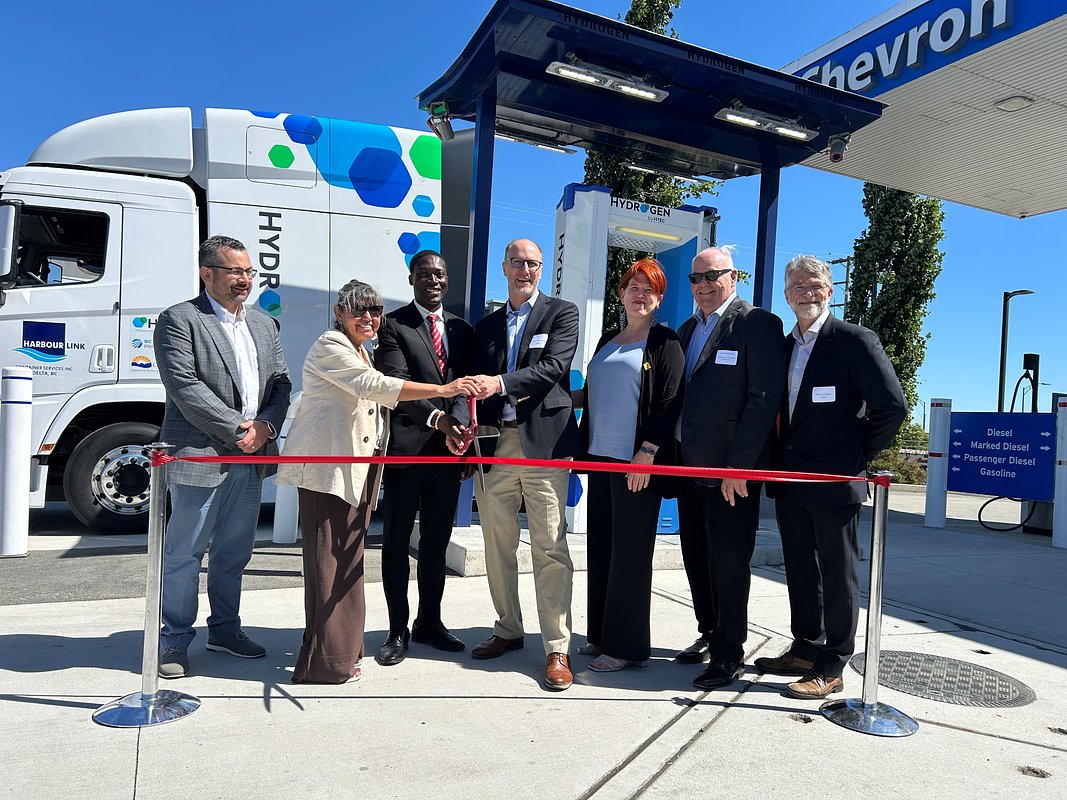
Canada's Hydrogen Highway Begins as First Heavy-Duty Station Opens
TSAWWASSEN, British Columbia – June 18, 2026 – The roar of diesel engines that has long defined North American freight may soon be joined by the quiet hum of hydrogen power. Today, HTEC (Hydrogen Technology & Energy Corp.) officially opened Canada’s first commercial heavy-duty hydrogen refueling station capable of dispensing at 700 bar pressure, a pivotal moment in the nation's quest to decarbonize its most challenging transportation sector.
Located on the industrial lands of the Tsawwassen First Nation (TFN) at a Chevron Commercial Cardlock, the station represents more than just new infrastructure. It is the linchpin of a burgeoning hydrogen ecosystem in British Columbia, designed to prove that zero-emission long-haul trucking is not a distant dream, but a present-day reality.
A New Era for Heavy-Duty Logistics
Heavy-duty transportation, responsible for a significant portion of Canada's greenhouse gas emissions, has long been considered a "hard-to-abate" sector. While battery-electric solutions are making inroads in passenger cars and short-haul urban delivery, their limitations in range, payload capacity due to heavy batteries, and long charging times have hindered their adoption for long-haul freight.
This is where hydrogen fuel cell electric vehicles (FCEVs) present a compelling alternative. HTEC's new station, with its 700 bar dispensing capability, allows trucks to carry more compressed hydrogen fuel, extending their range to be competitive with diesel counterparts—often exceeding 500 kilometers on a single fill. Crucially, refueling takes only 10 to 15 minutes, a stark contrast to the hours required for high-capacity battery charging, minimizing the costly downtime that plagues fleet operators.
The station will initially support a fleet of 12 Class 7 and 8 fuel cell trucks, including Hyundai's XCIENT Fuel Cell model, as part of two government-supported initiatives: the B.C. Hydrogen Truck Pilot Project and the B.C. Hydrogen Ports Project. These trucks will operate on real-world drayage and regional freight routes, gathering critical data on performance and operational economics.
John Bourbonniere, Executive Vice President of Harbour Link Container Services Inc., one of the first fleets to participate, underscored the project's significance. "Hydrogen fuel has the potential to redefine long-haul truck transportation," he stated. "Participating in this hydrogen truck pilot project allows us to evaluate cutting-edge technology in real operating conditions. We look forward to gathering and sharing valuable data with our project partners that will inform future investments and accelerate the transition to zero-emission transportation."
The Infrastructure Backbone: BC's H2 Gateway
The Tsawwassen station is not a standalone project but a critical node in a far more ambitious plan: HTEC's $900 million H2 Gateway Program. This comprehensive strategy aims to build an integrated hydrogen ecosystem across British Columbia and Alberta, tackling the classic "chicken-and-egg" dilemma that has stymied alternative fuel adoption for decades.
Bolstered by a landmark $337 million loan from the Canada Infrastructure Bank (CIB), the H2 Gateway program is designed to build out the entire value chain simultaneously. This includes constructing up to 20 hydrogen refueling stations, three separate hydrogen production facilities, and a major liquefaction plant in North Vancouver that will convert industrial by-product hydrogen into a valuable clean fuel.
"By supporting the deployment of HTEC’s hydrogen production, distribution, and refuelling infrastructure, the CIB is accelerating a sustainable fuel solution which can reduce emissions in the transportation sector," said Ehren Cory, CEO of the CIB.
The fuel for these trucks is "low-carbon hydrogen," produced at HTEC’s 1.8-tonne-per-day facility in Burnaby, which opened last year. It uses an electrolyzer to split water into hydrogen and oxygen, a process powered by British Columbia's grid, which generates over 98% of its electricity from clean, renewable sources like hydropower. This ensures the fuel's environmental credentials align with the province's aggressive climate goals.
This initiative is a cornerstone of both provincial and federal clean energy strategies. "Hydrogen is a key component of the clean energy mix needed for B.C.’s sustainable future, and we will continue to support the industry as it expands hydrogen deployment," commented Adrian Dix, B.C.'s Minister of Energy and Climate Solutions.
This sentiment is echoed at the federal level. "By harnessing Canadian innovation and our deep energy expertise, we are creating new opportunities, reducing emissions, and building a stronger, more resilient future," said The Honourable Jill McKnight, Minister of Veterans Affairs.
A Partnership Forged on Shared Land
The station's location is as significant as its technology. Sited on Tsawwassen First Nation industrial lands, the project exemplifies a new model of economic development rooted in partnership and mutual respect. The TFN was not merely a landlord but a key partner throughout the siting, permitting, and development process, ensuring the project aligned with its values of environmental stewardship and responsible growth.
Chief Laura Cassidy of the Tsawwassen First Nation spoke to this deeper meaning. "This project reflects what is possible when economic development is done in a way that respects the land and our shared future," she said. "Our Treaty was the first step in making opportunities like this possible - giving us the tools to plan, manage, and develop our lands in a way that benefits both our community and the region as a whole. Today, we are proud to see these industrial lands supporting innovation in clean energy."
This partnership extends beyond land use agreements. The station itself features artwork by five local TFN artists—Xwəstenəxən Karl Morgan, Kaitlin Williams, Tabitha Adams, Vincent Morgan, and Sarah Lang—giving the high-tech facility a distinct sense of place and cultural identity. It serves as a powerful symbol of how Indigenous communities are moving beyond historical grievances to become active leaders and innovators in Canada's transition to a sustainable economy.
Overcoming the Adoption Hurdle
For years, the widespread adoption of hydrogen vehicles was hampered by a paradox: fleet operators wouldn't buy the trucks without a reliable refueling network, and energy companies wouldn't build the network without guaranteed vehicle demand. HTEC's integrated strategy is designed to break this impasse.
In addition to building the production and refueling infrastructure, the company has established a Vehicle Leasing Corporation (VLC) to help deploy an initial 100 hydrogen-powered heavy-duty trucks. By creating both the supply of fuel and the initial demand for it, HTEC and its partners are de-risking the transition for fleet operators and kick-starting the market.
This holistic approach provides the certainty needed for logistics companies to commit to a new, cleaner technology. "This station is an important step in bringing hydrogen into heavy-duty transportation," said Colin Armstrong, President and CEO of HTEC. "It gives fleets the confidence to operate fuel cell trucks in day-to-day logistics."
With the first trucks now fueling up in Tsawwassen, the theoretical promise of hydrogen-powered freight is being put to the test on the busy roads and port terminals of Metro Vancouver. The data gathered here will be invaluable, but the message sent today is already clear: the journey to decarbonize Canada's trucking industry has begun, and it is being fueled by hydrogen.